
In professional espresso extraction techniques, controlling physical variables plays a decisive role in the uniformity and flavor quality of the cup. One of the most significant technological advancements in recent years is the ability to intervene in pressure structure (pressure profiling) and flow rate (flow profiling). Understanding how water interacts with the coffee puck structure not only helps optimize extraction but also minimizes common technical errors, particularly channeling.
The correlation between pressure, flow rate, and resistance
The physical interaction mechanism within the portafilter is governed by a fundamental core equation:
Pressure = Flow / Time / Resistance
Here, resistance is generated by the tightness of the coffee puck (puck resistance), which depends on grind size, coffee dose, and tamping force.
During extraction, soluble solids are continuously washed away, meaning the coffee puck structure gradually erodes and resistance drops significantly. If using a traditional espresso machine that maintains a constant flat pressure (e.g., 9 bar), the system is forced to sharply increase the flow rate in the later stages of extraction to compensate for the lost resistance. This sudden increase in flow rate, when the coffee puck is at its weakest state, is the direct cause of local erosion and the formation of channels (channeling).
The coffee puck from a physics perspective: Poroelastic Material
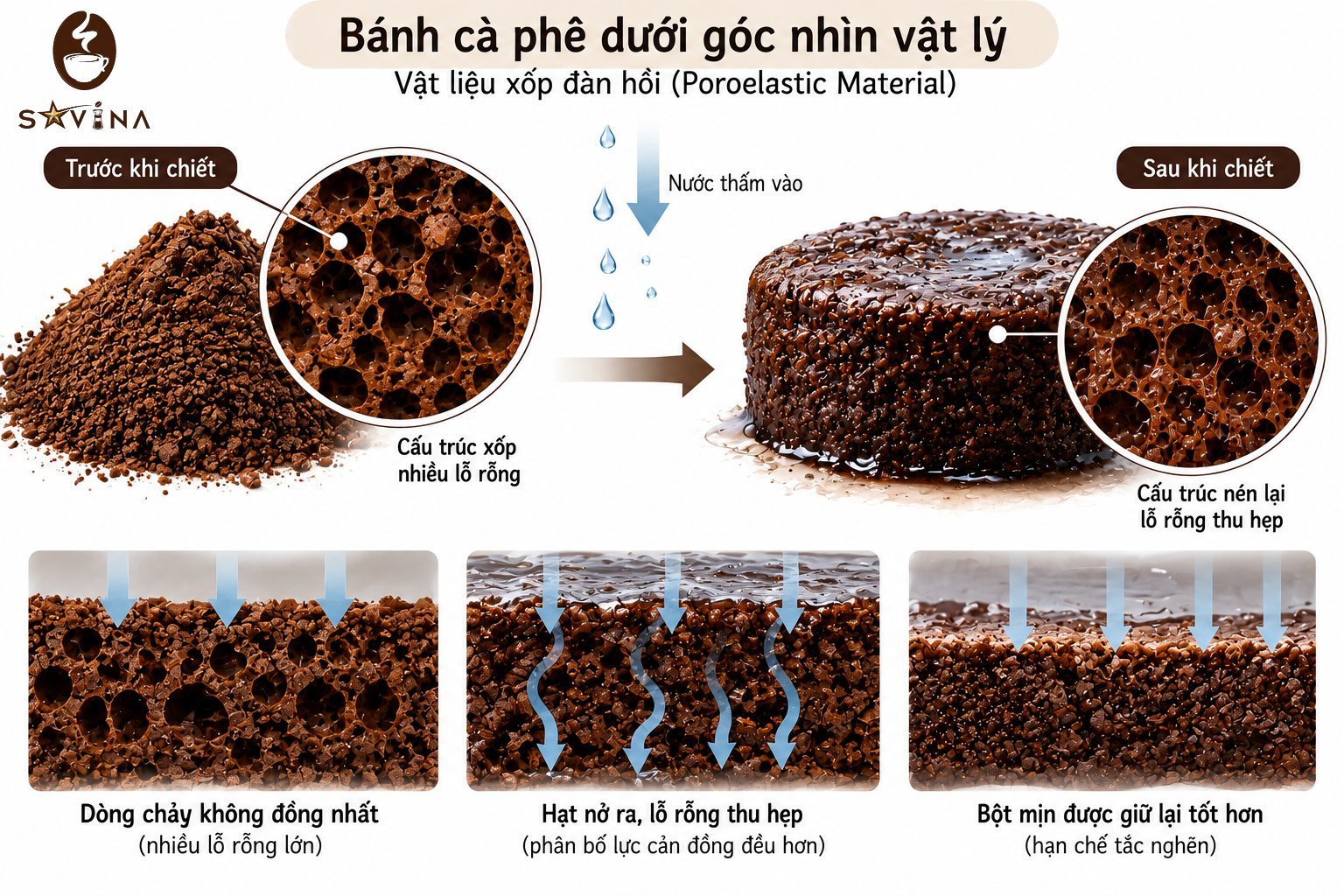
A fluid physics study published in the journal Physics of Fluids by a research team from the University of Warsaw has clarified the behavior of the coffee puck under high extraction pressure (from 6 to 9 bar).
The study results indicate that the coffee puck in the filter basket does not follow standard flow rules through a static porous medium. Instead, it behaves as a poroelastic material with nonlinear pressure dynamics.
When subjected to extreme water pressure from the pump:
- Fine coffee particles (fines) are compressed and move to the bottom of the filter basket.
- The porous structure of the coffee puck is physically compressed (poroelastic compaction), continuously altering the internal flow paths.
- If pressure increases too rapidly without corresponding flow control, this compressive force can create small cracks in the elastic bonding structure of the coffee puck, leading to internal structural collapse and the formation of major channels.
Flow Profiling mechanism and the ability to "heal" channels
Flow profiling techniques (flow profiling or adaptive profiles) were developed to thoroughly address the limitations of fixed-pressure methods by reacting flexibly to changes in the coffee puck.
When a small channel forms in the coffee puck, water tends to concentrate in this area because it offers the least resistance, causing the flow rate at that point to spike. On smart espresso systems supporting flow profiling (such as Decent Espresso), sensors immediately detect this sudden increase in flow rate.
Immediately, the system automatically reduces pump pressure to keep the overall water flow stable at the preset level. This timely pressure reduction lowers the kinetic energy of the water passing through the channel, allowing surrounding coffee particles to swell due to water absorption and partially close the crack. This phenomenon is known as the ability to "heal" channeling, helping to preserve the integrity of the coffee puck until the end of the extraction cycle.
Comparison of Constant Flat Pressure and Active Flow Control
Below is a detailed comparison table between the two extraction methods based on physical operational criteria:
| Comparison Criteria | Constant Flat Pressure (Flat 9 Bar) | Flow Control (Flow Profiling) |
|---|---|---|
| System Pressure | Maintain continuously at 9 bar. | Automatically vary up/down according to actual resistance. |
| Flow rate | Spike in the final stage of extraction. | Kept stable or gradually reduced according to settings. |
| Channeling risk | Very high due to strong erosion forces when the coffee puck weakens. | Low; the system automatically adjusts pressure to protect the puck structure. |
| Extraction uniformity | Prone to uneven extraction if there are distribution errors. | High, with the ability to compensate for deviations thanks to the automatic pressure adjustment mechanism. |
Technical notes and risks
Although flow control offers many superior benefits, pure application of this method still carries certain technical risks.
If the flow rate is set too low while the grind size is too fine, the system may trigger secondary compression. In this case, fine particles are continuously compacted under an excessively slow flow, clogging the pores of the basket filter screen, leading to an unintended spike in system pressure and causing localized over-extraction. Therefore, applying flow profiling always requires synchronized coordination between grind size, tamping force, and adaptive adjustment algorithms to achieve optimal results.
References
- Fluid physics study by the University of Warsaw published in the journal Physics of Fluids.