
What is pre-infusion? The physical mechanism within the coffee puck
In professional espresso brewing techniques, pre-infusion (the low-pressure pre-wetting phase) is the process of moistening the entire coffee puck (coffee puck) with hot water at low pressure, typically maintained between 1 and 3 bar, before the pump raises the pressure to the standard extraction level of 8 to 9 bar. The core objective of this phase is to transform the state of the coffee puck from a dry, heterogeneous powder into a cohesive, tightly bound porous mass that is fully saturated with water.
When hot water contacts the coffee grounds at low pressure, it immediately permeates the voids between the particles. This process helps release CO2 gas trapped within the cellular structure of the beans (which forms during roasting and accumulates significantly in freshly roasted coffee). Without this pre-infusion phase, the instantaneous force of high-pressure water (9 bar) would compress the CO2, creating large air bubbles that obstruct water flow, directly leading to uneven extraction.
Coffee bean swelling and changes in pore structure
One of the most important physical phenomena occurring during the pre-infusion phase is the swelling of coffee particles. As they absorb water, dry coffee grounds tend to expand, increasing their volume by approximately 15% compared to their initial state.
This increase in particle size leads to profound changes in the microstructure of the coffee puck:
- Reduction in effective pore diameter: As the particles swell, the empty space between them narrows significantly.
- Increased uniformity of flow resistance: The narrowing of random pores helps redistribute resistance across the entire surface area of the coffee puck.
- Formation of a natural filter: Fines (fines) are better fixed in position, limiting their migration to the bottom of the basket, which causes localized clogging.
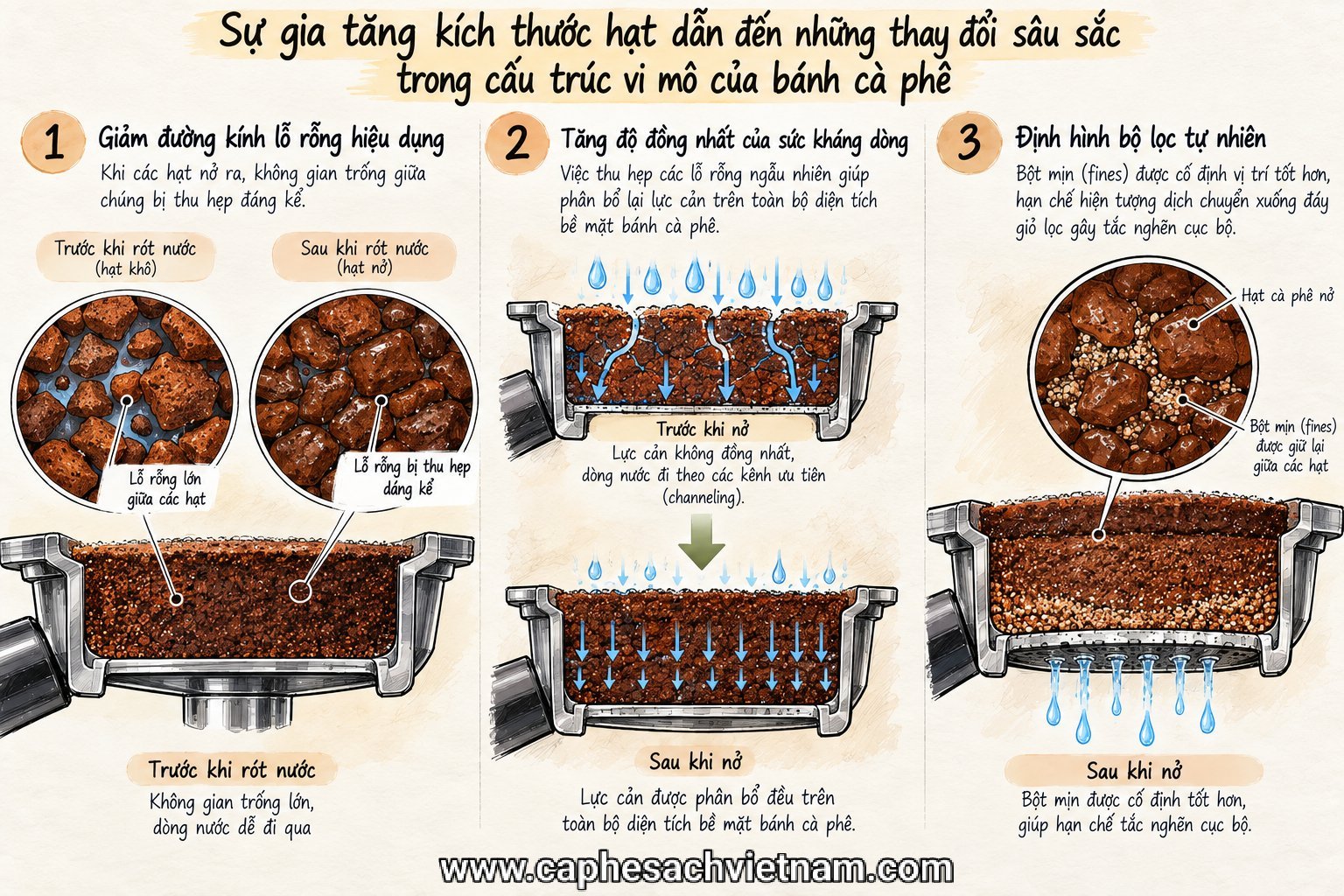
Thanks to this uniform swelling, the flow resistance of the coffee puck is distributed consistently from top to bottom, preventing water from flowing only through paths of least resistance.
Eliminating Channeling and uneven extraction errors
The phenomenon of channeling (preferential path formation) occurs when hot water finds areas of sparse ground density or small cracks in the coffee puck, concentrating flow and eroding these weak spots into one or more channels. In these channels, water flows extremely quickly, causing localized over-extraction, which releases excessive bitterness, astringency, and undesirable organic compounds. Conversely, the surrounding hydrophobic dry areas of the puck do not receive sufficient water contact, leading to under-extraction, resulting in a loss of body and inherent sweetness.
Pre-infusion technique thoroughly resolves this issue by completely eliminating hydrophobic dry zones from the outset. Low-pressure water slowly and comprehensively permeates the entire volume of the coffee puck, saturating every nook and cranny before strong mechanical pressure is applied. Consequently, consistency between extractions is significantly improved, eliminating the simultaneous occurrence of harsh bitterness and thin sourness in the same espresso shot.
Practical application of Pre-infusion technique in extraction
Mastering this technique requires the barista to effectively control three factors: pressure, time, and water volume.
- Pressure control: The ideal pressure during the pre-infusion phase is between 1 and 3 bar. This pressure is gentle enough to allow water permeation without disrupting the mechanical structure of the newly tamped coffee puck.
- Time control: Pre-infusion time typically ranges from 3 to 8 seconds, depending on grind size, bean freshness, and roast level. Light roast coffees or fine grinds often require longer times to allow water sufficient time to penetrate deeply into the hard bean structure.
- Optimization of Extraction Yield: When the coffee puck is uniformly saturated, the efficiency of dissolving total dissolved solids (TDS) increases. This helps raise the overall extraction yield, delivering an espresso cup with balanced flavor, a lingering aftertaste, and a stable, thick crema layer.