
Operating mechanism and fluid dynamics
To generate the standard pressure for espresso extraction, the machine requires a system to push water through the compacted coffee puck. The two most common technical solutions currently are the rotary pump (Rotary Vane Pump) and the vibratory pump (Vibratory Pump - often called a vane pump in some commercial contexts due to its magnetic oscillation-driven water displacement mechanism).
The rotary pump operates by combining a powerful electric motor with a rotating disc structure containing vanes. As the shaft rotates, centrifugal force pushes the vanes against the pump chamber walls, creating continuously varying volume chambers. This uniform circular motion sweeps and pushes water continuously, producing a steady flow without sudden pulsations.
Conversely, vibratory pumps operate on an electromagnetic principle. Alternating current passing through a coil generates a magnetic force that moves a spring-loaded metal piston back and forth within the chamber. With an average oscillation frequency of about 60 times per second (equivalent to the AC frequency), the piston continuously compresses and pushes small amounts of water through a one-way valve. This process creates a micro-pulsating intermittent flow rather than an absolutely smooth flow.
Pressure ramp-up speed and natural pre-infusion effects
The differences in mechanical structure lead to vastly different pressure ramp-up dynamics in the two pump types, directly shaping the initial stage of the extraction process (pre-infusion):
- Rotary Pump: When the motor is powered, the system takes only about 3 seconds to reach maximum rotational speed. Consequently, water is pushed with high flow, and the compression chamber pressure hits the target threshold of 9 bar almost instantly. This steep pressure ramp-up requires the machine to be equipped with additional flow control valves (gicleur) or active electronic/mechanical pre-infusion systems to prevent breaking the structure of the coffee puck.
- Vibratory Pump: Due to its piston oscillation cycle, system pressure does not spike immediately but accumulates gradually based on the resistance of the coffee puck. Water slowly saturates the coffee grounds at low pressure before the system compacts them and drives the pressure to its peak. This phenomenon inadvertently creates a natural pre-infusion (soaking) cycle occurring within the first 4 to 8 seconds, helping to limit channeling in home-use machines.
Flow rate and pressure control capability
Regarding free flow rate (when encountering minimal resistance from the coffee puck):
- Rotary Pump provides superior water flow, ranging from 10 to 12 ml/s. This high volume capacity allows the rotary pump to easily maintain stable pressure even when extracting simultaneously from multiple groupheads on high-power commercial machines.
- Vibratory Pump has a much lower flow rate, reaching only about 6 to 8 ml/s. This limitation makes vibratory pumps suitable only for single-group machines intended for home or small office use, where brewing frequency is not overly intense.
Furthermore, the rotary pump structure allows operators to directly adjust pressure via a bypass valve screw on the pump body, enabling flexible changes to the maximum extraction pressure. In contrast, adjusting pressure on a vibratory pump is more complex and necessitates an additional Over Pressure Valve (OPV) to release excess water when pressure exceeds safe thresholds.
Visual comparison of technical specifications
The table below summarizes the core technical parameters of the two pump systems based on practical fluid dynamics studies:
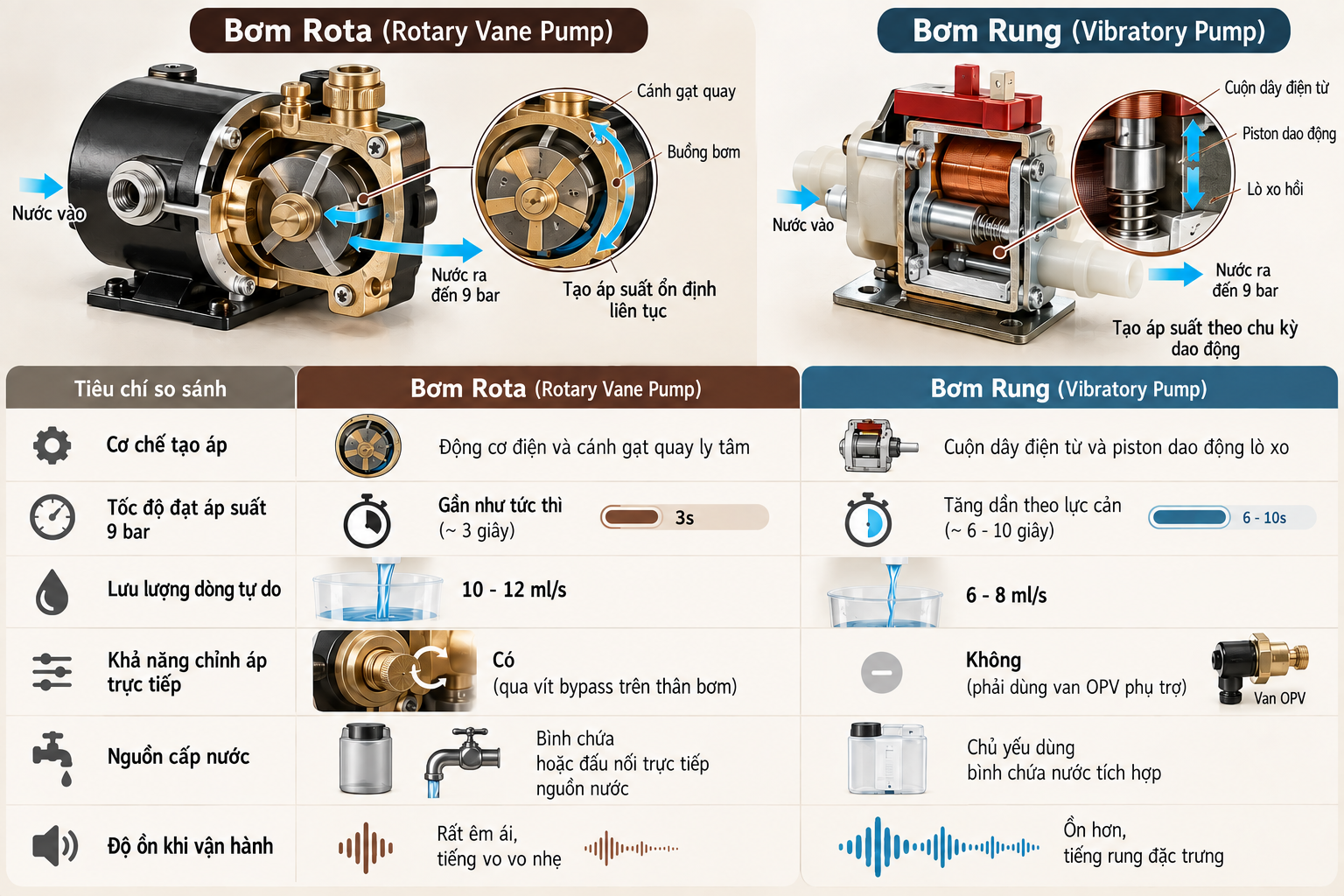
Comparison of Rotary and Vibratory pumps in espresso machines.
Impact on operational experience and installation
Beyond fluid dynamics, the choice between rotary pumps and vibratory/vane pumps directly affects the workspace and installation method:
- Operating Noise: The rotary pump's uniform rotational movement ensures extremely quiet operation, producing only a slight motor hum. In contrast, the vibratory pump's piston undergoes continuous linear motion, striking the pump walls and generating significant noise and mechanical vibration, which can transmit through the machine casing and cause disturbance in quiet environments.
- Water Supply Method: Thanks to its strong flow and stable self-priming mechanism, the rotary pump supports both methods: drawing water from a reservoir or connecting directly to the building's water supply (plumb-in). Due to limitations in mechanical thrust, vibratory pumps typically operate effectively only when drawing water directly from an integrated internal reservoir, limiting their suitability for continuous operation in professional bar settings.