
Does coffee cause dehydration? Distinguishing between diuretic effect and water deficiency
Caffeine can increase urine production, so coffee is often viewed as a drink that causes dehydration. However, frequent urination over a period of time does not necessarily mean the body is definitely dehydrated. What needs to be evaluated is the overall fluid balance, the amount of fluid consumed and the amount of water lost by the body.
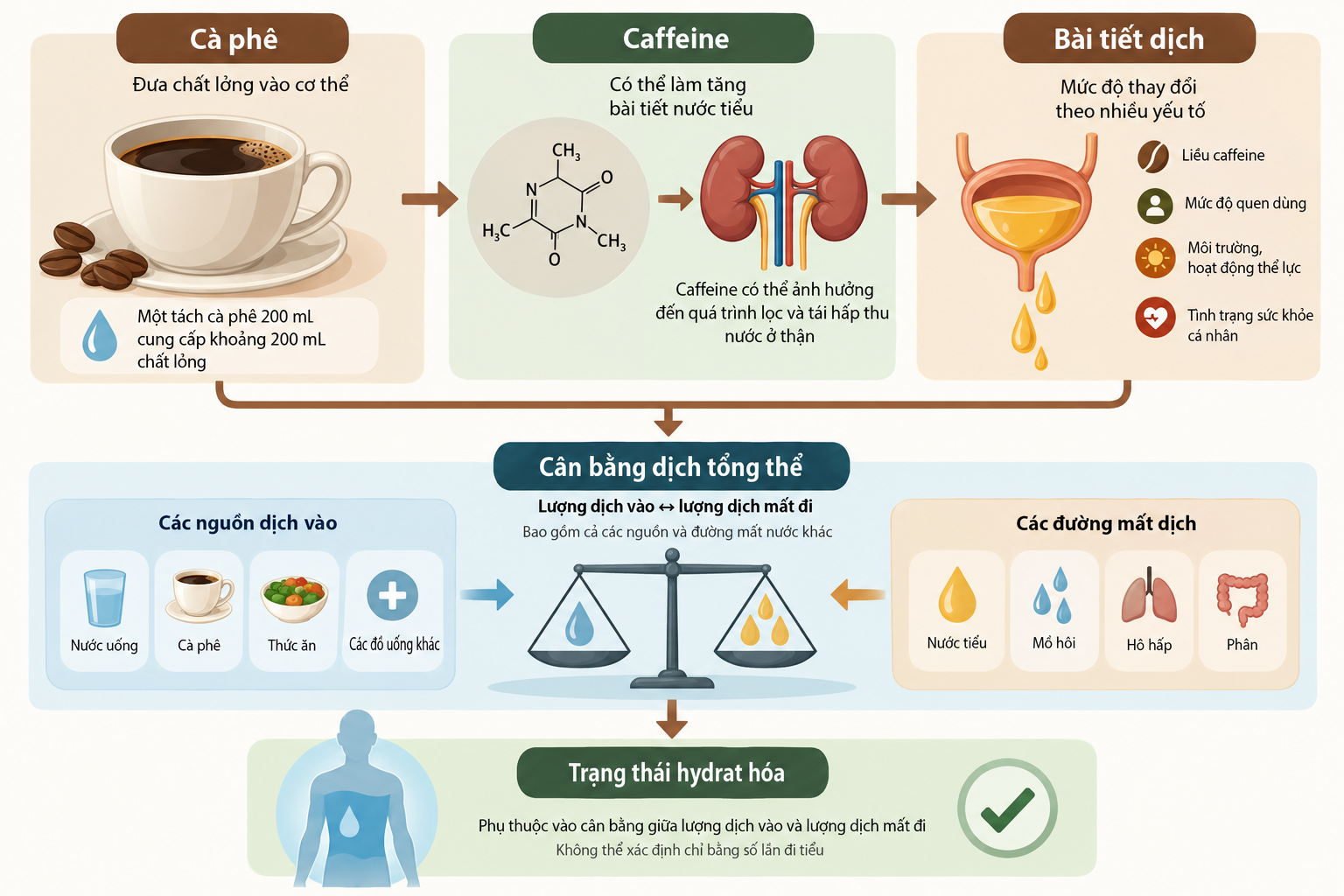
In healthy adults who regularly drink coffee, moderate amounts of coffee still contribute to the body's daily fluid intake. The diuretic effect of caffeine depends on the dose, caffeine tolerance and individual factors. Do not equate diuretic effect with dehydration.
1. How does caffeine affect water excretion?
Caffeine is a stimulant of the central nervous system. In addition to its effect on alertness, caffeine can increase urine production under certain conditions. This effect is called diuresis.
However, the body does not only receive water from filtered water. Coffee also contains a significant amount of water; therefore, when evaluating the impact of coffee on hydration status, both the amount of fluid consumed and the amount of water lost by the body need to be taken into account.
It is essential that diuresis is not fixed in everyone. The dose of caffeine, usage habits, health status, physical activity and environment can all affect the body's response.
2. What do studies say about coffee and hydration status?
3. Study: Moderate coffee consumption in habitual coffee drinkers
A 2014 study published in PLOS ONE compared coffee with water in 50 men who regularly consumed 3–6 cups of coffee per day. In two three-day experiments, participants drank 200 mL of coffee or water four times a day according to the study design.
The researchers found no significant differences between the two conditions in total body water, 24-hour urine volume and many other hydration indicators.
15. Read the original study on PLOS ONE.
This result shows that moderate coffee consumption can contribute to daily fluid intake in regular coffee drinkers. However, the study does not prove that all amounts of coffee are equivalent to filtered water in all circumstances.
4. Study: High caffeine dose can increase urine production
A 2017 study published in Frontiers in Nutrition investigated 10 healthy adults who regularly consumed coffee. Participants were tested with water, coffee containing 3 mg caffeine/kg body weight and coffee containing 6 mg caffeine/kg body weight.
During the three-hour observation period, the high-dose condition of 6 mg/kg increased urine production compared to the other two conditions. With a dose of 3 mg/kg, the study found no similar disruption of fluid balance.
20. Read the original study on Frontiers in Nutrition.
This study helps clarify that high caffeine doses can produce more pronounced diuresis in the short term. However, the study sample consisted of only 10 people and the observation period was short; the results should not be used to predict the exact response of everyone or conclude that a specific dose definitely causes dehydration.
3. Why does frequent urination after drinking coffee not necessarily mean dehydration?
23. Number of urinations is not a direct measure of hydration status. Three phenomena need to be distinguished:
| 24. Phenomenon | 25. Meaning |
|---|---|
| Increased urine output | The body produces or excretes more urine over a given period. |
| Negative fluid balance | Fluid loss exceeds fluid intake during the period under consideration. |
| Dehydration | A state of body water deficit; assessment should be based on context, signs, and medical evaluation when necessary. |
For example, when drinking a cup of coffee, the body takes in both water and caffeine. Caffeine may increase urine output, but this does not automatically prove that total fluid loss has exceeded fluid intake.
One cannot determine whether a person is dehydrated solely based on increased urination after drinking coffee. Nor can findings from studies on healthy individuals who regularly consume coffee be directly applied to those who are ill, dehydrated due to diarrhea, engaged in strenuous exercise, or working for extended periods in hot environments.
4. Factors to consider when drinking coffee
Caffeine dose
The amount of caffeine in coffee varies by bean type, ground mass, brewing method, extraction ratio, and serving size. One should not merely count the number of cups while ignoring strength and volume per cup.
Level of caffeine habituation
Regular coffee drinkers may respond differently than those who rarely or never consume caffeine. Research on diuretic effects shows that prior caffeine consumption is a factor to consider, but it is insufficient to absolutely predict individual responses.
Ambient temperature and physical activity
Sweating in hot weather or during exercise can increase water requirements. In such circumstances, drinking coffee should not replace an appropriate rehydration plan tailored to activity intensity and fluid losses.
Health status
Individuals experiencing vomiting, diarrhea, fever, or medical conditions requiring fluid management should follow appropriate medical guidance. Coffee is not an electrolyte rehydration solution and does not replace oral rehydration solutions when indicated.
5. How to drink coffee in alignment with hydration needs?
Coffee can contribute to total daily fluid intake. However, plain water remains the basic and convenient choice for meeting the body’s water requirements.
Caffeine content varies significantly across brewing methods. Pay attention to large servings, strong brews, and other caffeine sources such as tea, energy drinks, or certain medications.
Water needs depend on the individual, diet, activity level, and environment. During prolonged exercise or work in hot weather, proactive hydration is necessary; if significant sweating occurs, electrolyte replacement may be needed depending on the situation.
If caffeine causes jitteriness, hand tremors, sleep difficulties, or gastrointestinal discomfort, consider reducing intake and consult a healthcare professional if symptoms persist or are severe.
6. What is an appropriate amount of caffeine?
Assessing caffeine safety requires considering total intake from all sources, health status, and individual sensitivity. According to the European Food Safety Authority (EFSA), for most healthy non-pregnant adults, a total daily intake of up to 400 mg of caffeine, spread throughout the day, is not considered a safety concern at the population level. This is not a target to achieve nor a level suitable for everyone.
EFSA also notes that a single dose of approximately 100 mg may affect sleep in some individuals, especially when consumed close to bedtime. For pregnant or breastfeeding women, children, individuals sensitive to caffeine, or those with specific health conditions, more appropriate guidelines should be applied.
The caffeine safety reference level is not a threshold for determining dehydration. A person may consume low amounts of caffeine yet still become dehydrated due to fever, diarrhea, or excessive sweating; conversely, a slight increase in urination after coffee does not automatically mean the body is dehydrated.
Key points to remember
Caffeine can increase urine output, especially when consumed in high doses over a short period. However, studies on healthy adults who regularly drink coffee show that moderate consumption does not necessarily impair hydration status. The accurate interpretation is to assess overall fluid balance rather than viewing coffee as a beverage that inevitably causes dehydration.
References
- Killer SC, Blannin AK, Jeukendrup AE. (2014). No Evidence of Dehydration with Moderate Daily Coffee Intake: A Counterbalanced Cross-Over Study in a Free-Living Population. PLOS ONE, 9(1): e84154. https://doi.org/10.1371/journal.pone.0084154.
- Zhang Y, Coca A, Casa DJ, Antonio J, Green JM, Bishop PA. (2017). Coffee with High but Not Low Caffeine Content Augments Fluid and Electrolyte Excretion at Rest. Frontiers in Nutrition, 4:40. https://doi.org/10.3389/fnut.2017.00040.
- European Food Safety Authority (EFSA). Caffeine: safety levels and caffeine content in foods and beverages. https://www.efsa.europa.eu/en/topics/topic/caffeine.
- Mayo Clinic Staff. (2025). Caffeine: Is it dehydrating or not? Mayo Clinic – Caffeinated drinks and hydration.