
Overview of decaffeination methods using natural solvents
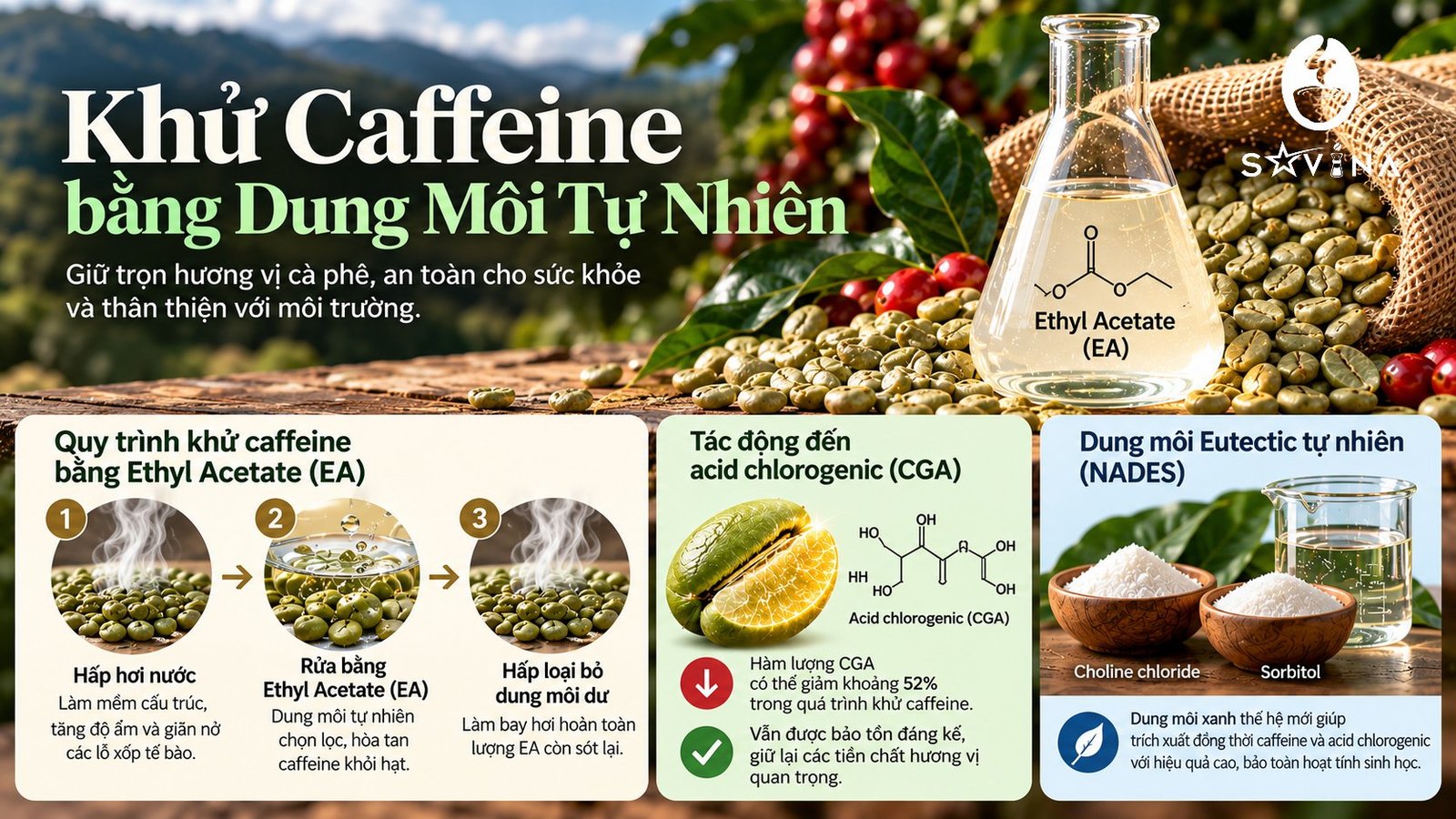
Image: Caffeine removal process from coffee using Ethyl Acetate (EA) and natural eutectic solvents (NADES).
The demand for enjoying green coffee beans that are caffeine-free or have extremely low caffeine content is rising, especially among those sensitive to this stimulant but still wishing to savor the original flavor of coffee beans. The decaffeination process using natural solvents offers an environmentally friendly and health-safe alternative compared to traditional synthetic chemicals such as Methylene Chloride.
The core mechanism of this method involves soaking coffee beans in water to swell the cellular structure and liquefy internal chemical bonds, thereby facilitating the selective deep penetration of natural solvents to dissolve and extract caffeine from the bean structure.
Mechanism of caffeine removal using Ethyl Acetate (EA)
Ethyl Acetate (EA) is a natural ester typically synthesized directly from fruit fermentation (such as sugarcane) or through the reaction between acetic acid and natural ethanol. In the direct decaffeination method (Sugarcane Process), EA serves as a highly selective solvent.
The process proceeds through rigorous technical steps:
- Steam pre-treatment: Green coffee beans are steamed at low pressure to soften the structure, increase moisture content, and expand cellular pores.
- Solvent washing: The beans are continuously soaked and washed in a natural Ethyl Acetate solution. Due to caffeine's strong affinity for EA, this solvent selectively binds and dissolves caffeine without significantly affecting other water-soluble flavor compounds.
- Steaming to remove residual solvent: After reaching the optimal soaking time, the coffee beans are steamed again at high temperature to completely evaporate any remaining EA.
This ester-based natural solvent method delivers impressive efficiency, capable of removing approximately 99.88% of the initial caffeine in green beans without leaving behind harmful chemical residues.
Impact of the decaffeination process on chlorogenic acid (CGA)
Chlorogenic acid (CGA) is the most abundant group of polyphenols in coffee beans, playing a decisive role in the acidity (Acidity), aftertaste (Aftertaste), and antioxidant bioactivity of the brewed coffee. Due to its high polarity and solubility in water and polar solutions, CGA content undergoes significant fluctuations throughout the decaffeination process.
- Mechanism of depletion: Continuous exposure to hot water during the pre-treatment stage and polar solvents during the extraction step causes a significant amount of CGA to be extracted along with caffeine. Studies on green selective extraction note a marked decrease in chlorogenic acid content, with reductions of around 52% observed under certain optimized experimental conditions with Ethyl Acetate.
- Preservation and recovery: Despite the decline, this polyphenol structure is still preserved to a significant extent in the processed green beans, helping retain important flavor precursors for chemical reactions when the beans enter the roaster. Furthermore, the application of green selective techniques opens up significant opportunities for recovering this lost CGA for use as a natural bioactive ingredient in the pharmaceutical and nutraceutical industries.
New technology: Natural Eutectic Solvents (NADES)
In addition to Ethyl Acetate, researchers are moving towards a new generation of green solvents known as Natural Eutectic Solvents (NADES). A typical example is a mixture of choline chloride combined with sorbitol.
NADES are solvent systems created by mixing natural hydrogen bond acceptors and donors in specific ratios, resulting in a liquid with a much lower melting point than its individual components. This solvent system is being tested for the simultaneous extraction of both caffeine and chlorogenic acid from green coffee beans with superior efficiency. The distinct advantage of NADES is its excellent ability to preserve the bioactivity of chlorogenic acid, enabling the comprehensive collection and purification of these valuable polyphenol compounds without denaturing their chemical structure.