
Coffee and the gut microbiota: Caffeine, polyphenols, and scientifically documented effects
Coffee provides more than just caffeine. Chlorogenic acid, soluble carbohydrates, and compounds formed during roasting can also interact with the gastrointestinal tract. Current research indicates that coffee is associated with changes in the gut microbiota, but the extent, mechanisms, and health implications of these changes remain to be clarified.
1. What is the gut microbiota and why study its relationship with coffee?
The gut microbiota is the population of microorganisms living in the gastrointestinal tract, particularly concentrated in the colon. These microorganisms participate in the metabolism of certain food components, produce metabolites, and interact with the intestinal environment and the host body.
Coffee is a complex chemical mixture. The composition of the beverage varies by variety, fruit ripeness, processing method, roast level, brewing ratio, and extraction technique. Therefore, one cannot assume that all coffees produce the same biological effects.
A 2024 overview by Saygili et al. compiles studies on coffee, gut function, and the microbiota. The authors also note that evidence comes from various types of studies, including human, animal, and experimental model studies. These types of evidence do not have equivalent value for inferring causality [1].
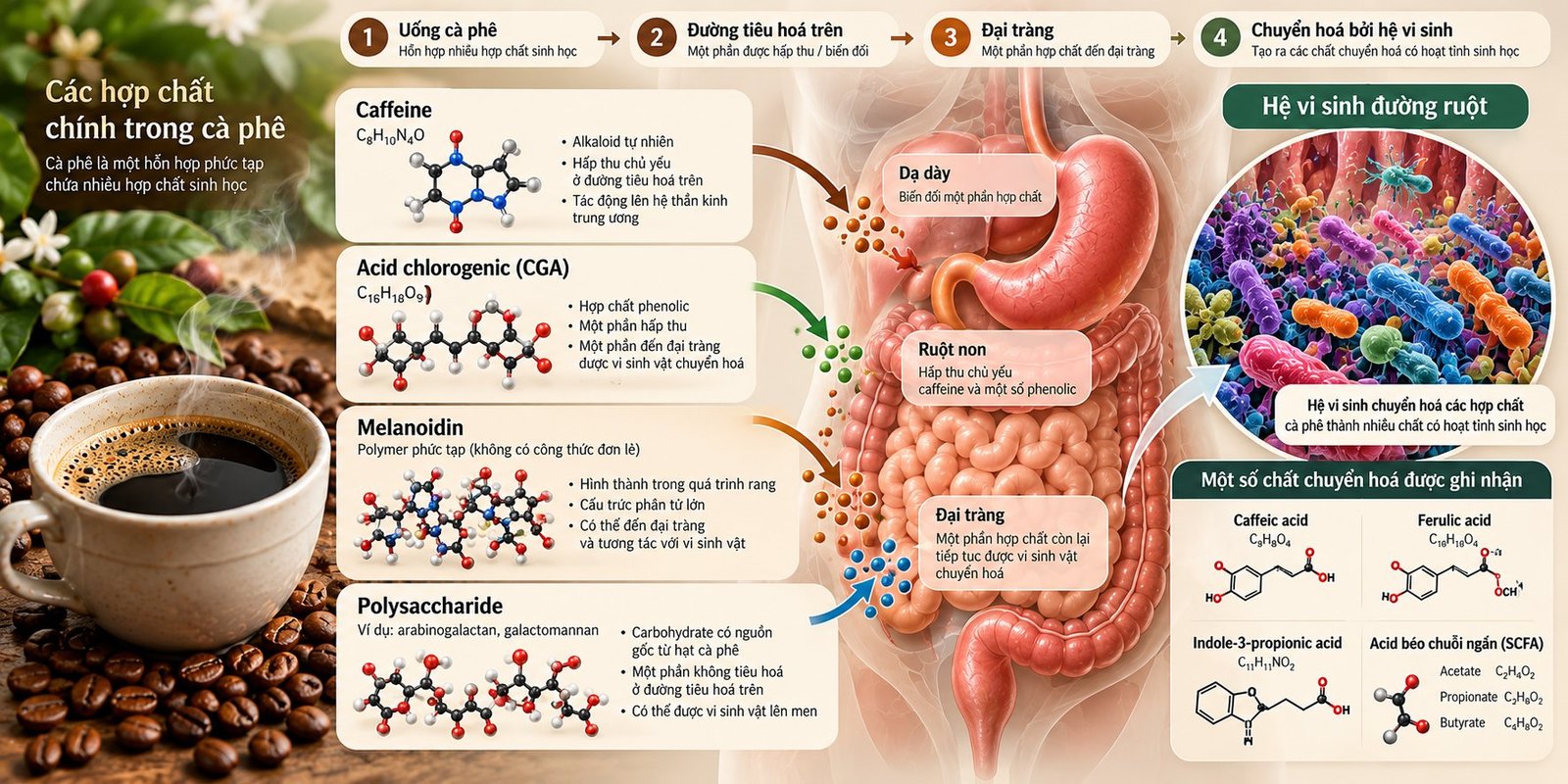
2. Key compounds in coffee
To understand the relationship between coffee and the gut microbiota, it is necessary to distinguish between compounds absorbed relatively early and those likely to continue down to the colon.
| Compound | Characteristics | Points to note |
|---|---|---|
| Caffeine | An alkaloid with physiological and neurological effects. | Absorbed relatively quickly; not a prebiotic fiber. |
| Chlorogenic acid | A group of phenolic compounds found in coffee. | Can be absorbed and metabolized by the body or microorganisms. |
| Polysaccharides | Structural carbohydrates of coffee beans. | The amount entering the beverage depends on processing and brewing methods. |
| Melanoidins | A group of complex compounds formed during roasting. | Studied for their ability to interact with the gastrointestinal tract; not all have been proven to be prebiotic. |
2.1. Caffeine
Caffeine affects the central nervous system, primarily through adenosine receptor antagonism. Caffeine may also influence gastrointestinal physiological responses in some individuals. However, not all effects of coffee on gut motility or the microbiome should be attributed solely to caffeine.
2.2. Chlorogenic acid
Chlorogenic acids (CGAs) are a general term for a group of phenolic compounds, including caffeoylquinic acid derivatives. After coffee consumption, these compounds can be metabolized in the upper gastrointestinal tract and colon. The resulting metabolites may differ from the original compounds present in the beverage.
2.3. Polysaccharides
Arabinogalactans and galactomannans are polysaccharides found in coffee beans. A portion of soluble carbohydrates may be present in the beverage and serve as substrates for microorganisms. However, actual content varies by raw material and extraction method; a cup of coffee cannot be considered a fiber serving equivalent to vegetables, fruits, or whole grains.
2.4. Melanoidins
Melanoidins form during chemical reactions in roasting, including the Maillard reaction. They are a group of compounds with complex structures, not a single molecule. Some components may interact with microorganisms or the digestive environment, but specific biological effects depend on structure and study conditions.
3. How is coffee metabolized?
3.1. Not all compounds reach the colon
After coffee consumption, compounds travel through the gastrointestinal tract via different pathways. Caffeine is absorbed relatively quickly. Some polyphenols are absorbed or modified before reaching the colon, while some compounds and carbohydrates may continue to the large intestine.
3.2. Chlorogenic acids and phenolic metabolites
A 2015 study by Mills et al. used an in vitro anaerobic fermentation model with human fecal microbiota. The researchers observed that chlorogenic acids were rapidly metabolized, producing products such as dihydrocaffeic acid and dihydroferulic acid under experimental conditions. Caffeine was not metabolized in the same model [2].
These results suggest that gut microbiota may participate in the metabolism of certain coffee components. However, in vitro fermentation models do not fully simulate absorption, hepatic metabolism, distribution in the body, or human health outcomes.
4. Evidence from human studies
4.1. Study by Jaquet et al. (2009)
This study monitored 16 healthy adults who consumed three cups of instant coffee daily for three weeks. Stool samples were collected before and after the consumption period to assess gut microbiota composition [3].
The results showed that the overall structure of the dominant microbial population did not change significantly according to the analytical method used. However, the research team noted an increase in the Bifidobacterium group after the intervention period.
It is important to note the small sample size, short study duration, and specific type of coffee used. The results do not prove that all types of coffee increase Bifidobacterium, nor do they determine long-term health impacts [3].
4.2. Study by Boscaini et al. (2026)
The study published in Nature Communications on 21/04/2026 focused on the association between coffee consumption habits, gut microbiota, metabolites, and certain physiological and cognitive indicators [4].
The authors observed differences in microbiota composition between the regular coffee drinkers and non-drinkers. The study also reported differences in certain fecal metabolites and behavioral and cognitive indicators. Some changes in the microbiota after cessation and resumption of coffee consumption suggest that components other than caffeine may be related to the observed response.
4.3. Comparison of two representative studies
| Criteria | Jaquet et al., 2009 | Boscaini et al., 2026 |
|---|---|---|
| Subjects | 16 healthy adults | Human study with comparison between coffee drinkers and non-drinkers |
| Focus | Gut bacterial composition after intervention | Microbiota, metabolites, and physiological and cognitive indicators |
| Notable results | Some changes in the Bifidobacterium group; no significant changes in the dominant microbial structure | Differences in microbiota composition and certain metabolites between groups |
| Limitations | Small sample size, short duration | Observed results cannot be generalized to establish causal relationships or universal clinical benefits |
The two studies differ in design and objectives; therefore, they should not be directly compared to determine which is “more correct.” They offer complementary perspectives on the relationship between coffee and the microbiome.
5. Melanoidins and polysaccharides: Overlooked components
5.1. Melanoidin formation during roasting
During roasting, chemical reactions between carbonyl compounds and amino groups contribute to browning and the formation of many new compounds. Melanoidins are a complex group of products resulting from these reactions.
Some studies examine the potential for melanoidins to interact with the digestive environment and the microbiome. However, melanoidins are not a single substance with a fixed composition; their effects depend on structure, raw material source, and experimental conditions.
5.2. Polysaccharides and fermentation products
Some carbohydrates that are not fully digested in the upper gastrointestinal tract can serve as substrates for microorganisms in the colon. Carbohydrate fermentation can produce short-chain fatty acids (SCFAs), including acetate, propionate, and butyrate.
SCFAs participate in various physiological processes in the gut and the body. However, identifying their presence during fermentation does not prove that coffee increases SCFA levels in humans or improves specific health outcomes.
5.3. Why should not every metabolite be associated with health benefits?
The impact of a metabolite depends on its concentration, site of formation, absorption capacity, excretion rate, and biological context. A substance may participate in normal physiological processes but not necessarily provide benefits when its concentration increases.
Therefore, terms such as SCFAs, indole, or GABA in scientific diagrams should be understood as groups of substances that can be studied in the context of microbial metabolism. It should not be asserted that all are produced by coffee or increase after coffee consumption.
6. Do roast level and brewing method have an influence?
6.1. Roast level
Roasting changes the chemical composition of coffee beans. Some chlorogenic acids decrease as the roast level increases, while compounds formed during roasting change according to time and temperature.
However, changes in the content of a single compound are insufficient to conclude that light-roast coffee is better for the microbiome or gut health. To draw such conclusions, comparative studies of beverages with clearly defined health criteria are required.
6.2. Brewing method
Coffee-to-water ratio, grind size, temperature, contact time, and filtration affect the amount of compounds extracted. These factors can alter beverage composition, but they are insufficient to rank drip, espresso, pour-over, or cold brew as “best for the gut microbiome.”
6.3. Caffeinated and decaffeinated coffee
Decaffeinated coffee still contains polyphenols and many other compounds. Comparing caffeinated coffee with decaffeinated coffee can help analyze the relative role of caffeine, but differences in raw materials, roast level, and decaffeination process must be taken into account.
7. What are the implications for health?
Evidence regarding the microbiome must be placed in the context of overall health. A change in fecal bacteria does not automatically reflect a similar change in the intestinal mucosa, nor does it directly indicate an individual’s disease risk.
- Tolerance: some people may experience acid reflux, abdominal discomfort, or urgent bowel movements after drinking coffee.
- Total caffeine intake: calculate all daily caffeine sources, not just coffee.
- Overall diet: coffee does not replace fiber-rich foods such as vegetables, fruits, legumes, and whole grains.
- Sleep and individual sensitivity: caffeine may affect sleep or cause restlessness in some individuals.
- Health status: individuals with persistent digestive symptoms or medical conditions should consult healthcare professionals rather than self-treating by adjusting coffee consumption.
8. Limitations of current evidence
Research on coffee and the gut microbiome is evolving, but several important issues remain:
- Sample size: some human trials have small participant numbers, limiting the generalizability of results.
- Beverage variability: coffee type, caffeine content, roast level, and brewing methods vary across studies.
- Confounding factors: diet, medication, lifestyle, and health characteristics can influence the microbiome.
- Measurement differences: microbial composition, fecal metabolic activity, and clinical outcomes are distinct criteria.
- Causality: the co-occurrence of two phenomena does not prove that one directly causes the other.
Future studies need to combine chemical characterization of beverages, microbiome and metabolite analysis, and assessment of clinically meaningful health outcomes in humans. Specific recommendations for different population groups can only be developed when sufficient evidence is available.
Scientific perspective of the SAVINA Coffee Library
Coffee is a complex chemical system in which caffeine, polyphenols, polysaccharides, and roasting-derived compounds may interact with the body through various pathways. The gut microbiome is part of this interaction network, but it is not the sole explanation for all physiological effects of coffee.
Current evidence suggests that the link between coffee and the microbiome warrants further investigation. However, a clear distinction must be made between observed associations, potential mechanisms, and proven health benefits in humans.
An appropriate scientific approach does not claim that coffee “feeds good bacteria,” but rather identifies which compounds, at what doses, affect which microbial communities and produce which proven health outcomes.
Frequently asked questions
Uống cà phê có cải thiện hệ vi sinh đường ruột không?
Some studies report changes in certain microbial groups after coffee consumption. However, results are inconsistent and insufficient to conclude that coffee improves the microbiome in all individuals.
Cà phê khử caffeine có tác động đến hệ vi sinh không?
Decaffeinated coffee still contains many compounds other than caffeine. Some studies report changes after consuming this type of coffee, but the magnitude and health significance of these effects require further confirmation.
Acid chlorogenic có phải probiotic không?
No. Chlorogenic acids are a group of phenolic compounds, not living microorganisms. They can be metabolized by gut microbes but are not classified as probiotics.
Cà phê có thể thay thế thực phẩm giàu chất xơ không?
No. Coffee cannot replace fiber sources from vegetables, fruits, legumes, and whole grains.
Cà phê rang nhạt có tốt cho đường ruột hơn cà phê rang đậm không?
There is insufficient clinical evidence to make such a general conclusion. Roast level alters chemical composition, but effects on the microbiome also depend on consumption volume, brewing method, diet, and individual characteristics.
Melanoidin có phải prebiotic đã được chứng minh không?
It is not possible to make general claims for the entire melanoidin group. This is a complex group of compounds; specific evidence regarding structure, microbial utilization, and health benefits is required to establish prebiotic effects.
Scientific references
- Saygili S, Hegde S, Shi X-Z. (2024). Effects of Coffee on Gut Microbiota and Bowel Functions in Health and Diseases: A Literature Review. Nutrients, 16(18), 3155. DOI: 10.3390/nu16183155. Full text: PubMed Central.
- Mills C, Tzounis X, Oruna-Concha M-J, Mottram DS, Gibson GR, Spencer JPE. (2015). In vitro colonic metabolism of coffee and chlorogenic acid results in selective changes in human faecal microbiota growth. British Journal of Nutrition, 113(8), 1220–1227. DOI: 10.1017/S0007114514003948. PubMed: PMID 25809126. Study type: in vitro colonic fermentation model.
- Jaquet M, Rochat I, Moulin J, Cavin C, Bibiloni R. (2009). Impact of coffee consumption on the gut microbiota: a human volunteer study. International Journal of Food Microbiology, 130(2), 117–121. DOI: 10.1016/j.ijfoodmicro.2009.01.011. PubMed: PMID 19217682.
- Boscaini S, Bastiaanssen TFS, Moloney GM, et al. (2026). Habitual coffee intake shapes the gut microbiome and modifies host physiology and cognition. Nature Communications, 17, 3439. DOI: 10.1038/s41467-026-71264-8. Full text: Nature Communications. Published on 21/04/2026.
- EFSA Panel on Dietetic Products, Nutrition and Allergies. (2015). Scientific Opinion on the Safety of Caffeine. EFSA Journal, 13(5), 4102. DOI: 10.2903/j.efsa.2015.4102. Full text: EFSA Journal.