
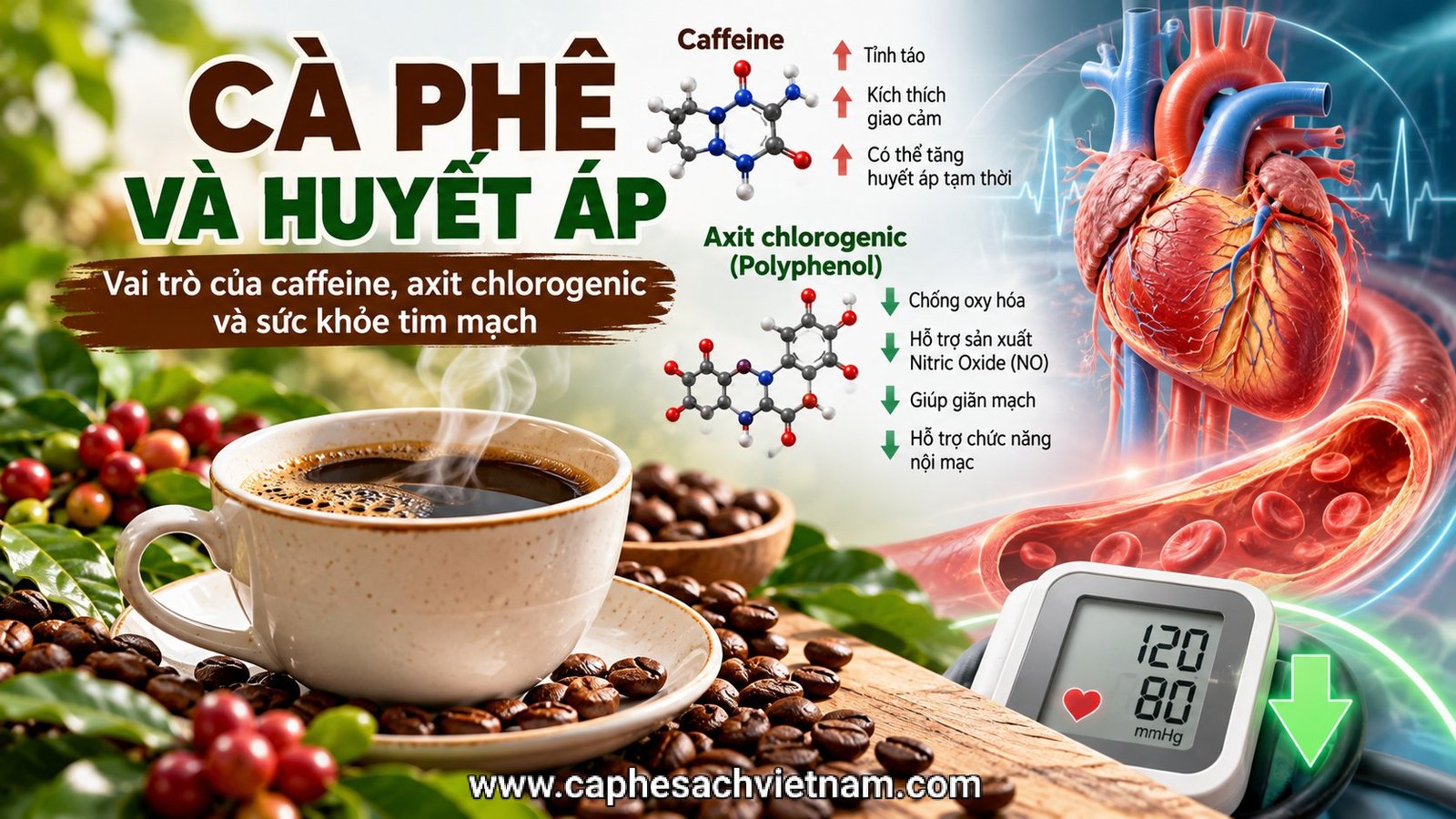
Coffee and Blood Pressure: The Role of Caffeine, Chlorogenic Acid, and Cardiovascular Health
Does coffee raise blood pressure or contribute to protecting cardiovascular health? This question has been studied for decades. The answer is not simply that coffee is good or bad, as the impact of this beverage depends on caffeine, bioactive compounds, consumption volume, brewing methods, and individual physiological characteristics.
Besides caffeine, coffee contains many polyphenol compounds, including chlorogenic acids (CGAs). Studies are investigating the role of these compounds in vascular endothelial function, oxidative stress, and blood pressure regulation. However, it is necessary to distinguish between mechanisms observed in the laboratory, results from human trials, and associations recorded in epidemiological studies.
1. Caffeine and Blood Pressure: Why Short-Term Effects Differ from Long-Term Ones?
1.1. Mechanism of Short-Term Caffeine Effects
Caffeine acts primarily by antagonizing adenosine receptors in the nervous system. Adenosine participates in regulating neural activity and vascular tone. When adenosine effects are inhibited, caffeine can increase alertness, affect sympathetic nervous system activity, and cause temporary changes in cardiovascular response.
After drinking coffee, some people may experience a short-term increase in blood pressure. The magnitude of this increase varies among individuals, depending on caffeine dosage, absorption rate, tolerance level, medications used, and underlying health status.
People who rarely drink coffee or are sensitive to caffeine may notice a more pronounced response. Conversely, regular drinkers may develop a degree of tolerance to certain effects of caffeine. However, tolerance does not mean caffeine has no effect on blood pressure whatsoever.
1.2. Why Chronic Hypertension Risk Cannot Be Inferred from a Single Consumption Event?
A temporary increase in blood pressure after drinking coffee does not mean the drinker will develop chronic hypertension. These two phenomena differ in duration, mechanism, and assessment methods.
To determine hypertension status, appropriate blood pressure measurements and clinical evaluation are required, rather than a single measurement taken immediately after caffeine consumption.
A meta-analysis published in 2023, including 25 observational studies, noted an association between higher coffee consumption and lower risk of hypertension in cohort studies. However, results varied across study groups and did not prove that coffee directly prevents hypertension.
In other words, current evidence does not support equating immediate blood pressure responses with the long-term health impacts of coffee drinking habits. At the same time, observed associations cannot be used to assert that coffee is a method for preventing or treating hypertension.
Source: Coffee Consumption and Risk of Hypertension in Adults: Systematic Review and Meta-Analysis (2023).
2. Chlorogenic Acid in Coffee and Vascular Endothelial Function
2.1. What Is Chlorogenic Acid?
Chlorogenic acid is the general name for a group of phenolic compounds found in coffee and many plants. In coffee, this group includes esters formed from quinic acid and hydroxycinnamic acids, notably caffeic acid and ferulic acid.
Caffeoylquinic acids are an important group within the chlorogenic acid composition of coffee. The content and ratio of each compound vary according to coffee variety, fruit ripeness, processing methods, storage conditions, and roasting degree.
During roasting, chlorogenic acids may degrade, transform, or participate in reactions to form other compounds. Therefore, one should not assume that all roasted coffees have the same polyphenol content or that lighter roasts are necessarily more beneficial for cardiovascular health.
2.2. What Is the Role of the Vascular Endothelium?
The endothelium is the cell layer lining the interior surface of blood vessels. Besides serving as a barrier between blood and the vessel wall, the endothelium participates in regulating vascular tone, inflammatory responses, coagulation, and cell interactions within the circulatory system.
One substance produced by endothelial cells is nitric oxide (NO). This molecule helps vascular smooth muscle cells relax, thereby contributing to the regulation of vessel diameter and vascular resistance.
Endothelial dysfunction is associated with many cardiovascular risk factors, including hypertension and atherosclerosis. However, these conditions have complex mechanisms and cannot be explained by a single molecule or food type alone.
2.3. Chlorogenic acid and the nitric oxide pathway
Some preclinical studies suggest that chlorogenic acid and its metabolites may influence cellular signaling pathways related to endothelial function, antioxidant capacity, and vascular regulation.
AMP-activated protein kinase (AMPK) is an enzyme that senses cellular energy status and participates in regulating various metabolic processes. In certain research models, AMPK may be involved in the activity of the enzyme endothelial nitric oxide synthase (eNOS).
The eNOS enzyme catalyzes the production of NO from L-arginine. NO then participates in vascular smooth muscle relaxation through intracellular signaling mechanisms.
However, caution is warranted: it cannot be asserted that every instance of coffee consumption sequentially activates the AMPK–eNOS–NO pathway in humans, nor can it be assumed that this mechanism produces a clinically significant reduction in blood pressure. The actual effect also depends on absorption, metabolism, dosage, and interactions among multiple components in coffee.
3. Polyphenols, oxidative stress, and nitric oxide
Oxidative stress occurs when the formation of oxidants exceeds the control capacity of the antioxidant system. In blood vessels, superoxide (O2•−) can react with nitric oxide to form peroxynitrite (ONOO−). This process reduces the amount of bioavailable NO and may contribute to cellular damage under certain pathological conditions.
Chlorogenic acid and some polyphenols have the capacity to participate in antioxidant reactions under experimental conditions. Their metabolites may also influence pathways related to inflammatory responses and cellular oxidative status.
Nevertheless, antioxidant effects observed in the laboratory do not mean that polyphenols from coffee will directly scavenge free radicals in the body to the same extent. After ingestion, these compounds are absorbed, metabolized, and excreted; actual concentrations at target tissues may differ significantly from those used in experiments.
Therefore, a more accurate statement is that polyphenols in coffee may participate in regulating biological processes related to oxidative stress and vascular function. The extent to which each compound contributes to cardiovascular health in humans still needs to be evaluated based on clinical studies.
4. Does long-term coffee consumption increase blood pressure?
Current evidence suggests that the relationship between coffee and blood pressure is more complex than simply viewing caffeine as a factor that raises blood pressure or polyphenols as a factor that lowers it.
The American Heart Association’s scientific statement on caffeine and cardiovascular disease, published in July 2026 in the journal Circulation, synthesizes evidence showing that the association between caffeine and cardiovascular outcomes depends on the source of caffeine, dosage, and individual characteristics. Many studies on moderate coffee consumption report a neutral or beneficial association with certain cardiovascular outcomes, but most long-term evidence remains observational.
This means it cannot be concluded that all regular coffee drinkers have better blood pressure, nor can it be asserted that coffee causes chronic hypertension in all adults.
Factors such as smoking, diet, salt intake, physical activity, sleep quality, stress levels, and metabolic status can all influence both coffee consumption habits and cardiovascular risk. These confounding factors need to be considered when interpreting epidemiological studies.
Source: American Heart Association – Caffeine & Cardiovascular Disease (2026).
5. How much coffee per day is reasonable?
There is no single number of cups suitable for everyone. Caffeine content varies significantly depending on bean type, blend ratio, coffee mass, brewing method, extraction time, and beverage volume.
In its 2026 scientific statement, the AHA stated that caffeine intake of up to approximately 400 mg/day is generally considered a level that does not cause adverse effects in most healthy adults. This is a reference threshold for total caffeine intake, not a recommendation that everyone should consume up to that amount.
| Target population | Cautious approach |
|---|---|
| Healthy adults | Monitor total caffeine intake from coffee and other sources; do not assume the number of cups is an accurate measure. |
| Individuals sensitive to caffeine | Consider reducing intake, avoid drinking close to bedtime, and monitor for palpitations, restlessness, or insomnia. |
| Individuals with uncontrolled hypertension | Consult healthcare professionals regarding appropriate caffeine intake; do not self-medicate with coffee to treat blood pressure. |
| Individuals with very high blood pressure or cardiovascular disease | Caffeine consumption should be individualized based on clinical status and professional guidelines. |
The 2025 ACC/AHA Hypertension Guideline recommends limiting caffeine to under 300 mg/day and avoiding more than one cup per day in individuals with severe, uncontrolled hypertension. This emphasizes that consumption thresholds should be adjusted according to health status, rather than applying a one-size-fits-all formula.
If assessing the body's response is necessary, blood pressure can be recorded before and after coffee consumption under consistent measurement conditions. However, medication regimens should not be self-adjusted based on single measurements.
Source: ACC/AHA Guideline for the Prevention, Detection, Evaluation, and Management of High Blood Pressure in Adults, 2025; FDA – How Much Caffeine Is Too Much?.
6. Does coffee roasting affect polyphenols and caffeine?
Coffee roasting alters the chemical composition of beans through complex thermal reactions. Chlorogenic acids may degrade or transform, while numerous aromatic compounds, Maillard reaction products, and other substances are formed.
Caffeine is relatively stable under typical coffee roasting conditions compared to many heat-labile compounds. However, caffeine content per gram of beans and per serving depends on multiple factors, including bean mass, roast level, bean variety, and brewing method.
Therefore, it is inappropriate to claim that a specific roast level reliably preserves high polyphenol levels while optimizing caffeine for cardiovascular protection. Determining actual content requires appropriate chemical analysis methods and product-specific data.
For individuals seeking to manage caffeine intake, adjusting coffee consumption volume, selecting appropriate serving sizes, or considering decaffeinated coffee is more practical than relying solely on roast color.
7. Key points regarding coffee and cardiovascular health
- Caffeine can cause temporary increases in blood pressure; the magnitude of this effect varies among individuals.
- A blood pressure response to a single dose does not equate to a risk of chronic hypertension.
- Chlorogenic acid and other polyphenols are bioactive compounds of interest, but potential mechanisms do not necessarily translate to confirmed clinical benefits.
- Appropriate caffeine consumption depends on baseline health, concurrent medications, and individual sensitivity.
- Individuals with uncontrolled hypertension or cardiovascular symptoms should consult healthcare professionals regarding appropriate caffeine intake.
8. Frequently Asked Questions
Does drinking coffee raise blood pressure?
It can. Caffeine may cause temporary increases in blood pressure in some individuals. The degree of response depends on dosage, consumption habits, and caffeine sensitivity.
Do polyphenols in coffee lower blood pressure?
Some studies suggest that polyphenols and chlorogenic acid may influence mechanisms related to vascular function. However, there is insufficient evidence to confirm that coffee polyphenols definitively lower blood pressure or completely neutralize the effects of caffeine.
Do individuals with hypertension need to stop drinking coffee?
Not everyone needs to stop completely. The decision depends on blood pressure levels, disease control, response to caffeine, and guidance from healthcare professionals. Individuals with severe, uncontrolled hypertension should exercise particular caution.
Is light roast coffee better for cardiovascular health than dark roast coffee?
No conclusion can be drawn based solely on roast color. Roast level alters chemical composition, but actual cardiovascular benefits also depend on serving size, brewing method, total caffeine intake, and individual user characteristics.
Is 400 mg of caffeine per day a suitable amount for everyone?
No. This is a reference level generally considered safe for most healthy adults; it is not a consumption target and does not replace personalized guidance for individuals with medical conditions.
9. Scientific references
- American Heart Association (2026). Caffeine and Cardiovascular Disease: A Scientific Statement From the American Heart Association. Circulation. https://doi.org/10.1161/CIR.0000000000001454
- American Heart Association (2026). Top Things to Know: Caffeine & Cardiovascular Disease. View document
- ACC/AHA and professional organizations (2025). Guideline for the Prevention, Detection, Evaluation and Management of High Blood Pressure in Adults. View guideline
- Systematic Review and Meta-Analysis (2023). Coffee Consumption and Risk of Hypertension in Adults. Nutrients, 15(13), 3060. Read full text
- U.S. Food and Drug Administration. Spilling the Beans: How Much Caffeine Is Too Much? View guideline