
Thermal stability of the alkaloid structure under roasting conditions
Caffeine (1,3,7-Trimethylxanthine) is a natural alkaloid compound found in coffee beans, serving as a biological defense mechanism for the plant against pests and diseases. In organic chemistry, the xanthine double-ring structure gives caffeine exceptionally high thermal stability.
In commercial and pilot coffee roasters, bean temperature typically ranges from 180°C to below 250°C. This temperature threshold is insufficient to reach the complete thermal decomposition point of pure caffeine. Therefore, overall, caffeine is considered one of the most stable compounds under typical roasting temperatures. Its absolute content in each coffee bean is largely preserved at light roast or medium roast levels.
Sublimation and caffeine loss in dark roast batches
Despite its high thermal stability, caffeine is not entirely immutable when roasting progresses into more severe stages.
When the batch moves to a dark roast, the drop temperature is often pushed very high, exceeding 400–420°F (approximately 200°C to 215°C) and maintained for an extended period. This is accompanied by significant total mass loss of the coffee beans due to water evaporation and decomposition of organic compounds (bean weight loss exceeding 12–14%).
In this state, scientific studies record two simultaneous phenomena that reduce actual caffeine content:
- Sublimation: Caffeine can transition directly from a solid to a gaseous state at high temperatures and escape through the roaster's exhaust airflow.
- Mild Thermal Degradation: Weaker bonds within the cellular structure break down, leading to partial decomposition of the alkaloid compound during prolonged exposure to forced heat.
Analysis results from publications in Scientific Reports (2024) and MDPI show that caffeine concentration in extracts from very dark roasted samples decreases significantly compared to light roasted samples from the same raw material lot.
Impact of microporous structure on caffeine extraction efficiency
To understand the actual caffeine intake from a cup of coffee, we must look beyond roasting losses and consider the kinetics of the extraction process. This is where the physical structure of the bean plays a decisive role.
Under scanning electron microscopy (SEM), the cellular structure of coffee beans undergoes profound changes across different roast levels:
- In light roasts: The bean's cellular structure is relatively tight and dense. Water struggles to penetrate quickly into the core of the bean, slowing the dissolution rate of caffeine even though the total caffeine content in the bean remains intact.
- In dark roasts: Bean volume expands significantly, releasing CO2 and breaking down internal cellulose cell walls. This process creates an expanded micro-porous network. This porous structure acts as a direct competitive mechanism: it allows the solvent (hot water) to penetrate easily and dissolve caffeine much faster during brewing.
Thus, although dark roasting may cause a small percentage of caffeine loss due to sublimation, its highly porous structure optimizes the dissolution efficiency of this compound into your cup, creating an interesting balance in the practical experience.
Appendix: Comparative data table and images
To visualize the physicochemical changes of caffeine according to roast level, data from experimental studies are summarized below:
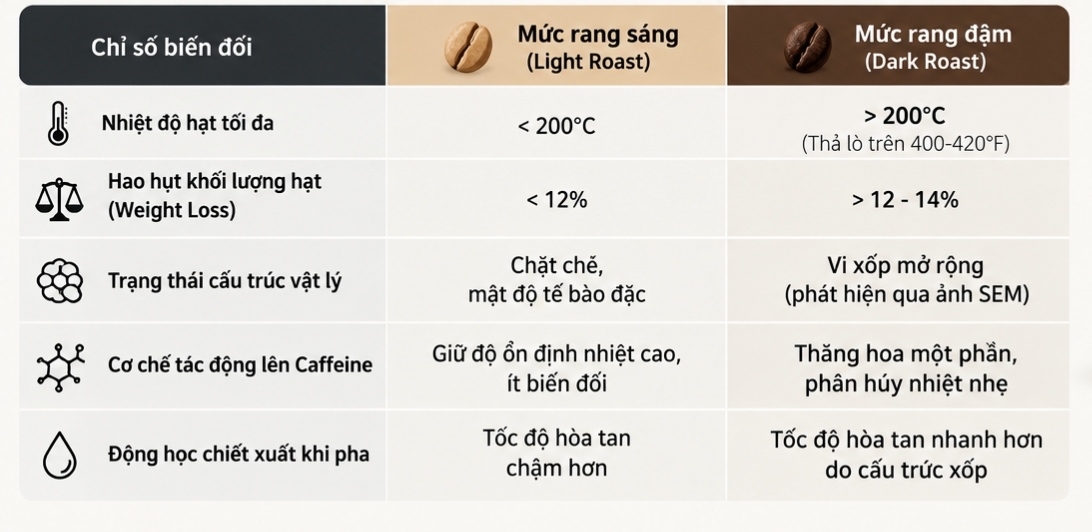
(Note: The above figures are for reference based on experimental research; actual loss ratios may vary depending on the roasting equipment and coffee variety used).
Illustrative images of bean cellular structure
