
Cellular structure and hydration mechanism of cascara in a cold environment
To understand how cascara interacts with water during cold steeping (brewing & extraction cold brew), we need to analyze the anatomical structure of dried coffee cherry skin. The pericarp consists of three main layers: the tough, waterproof exocarp; the mesocarp, rich in pectin mucilage; and the endocarp, which closely encases the bean.
During the drying process to produce commercial cascara, the cellular structure of the mesocarp shrinks, creating a complex capillary network containing biopolymers. When exposed to cold water:
- Hydration of soluble fiber: Long-chain polysaccharides such as pectin and hemicellulose located within the cell wall structure rapidly bind with water molecules through hydrogen bonds. This process swells the polymer fiber network, creating the natural viscosity characteristic of the extract.
- Water Retention Capacity (WRC): Although standardized experimental data on the WRC of cascara are still being clarified, the hydrogen bond-rich nature of insoluble fiber (such as cellulose) helps retain a large amount of water in the pomace. This explains why the water absorption ratio of cascara in cold brew is significantly higher than that of roasted ground coffee.
Cold extraction kinetics of bioactive compounds
The coffee science cold brewing process creates dissolution dynamics completely different from hot water brewing. Due to the lack of high thermal energy catalysis, the diffusion rate of molecules slows down, requiring prolonged contact time (12 to 24 hours) to reach concentration equilibrium.
In low-temperature environments, the water solvent preferentially dissolves substances with low molecular weight and high polarity:
- Caffeine: As a moderately polar alkaloid, caffeine diffuses steadily from the cherry skin cell cavities into the water. Although the dissolution rate is slower than in hot water, the extended steeping time of the cold brew method ensures optimal caffeine extraction.
- Chlorogenic Acids (CGA): This polyphenolic compound acts as the primary antioxidant in cascara. In a cold environment, CGA is better preserved, avoiding thermal decomposition into caffeic acid and quinic acid as occurs at boiling temperatures, helping the beverage retain its natural bright acidity with less bitterness and astringency.
- Melanoidins: These brown polymers form naturally during the drying of coffee cherry skins. They not only give cold brew its deep amber color but also act as soluble fibers, increasing the sensory body (body) of the beverage.
Biochemical effects on the brain-gut axis and colonic immune system
Recent experimental biological studies have clarified the effects of concentrated cascara extract (Instant Cascara) on the digestive physiological system. Contrary to previous misconceptions equating the effects of coffee cascara with strong laxative herbs (such as Cascara Sagrada), coffee cherry skin acts through a subtle neuro-immune regulatory mechanism.
Regulation of the Brain-Gut Axis
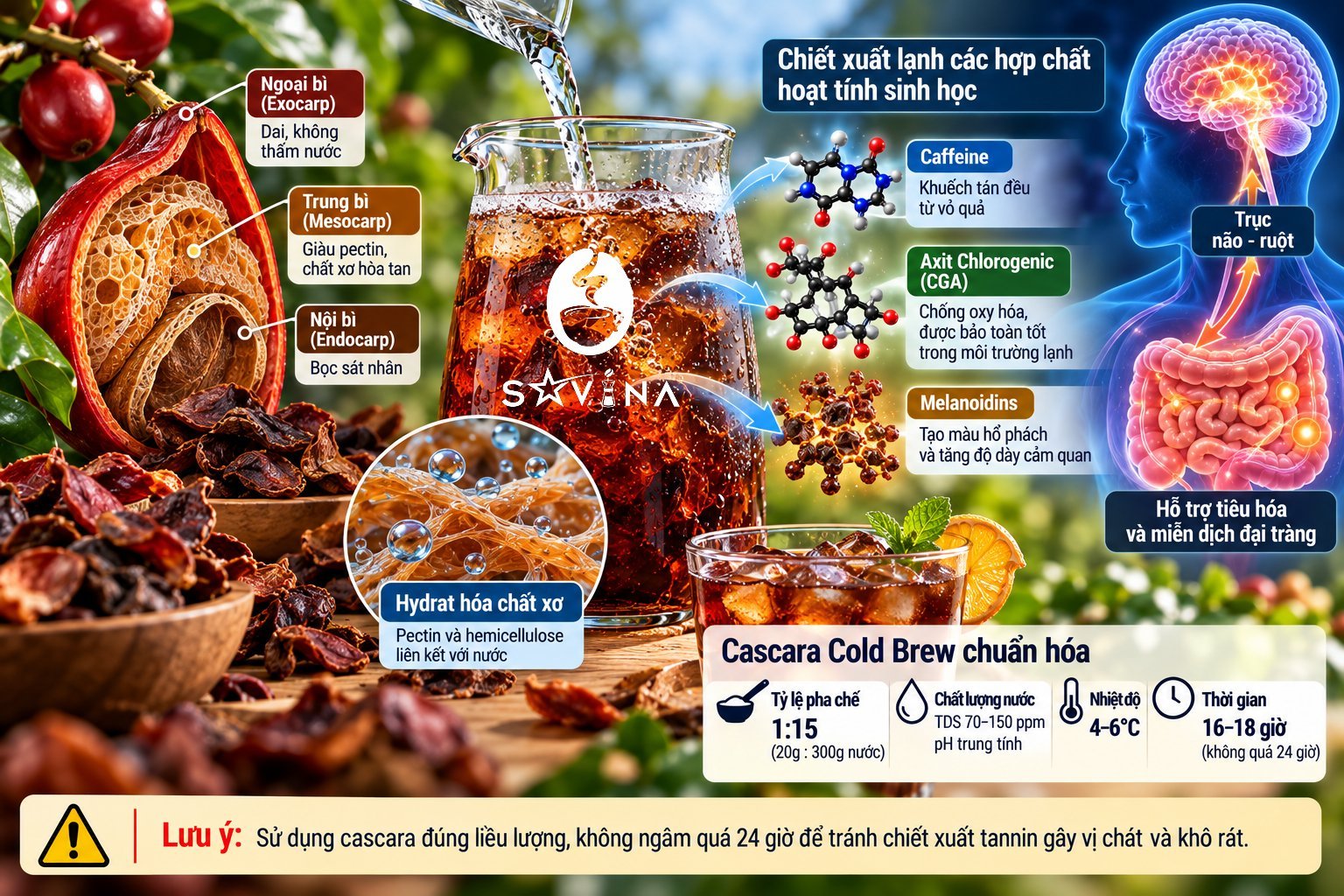
Upon entering the digestive system, bioactive compounds in cascara act as chemical signals interacting directly with the Enteric Nervous System (Enteric Nervous System - ENS). Immunohistochemical tests on healthy animal models (Wistar rats) showed that regular consumption of cascara extract for 3 weeks led to an increase in the density of enteric glial cells in the myenteric plexus of the colon. These cells play a role in maintaining the integrity of the intestinal epithelial barrier and regulating intestinal motility.
Sex-dependent immune response
A notable finding from biological research is that the immunomodulatory and visceral sensory effects of cascara show clear differences between the two sexes (sex-dependent effects). Changes in immune markers in the colon and the sensitivity levels of the enteric nervous system were recorded at different levels in male and female individuals. This opens new directions for personalized nutrition, applying cascara as a functional food to help improve irritable bowel syndrome or brain-gut axis disorders.
Standardized Cascara Cold Brew Brewing Process
To optimize the extraction of antioxidants without increasing the astringency of fibers, the brewing process must adhere to strict technical parameters:
- Brewing ratio: It is recommended to use a 1:15 ratio (20g dry cascara corresponding to 300g filtered water). This ratio ensures that the water solvent does not become saturated too quickly by swelling polysaccharides.
- Water quality: Use water with Total Dissolved Solids (TDS) of 70-150 ppm and neutral pH to create the best dissolution force for polyphenol compounds.
- Time and temperature: Steep in the refrigerator at 4-6°C for 16-18 hours. Do not exceed 24 hours to avoid extracting high-molecular-weight tannins that cause a dry, rough sensation in the throat when drinking.
- Esquivel, P., & Jiménez, V. M. (2012). Functional properties of coffee and coffee by-products. Food Research International, 46(2), 488-499. (Detailed study on the anatomical composition of coffee cherry skin (pericarp), soluble fiber content (pectin, hemicellulose), and water retention capacity (WRC) of coffee by-products.)
- Rebollo-Hernanz, M., et al. (2019). Physicochemical and techno-functional properties of coffee husk: A candidate ingredient for the food industry. Foods, 8(8), 351. (Analysis of capillary structure, swelling properties in aqueous environments, and hydrogen bonding capacity of polysaccharides in dried coffee husk.)
- Cordoba, N., et al. (2019). Chemical and sensory evaluation of cold brew coffee using different extraction techniques. Food Research International, 123, 590-597. (Investigation of dissolution kinetics in cold environments, preservation of Chlorogenic Acid (CGA) from thermal degradation into caffeic/quinic acids, and caffeine extraction yield over time.)
- Heeger, A., et al. (2017). Bioactive compounds, antioxidant capacity and material quality of coffee cherry husk (cascara). Food Chemistry, 221, 969-975. (Determination of polyphenol, caffeine, and melanoidin content, as well as the antioxidant capacity of cascara extracts.)
- Rebollo-Hernanz, M., et al. (2020). Phenolic compounds from coffee by-products modulate gut microbiota and brain-gut axis dynamics. Journal of Agricultural and Food Chemistry, 68(47), 13600-13610. (In vivo trials demonstrating the impact of cascara polyphenols on the enteric nervous system (ENS), maintenance of enteric glial cells, and colonic epithelial barrier integrity.)
- Pérez-Burillo, S., et al. (2021). Sex-dependent bioactivity of coffee spent grounds and cascara extracts in gut health models. Nutrients, 13(9), 3120.
- Specialty Coffee Association (SCA). Cold Brew and Cascara Extraction Guidelines & Research Series. (Standards for brewing ratio (1:12 - 1:15), water quality (TDS 70–150 ppm, neutral pH), and cold steeping time limits (16–18 hours) to control astringency (tannins).)