
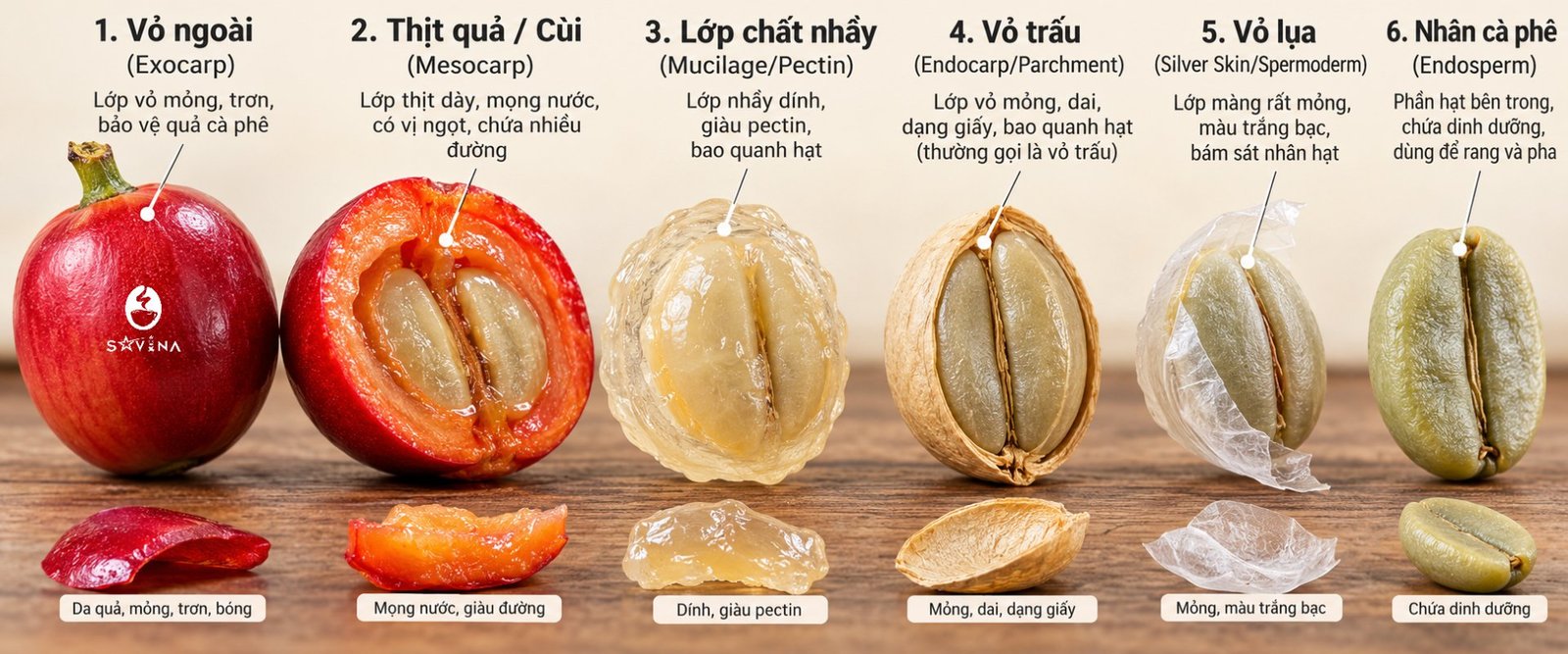
Coffee cherry anatomy: Six components from the outer skin to the green bean
The coffee cherry is not merely a red skin surrounding the bean. Inside the fruit are various plant tissues with distinct structures and functions, ranging from the outer skin, pulp, and mucilage to the parchment, silver skin, and coffee bean. A correct understanding of this anatomy helps growers, processors, and roasters better comprehend post-harvest handling and the factors that can influence coffee quality.
In botanical terminology, the coffee fruit is often referred to as a coffee berry or coffee cherry. It is a drupe, not a true berry in the common botanical sense. The fruit structure consists of the pericarp and the inner seed. In processing practice, six distinct parts are commonly identified to facilitate visualization of the processing and milling stages.
General structure: The pericarp and the seed
Fundamentally, the coffee cherry structure can be divided into two groups: the pericarp and the seed. The pericarp comprises three main tissue layers: the exocarp, mesocarp, and endocarp. The seed contains the endosperm, embryo, and a thin tissue layer associated with the seed coat, commonly known in the coffee industry as the silver skin.
In processing practice, the mucilage is often treated as a separate category due to its significant role in fermentation, washing, and drying. However, the boundary between the pulp and the mucilage may be described slightly differently across specialized literature.
As the fruit develops and ripens, tissues undergo changes in hardness, water content, carbohydrates, pectin, and other compounds. These transformations affect raw material characteristics and how the fruit responds to processing methods, but fruit anatomy alone cannot accurately predict the final cup flavor.
Detailed breakdown of coffee cherry components
1. Outer Skin – Exocarp
The exocarp is the outermost layer of the coffee cherry. When the fruit is immature, this skin is typically green due to the presence of chlorophyll. During ripening, pigments change, and the fruit may turn red, yellow, orange, or other shades depending on the coffee variety's genetics.
The red color in many varieties is linked to anthocyanin accumulation, while yellow-ripening fruits may involve the expression of other pigments, including compounds from the flavonoid group. This color change occurs alongside other physiological changes within the fruit.
Skin color is a useful indicator for harvesting, but it is not the sole determinant of ripeness. Variety characteristics, fruit uniformity, and harvesting objectives must be considered. Harvesting overly green or overripe cherries can increase inconsistency in the raw material input.
Learn more about coffee varieties and differences in growth characteristics and fruit morphology.
2. Pulp – Mesocarp / Pulp
The mesocarp is the tissue layer located between the outer skin and the hard endocarp. In common coffee industry terminology, the outer fleshy tissue is often called pulp, while the inner mucilaginous layer is separately described as mucilage. Some references use the term mesocarp more broadly, encompassing both the fleshy and mucilaginous regions.
The pulp contains water, carbohydrates, pectin, fiber, and various other compounds. Composition varies by variety, developmental stage, and growing conditions. These components form part of the biological environment surrounding the seed during processing.
In natural (dry) processing, the whole fruit is typically dried before the outer layers are removed by milling. In washed (wet) processing, the skin and pulp are usually removed early using depulping equipment. These two methods create different drying conditions and microbial interactions.
It should not be assumed that sugars and acids in the pulp automatically diffuse directly into the bean through a simple mechanism. Compound exchange, microbial activity, and chemical transformations depend on numerous factors throughout the processing stage.
3. Mucilage – Mucilage
Mucilage is a pectin-rich mucilaginous layer adhering to the outside of the parchment. This layer has high water content and contains carbohydrates and other compounds, creating a favorable environment for microbial activity under certain processing conditions.
In washed processing, the mucilage can be removed through fermentation, mechanical action, enzymes, or a combination of methods. In honey/pulped natural processes, a portion of the mucilage is retained while the beans are dried. In whole-fruit natural processing, the outer tissues remain surrounding the bean for most of the drying period.
Microorganisms and enzymes may participate in breaking down pectin and transforming compounds in the processing environment. However, outcomes depend on the microbial community, temperature, time, humidity, fruit ripeness, and process management. One cannot conclude solely from the amount of mucilage that the coffee will exhibit specific levels of sweetness, fruitiness, or fermented flavors.
4. Parchment – Endocarp / Parchment
The endocarp is the innermost layer of the fruit skin. As it develops, this tissue becomes harder and forms the parchment layer enclosing the coffee bean. In the coffee industry, "parchment" is the common term for this enclosing layer in coffee dried through various processes, particularly wet processing.
The parchment layer helps protect the beans from mechanical impact during drying and processing. Once the coffee reaches suitable conditions for milling, the parchment layer is removed through hulling to obtain green coffee beans. Parchment does not replace the need for moisture control, hygiene, and proper storage conditions.
In whole-dry (natural) processing, the outer layers are dried together with the bean and subsequently removed during milling. Therefore, terminology and the state of the raw material before milling may vary depending on the processing method.
5. Silver Skin
Silver skin is a thin membrane associated with the seed coat, lying close to the surface of the green coffee bean. In plant anatomy, this layer is often linked to the remaining perisperm and seed coat tissues, depending on the classification used in specialized literature.
During roasting, part of the silver skin detaches from the bean due to heat exposure and bean movement. These fragments are called chaff and are typically collected by the roaster’s chaff separation system.
The amount of chaff visible in the roaster depends on the raw material, the degree of silver skin detachment, and equipment characteristics. One should not assert that chaff always increases bitterness, smokiness, or astringency in the beverage; specific sensory impacts must be evaluated under practical conditions.
6. Green Coffee Bean
Green coffee beans are the seeds obtained after primary processing and milling. In many coffee fruits, two seeds develop within the same fruit, with their flat sides pressing against each other. Green beans are the raw material classified, stored, transported, and introduced into the roasting stage.
The majority of the bean’s mass consists of endosperm, containing carbohydrates, lipids, caffeine, chlorogenic acids, proteins, minerals, and many other compounds. The seed also contains an embryo, a biological structure related to germination potential.
During roasting, heat alters the structure and chemical composition of the bean. The Maillard reaction, thermal degradation, and the breakdown and transformation of numerous precursors contribute to the aroma, color, and flavor of roasted coffee. Caramelization may occur with suitable sugars under corresponding temperature conditions, but not all flavor compounds are formed solely by these two reactions.
Read more about green coffee beans and the coffee roasting process.
How are Peaberry beans formed?
Typically, a coffee fruit develops two seeds. However, sometimes only one seed develops within the fruit, resulting in a single bean that is rounder or more oval-shaped compared to the usual flat-sided beans. This type of bean is called peaberry, or commonly referred to as "Culi" in Vietnam.
Peaberry is not a separate class of coffee fruit. It is a morphological form of the seed, related to the development of only one of the two usual seeds within the fruit. The cause of formation may be linked to development and pollination processes; one should not default to explaining it as one embryo shrinking while the other becomes spherical.
The peaberry shape does not automatically prove higher quality than flat-sided beans. Quality still depends on variety, ripeness, growing conditions, primary processing, storage, and roasting.
How does fruit structure affect primary processing techniques?
Different primary processing methods mainly differ in the timing and method of removing the skin, pulp, and mucilage; how the beans are dried; and the level of fermentation control. Three common groups can be summarized as follows.
Natural Processing
The fruit is dried whole before milling. The outer tissues continue to surround the bean for most of the drying stage. This method requires management of fruit layer uniformity, turning, drying rate, moisture content, and risk of microbial spoilage.
Natural-processed coffee may exhibit prominent body and fruity characteristics, but this is not a guaranteed outcome for every lot. Variety, ripeness, natural fermentation conditions, climate, and drying control can all influence flavor.
Washed Processing
The skin and pulp are usually removed early using depulping machines. The mucilage is treated through fermentation, mechanical action, enzymes, or a combination of methods; then the beans are washed if the process requires it and dried, typically still enclosed in parchment.
Washed processing is often chosen when producers want clear control over the steps of removing fruit tissue and cleaning the beans. However, one cannot assert that all washed coffees have higher acidity or cleaner flavors than other methods; results also depend on raw materials and processing protocols.
Honey / Pulped Natural Processing
In many honey processing methods, the skin is removed but a portion of the mucilage is retained while the beans are dried. The amount of remaining mucilage and drying management practices can vary significantly among producers.
The term "honey" does not mean that honey is added to the coffee. The sensory characteristics of honey-processed coffee cannot be predicted solely by the color name assigned to the process; variety, ripeness, amount of retained mucilage, drying conditions, and quality management must also be considered.
Learn more about post-harvest processing to better understand the stages of coffee fruit handling.
Frequently asked questions about coffee fruit anatomy
Is the coffee fruit a drupe?
In standard botanical classification, the coffee fruit is described as a berry. The term "coffee cherry" is a common industry name and does not imply that coffee belongs to the drupe group like peaches or plums.
How many layers does a coffee fruit have?
In processing practice, six parts are commonly distinguished: exocarp (skin), mesocarp (pulp), mucilage, parchment, silverskin, and green bean. This division is useful for learning and production but does not represent six independent botanical layers of the same anatomical level.
Are parchment and silverskin the same?
No. Parchment is the relatively hard endocarp enclosing the bean, while silverskin is the thin membrane adjacent to the bean surface. Parchment is usually removed during milling; silverskin may detach during roasting.
Why is the mucilage layer important in primary processing?
The mucilage is rich in pectin and contains water and carbohydrates. It can serve as a medium for microbial activity in certain processes. Managing the mucilage, along with time, temperature, humidity, and hygiene, helps control the primary processing; improper management can increase the risk of quality defects.
Is Peaberry a distinct coffee variety?
Peaberry (culi) refers to the single-bean shape that often develops within the coffee fruit, not a distinct coffee species. This shape does not automatically determine the quality or sensory value of the bean.
References
- Esquivel, P. & Jiménez, V. M. (2012). Functional properties of coffee and coffee by-products. Food Research International, 46(2), 488–495. https://doi.org/10.1016/j.foodres.2011.05.028
- Applications of Compounds from Coffee Processing By-Products. A review source on coffee fruit anatomy and processing by-products, published on PubMed Central. Read full text
- From Plantation to Cup: Changes in Bioactive Compounds during Coffee Processing. A review article on compound changes during coffee processing. Read full text
- Drinking Coffee. NCBI Bookshelf. A review document featuring a diagram of coffee fruit anatomy, including the endosperm, silverskin, parchment, and parts of the pericarp. Read document
- Introduction to Coffee Plant and Genetics. Royal Society of Chemistry. A specialized resource on biology, genetics, and coffee fruit anatomy. View book chapter
The above sources are referenced for fruit anatomy, tissue composition, and primary processing methods. Flavor descriptions in this article are presented in general terms; processing method names should not be regarded as the sole evidence for predicting the sensory quality of a coffee lot.