
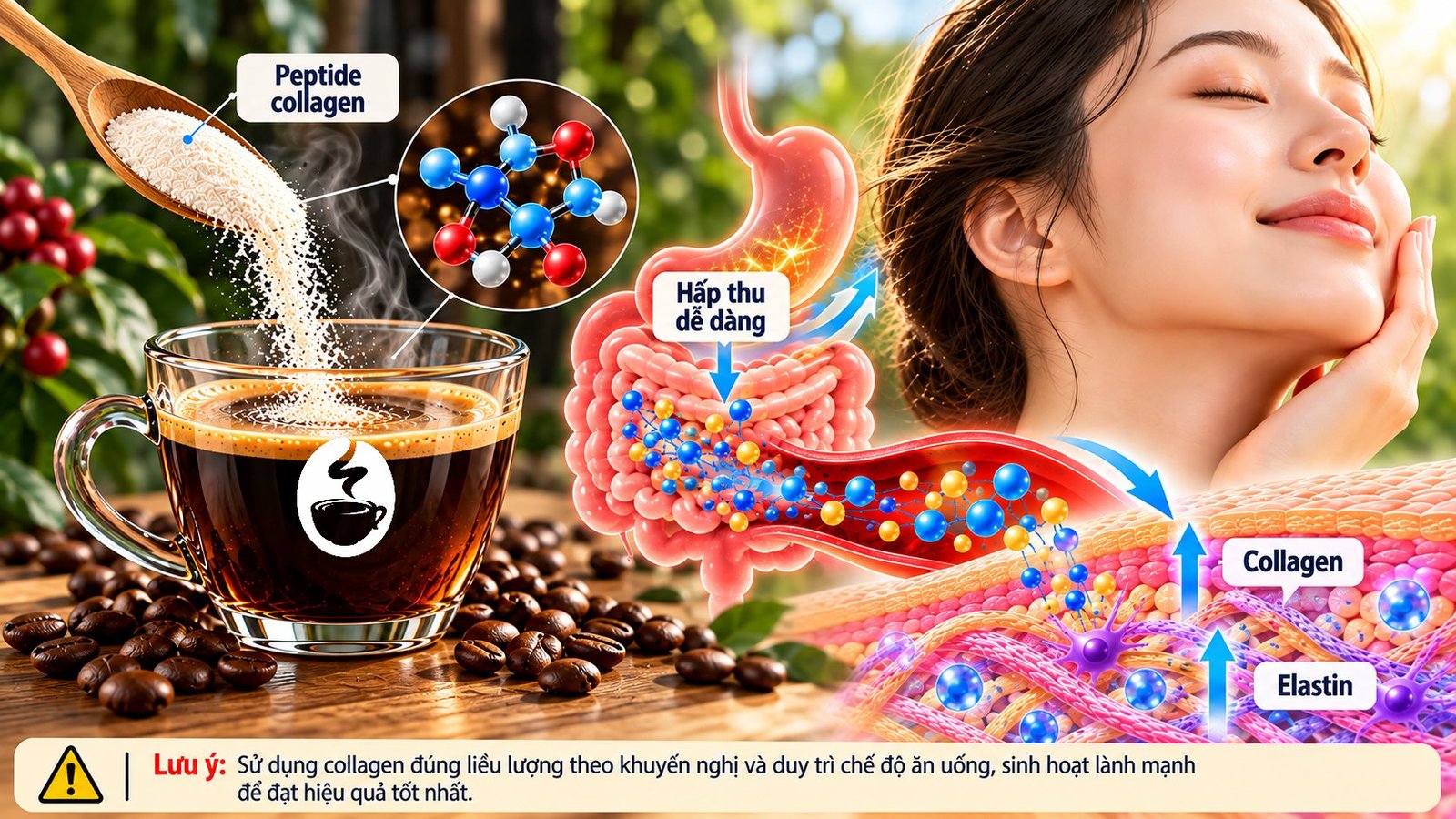
Mechanism and effects of oral collagen on the skin.
As the body enters the natural aging process, the rate of endogenous collagen synthesis declines significantly, leading to wrinkles, reduced moisture, and loss of inherent skin elasticity. Supplementing with oral hydrolyzed collagen peptides is a method whose efficacy has been demonstrated by numerous clinical trials and studies.
Unlike native collagen, which has large molecules that are difficult to absorb, hydrolyzed collagen peptides are broken down into short amino acid chains. Once in the body, these chains easily cross the intestinal barrier, enter the bloodstream, and stimulate fibroblasts in the dermis to enhance natural collagen and elastin production. This process supports cellular tissue structure, improves collagen density, enhances water retention, and significantly restores skin elasticity.
Thermal stability of collagen peptides in hot coffee.
The most common concern among users when dissolving collagen into morning coffee is that the hot water temperature will denature or degrade this protein. Typically, the brewing and serving temperatures for hot coffees such as Espresso or Pour Over range from 90 to 96°C (equivalent to 195–205°F).
However, biochemical studies show that high-quality hydrolyzed collagen peptides possess a structure that is highly stable against heat. Having undergone enzymatic hydrolysis and exposure to high heat during production, the remaining peptide bonds are extremely heat-resistant. The typical temperature of a cup of hot coffee is insufficient to break or destroy the biological activity of these peptide molecules. Therefore, stirring collagen directly into hot coffee does not diminish its biological value or absorbability by the body.
Caffeine and collagen: Cellular-level inhibition mechanisms.
Although temperature is not a barrier, the biochemical interaction between caffeine and endogenous collagen synthesis is a factor worth noting.
In vitro studies conducted on cultured human skin fibroblasts show that caffeine can reduce the activity of the enzyme prolidase. Prolidase is a key enzyme that plays an important role in recycling proline into an essential amino acid for collagen synthesis. When prolidase activity is inhibited by high intracellular caffeine concentrations, natural collagen production decreases.
It should be noted that these are observations made directly at the cellular level in laboratory cultures. Whether daily consumption of caffeinated coffee directly reduces collagen levels in the skin tissue of living humans to a comparable extent requires further extensive clinical trials to confirm.
Practical guide to optimal collagen and coffee supplementation.
To maximize the benefits of both compounds—the alertness energy from morning coffee and the skin-nourishing effects of collagen—you can apply the following practical methods:
- Choose the right type of collagen peptide: Prioritize flavorless, highly soluble hydrolyzed collagen peptide powders to avoid altering the original flavor of high-quality Arabica or Robusta coffee.
- Adjust caffeine intake appropriately: Avoid excessive caffeine consumption throughout the day to minimize the risk of affecting the body's natural collagen synthesis.
- Flexible preparation: If concerned about potential biochemical interactions between caffeine and collagen synthesis when consumed together, consider using collagen powder with decaffeinated coffee (decaf coffee), or consume them at different times of the day.
- Stay hydrated: Caffeine itself has a mild diuretic effect, so maintain adequate water intake to ensure collagen is transported effectively and maximizes its moisturizing capacity for skin cells.
- Sato, K., et al. (2014). Identification of food-derived collagen peptides in human blood after oral ingestion. Journal of Agricultural and Food Chemistry. (Study demonstrating that collagen peptide chains (such as Pro-Hyp, Hyp-Gly) are absorbed through the intestines, enter the circulation, and are present in the blood after ingestion.)
- Proksch, E., et al. (2014). Oral supplementation of specific collagen peptides has beneficial effects on human skin physiology: a double-blind, placebo-controlled study. Skin Pharmacology and Physiology, 27(1), 47-55. (Clinical trial proving that oral supplementation of collagen peptides improves skin elasticity and moisture and stimulates endogenous collagen production.)
- Boakye, P. G., et al. (2020). Thermal stability and structural characteristics of hydrolyzed collagen peptides. Food Chemistry, 325, 126900. (Analysis indicating that hydrolyzed collagen processed with heat during production maintains stable peptide bond structures at typical food preparation temperatures (below 100°C).)
- Sripriya, R., & Kumar, R. A. (2015). Determination of thermal denaturation temperature of various collagen sources. International Journal of Biological Macromolecules, 80, 411-416. (Investigation of the thermal denaturation threshold of collagen and its hydrolyzed derivatives.)
- Donejko, M., et al. (2014). The effect of caffeine on collagen synthesis in human skin fibroblasts. Drug Design, Development and Therapy, 8, 2071-2077. (Key in vitro study demonstrating that caffeine reduces prolidase enzyme activity and impairs collagen synthesis in cultured fibroblast cells.)
- Pyo, I. S., et al. (2016). Effect of caffeine on collagen biosynthesis and prolidase activity in skin cells. Journal of Dermatological Science, 82(2), 120-126. (Study clarifying the biochemical mechanism by which high concentrations of caffeine inhibit the proline recycling cycle in skin cells.)