
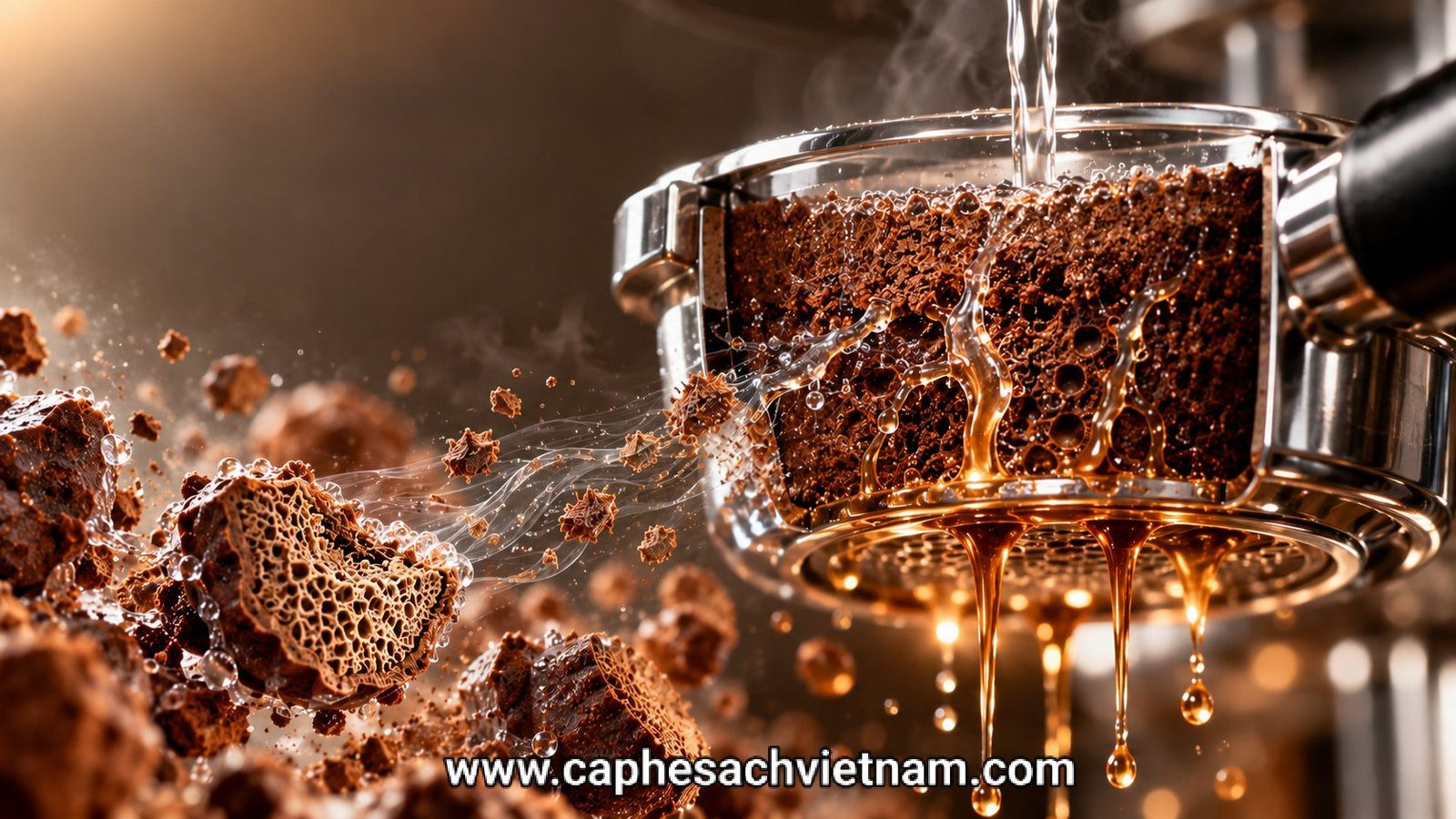
Surface area and the physicochemical dissolution dynamics in Espresso
Why can even a very small change in grind size cause Espresso to flow too fast or drip? The answer lies in the relationship between surface area, coffee puck structure, hydraulic resistance, particle size distribution, and flow through porous media.
1. Espresso is a mass transfer and flow problem
An Espresso shot takes place over a relatively short period, typically around 20–30 seconds in many brewing recipes. During this time, hot water must contact a large amount of coffee surface area while simultaneously passing through a porous material layer with significant hydraulic resistance.
Therefore, Espresso is not simply a process of “water dissolving coffee”. It is a combination of two processes:
Mass transfer
Water contacts the particle surface, dissolves compounds, and transfers them from the solid phase to the liquid phase.
Percolation
Water under pressure moves through the pore network of the coffee puck, where particle structure determines hydraulic resistance.
Grind size determines both the amount of surface area available for water contact and changes the pore structure of the coffee puck. Therefore, changing the grind size can simultaneously alter extraction rate and flow rate.
2. Surface area: why does finer grinding increase dissolution speed?
A whole coffee bean has only a limited surface area in direct contact with water. When the bean is ground into thousands or tens of thousands of small fragments, the total contact surface area increases dramatically.
This is one of the reasons why fine grind sizes often increase extraction rate: water has more surface area to contact, and the diffusion distance from the interior of the particle to the surface is also reduced.
• • • •
• • •
In some illustrative models, grinding a coffee bean to a very small size can increase the total surface area by approximately 1,000 times compared to the whole bean. This is an illustrative value that depends heavily on particle size and distribution, not a constant applicable to all Espresso.
3. Grind size: surface area and pore structure
When adjusting the grinder, the barista does not only change surface area. They simultaneously change the spatial structure between the coffee particles.
Fine grind size
- Specific surface area increases.
- Diffusion distance decreases.
- Voids in the puck become smaller.
- Hydraulic resistance usually increases.
- Flow rate tends to decrease.

Coarse grind size
- Specific surface area decreases.
- Diffusion distance increases.
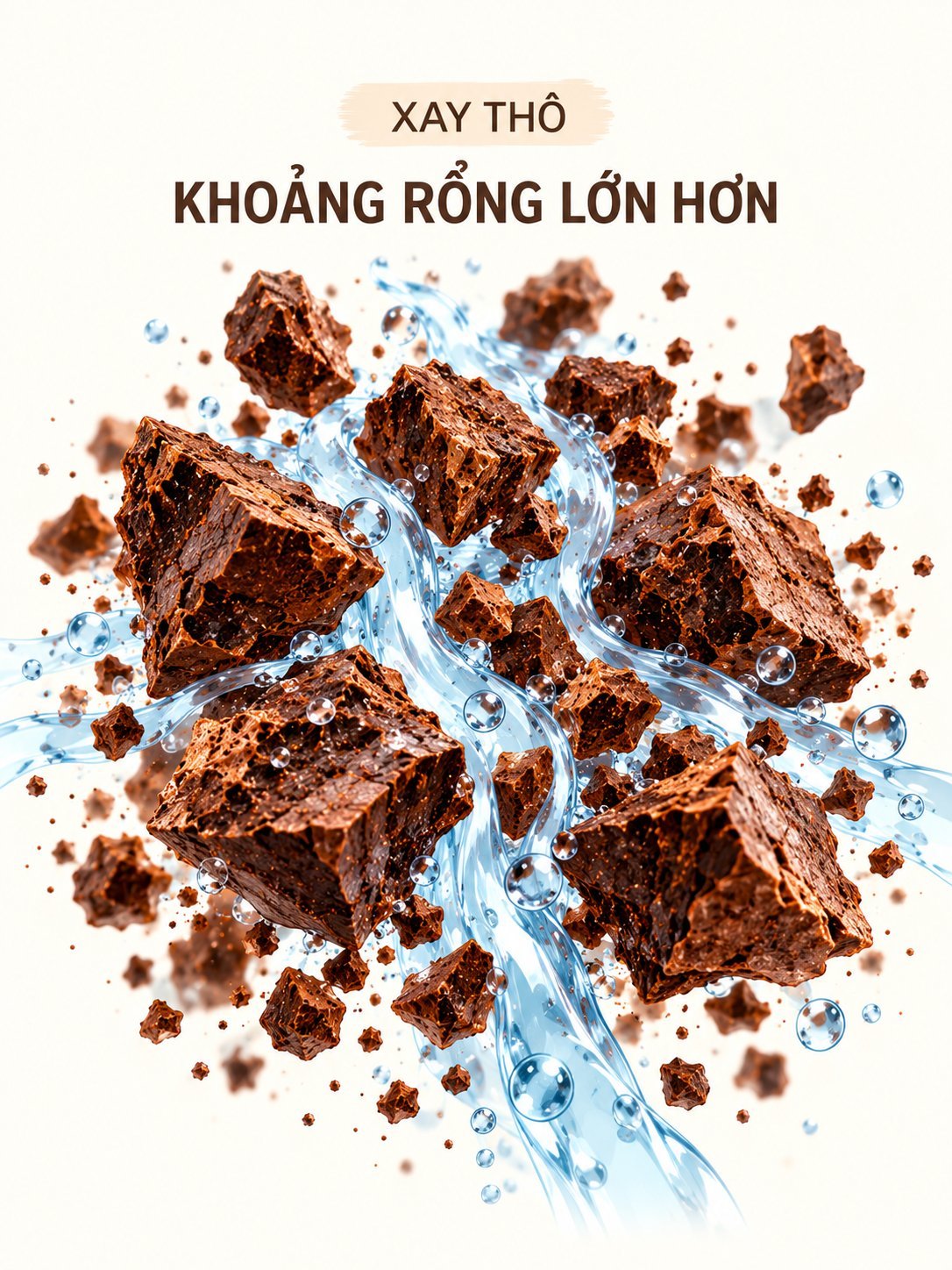
- Void space within the puck increases.
- Hydraulic resistance typically decreases.
- Flow rate tends to increase.
Therefore, the correct question is not “is finer or coarser grinding better?”, but rather:
4. Hydraulic resistance: the coffee puck as a porous medium
When the espresso machine pumps water into the group head, the water passes through the coffee puck under high pressure. In traditional espresso systems, brewing pressure is typically set around 9 bar, but the actual value depends on the machine, pressure profile, and brewing recipe.
The coffee puck acts as a porous medium. Water does not flow through a single channel but must travel through a network of voids formed between millions of coffee particles.
Within the same system, as the hydraulic resistance of the puck increases, flow rate tends to decrease.
Grind size and hydraulic resistance
Smaller particles generally create a void network with smaller characteristic dimensions. This increases flow resistance through the puck. If resistance is too high, the machine takes longer to deliver the same output volume.
Coarse grind size and hydraulic resistance
Larger particles generally create larger void spaces. Water can move more easily through the puck, increasing flow rate and shortening contact time if other variables are held constant.
A long-running shot does not automatically imply over-extraction, nor does a fast-running shot automatically prove under-extraction. Extraction also depends on dose, yield, temperature, water quality, particle size distribution, puck preparation, and many other factors.
5. Particle Size Distribution: Espresso is not composed of uniformly sized particles
Even a high-quality burr grinder produces a particle size distribution (PSD), meaning a spectrum of particle sizes rather than a single uniform size.
Very fine particles have a large specific surface area and can increase flow resistance.
The bulk fraction constitutes the majority of the coffee puck's structure.
Larger particles create larger void spaces and influence water pathways.
Thus, two shots using the same grinder setting may still differ if PSD, freshness, humidity, temperature, and puck preparation vary.
The goal is not simply to produce “perfectly uniform particles.” An appropriate size distribution must balance diffusion rates from fine particles with the ability of water to permeate the entire puck.
6. Channeling: when water finds the path of least resistance
An ideal coffee puck is not a completely homogeneous block. It is a complex void network. If powder distribution, WDT, tamping, or puck structure creates zones of low hydraulic resistance, water may concentrate in those areas.
Water preferentially flows through low-resistance zones. Parts of the puck may be heavily impacted by water flow, while other regions receive less water.
This is why a single shot can simultaneously present sensations of sourness, harshness, bitterness, and dryness. The issue is not necessarily that the entire puck is over-extracted or under-extracted, but rather that multiple zones within the same puck are being extracted at vastly different levels.
Distribution, WDT, tamping, basket geometry, grinder uniformity, fines migration, and the way water interacts with the puck all contribute to channeling.
7. From grind size to flow: the physical chain of an Espresso shot
This is the most critical chain of links to understand when dialing in Espresso. A change at the grinder can simultaneously impact both mass transfer and hydraulic flow.
8. Practical grind size alignment
In practice, baristas do not adjust the grinder based solely on the timer. It is necessary to simultaneously observe flow rate, shot yield, time, crema, and especially taste.
Shot flows too fast
- High flow rate.
- Shot reaches target yield very quickly.
- Taste may be sour, thin, or lacking sweetness.
Grind finer in small increments to increase hydraulic resistance and reduce flow rate.
Shot flows too slowly
- Very low flow rate.
- Shot drips or chokes.
- Taste may be bitter, dry, or astringent.
Grind coarser in small increments to reduce hydraulic resistance and improve flow.
Around 25–30 seconds can be a useful starting point for dialing in, but it is not a mandatory physical standard. A good shot may fall outside this range if dose, yield, grind, temperature, and recipe are balanced.
9. Balanced Espresso is a multi-variable optimization problem
No single independent grinder setting can determine Espresso quality. The barista is controlling a multi-variable system.
Among these, grind size is one of the most powerful levers because it simultaneously affects surface area, diffusion distance, pore structure, and the hydraulic resistance of the coffee puck.
10. Conclusion: grind size is the intersection of chemistry and mechanics
Grind size is not simply a number on the grinder. It changes the geometry of the coffee puck and simultaneously changes the surface area available for water contact.
Finer grinding increases surface area and shortens diffusion distance, but can also reduce pore size and increase hydraulic resistance. Coarser grinding creates easier flow paths but reduces surface area and may decrease mass transfer rates.
Therefore, good Espresso is not the result of “grinding extremely fine to maximize extraction” or “grinding extremely coarse to avoid bitterness”.
The goal is to find a state where surface area + particle size distribution + hydraulic resistance + flow rate produce an extraction process that is sufficiently uniform and aligned with the flavor profile the brewer aims to achieve.
Grind size → Surface area → Puck structure → Hydraulic resistance → Flow rate → Extraction
Understanding this chain helps baristas stop adjusting the grinder based on intuition, and instead interpret the relationship between flow rate and flavor.
Technical terminology
- Surface area
- The surface area of coffee particles exposed to water.
- Mass transfer
- The process by which compounds move from the solid phase of the coffee into the aqueous phase.
- Hydraulic resistance
- The resistance to water flow as it passes through the coffee puck.
- Percolation
- The flow of liquid through a porous medium.
- Particle Size Distribution
- The distribution of particle sizes resulting from the grinding process.
- Fines
- The very fine particles within the particle size distribution.
- Boulders
- The larger particles within the particle size spectrum.
- Channeling
- The phenomenon where water preferentially flows through low-resistance zones in the coffee puck.
- Flow rate
- The volume of water passing through the coffee puck per unit of time.
- Extraction
- The process by which compounds from the coffee dissolve and transfer into the water.
References
- ETH Zurich / ETH Research Collection — research on coffee grinding, particle size distribution, percolation, and extraction.
- Baggenstoss, J. et al. — Water content of roasted coffee: impact on grinding behaviour, extraction, and aroma retention. European Food Research and Technology.
- Khamitova, G. et al. — Optimization of espresso coffee extraction through variation of particle sizes, perforated disk height and filter basket. Food Chemistry, 2020.
- Specialty Coffee Association — research on static electricity, fines, clumping, and changes in coffee bed porosity.
- Modern Process Equipment — technical documentation on the influence of grind size on surface area and espresso extraction.