
Fracture mechanics and particle size distribution (PSD)
In professional coffee grinding techniques, burrs play a decisive role in the fracture mechanics of the bean's cellular structure. Detailed geometric parameters of the burrs include:
- Cutting edge angle.
- Tooth progression.
- Channel/outlet spacing and depth.
- Surface texture profile.
The combination of these factors shapes how coffee beans break apart upon initial impact and cutting. This process creates a distinct Particle Size Distribution (PSD) for the same input batch, determining how hot water accesses and dissolves solids within the coffee cells.
Flat Burrs and unimodal distribution advantage
Flat burrs consist of two metal discs placed parallel and opposite each other. During operation, coffee beans are fed into the center, and centrifugal force pushes them toward the outer edge, where sharp cutting edges slice and fragment the beans.
This design aims for extremely tight control over the particle size range, minimizing significant disparities between particle groups. As a result, flat burrs typically produce a highly uniform unimodal particle size distribution.
Sensory characteristics of flat burrs
- Flavor Clarity: Due to the uniform particle size, extraction occurs consistently, enhancing flavor layering and highlighting elegant floral and fruity notes.
- Acidity: Bright and clean acidity is characteristic, making it ideal for brewing single-origin Arabica or light roast coffees.
Conical Burrs and bimodal distribution characteristics
Conical burrs operate based on a vertical grinding mechanism between a rotating inner cone and a stationary outer ring. Gravity assists in pulling coffee beans down through the narrowing gap.
This friction and compression generate a distinct bimodal particle size distribution. Within this distribution, alongside standard-sized particles, the grinder produces a significant proportion of fines.
Sensory characteristics of conical burrs
- Body: The high presence of fines increases the thickness, fullness, and smooth mouthfeel of the espresso cup.
- Balanced Sweetness: Caramel and chocolate notes are prominently enhanced, delivering a deep and rounded aftertaste.
- Optimal Application: Perfectly suited for medium to dark roast coffees or traditional espresso blends incorporating Robusta and milk-based preparations.
Impact on puck resistance and extraction flow
The ratio of fines and boulders generated by the burr geometry directly relates to the physical properties of the coffee puck under brewing pressure:
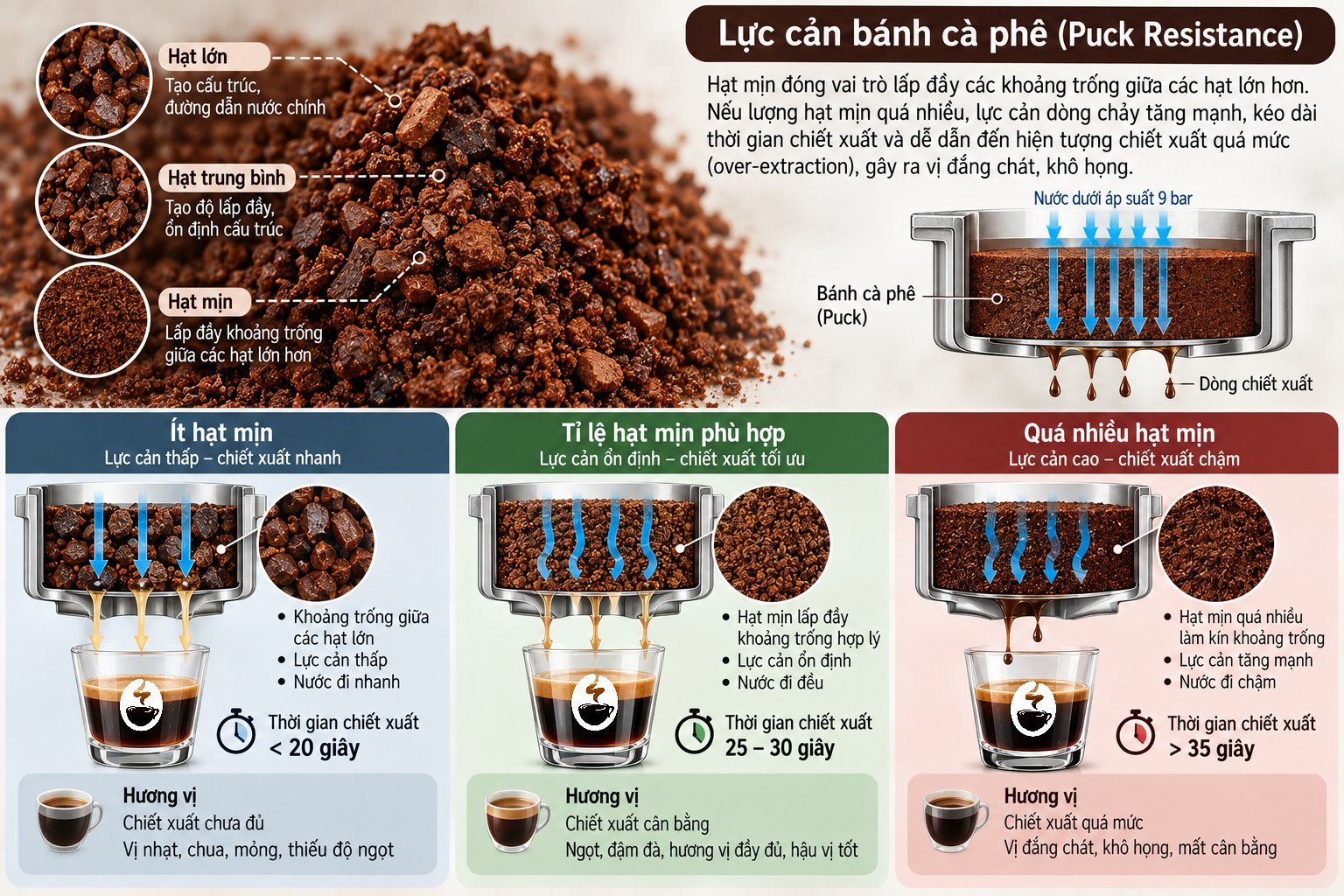
- Puck Resistance: Fines fill the voids between larger particles. If there are too many fines, flow resistance increases significantly, prolonging extraction time and easily leading to over-extraction, resulting in bitter, astringent, and drying flavors.
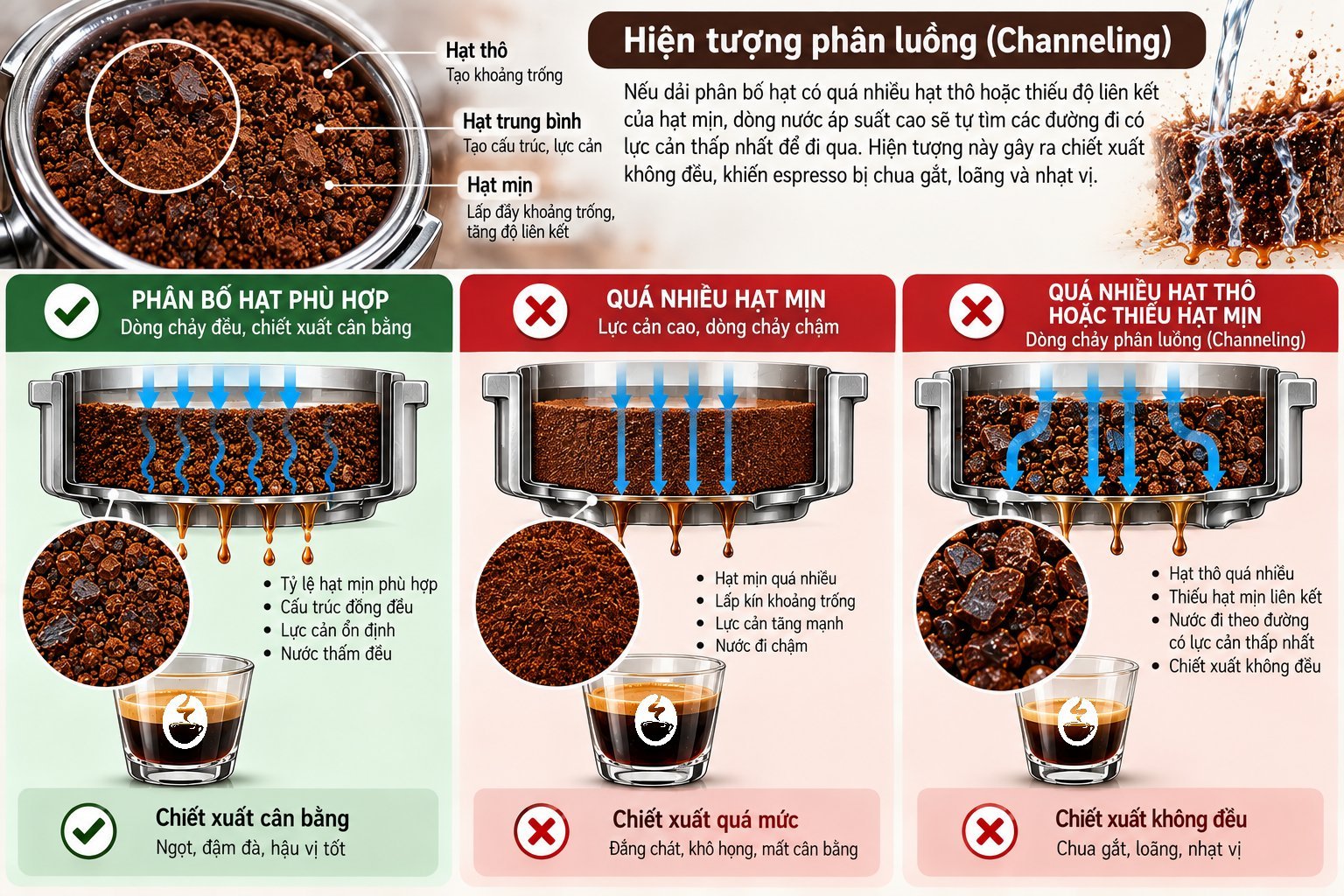
- Channeling: Conversely, if the particle size distribution contains too many coarse particles or lacks sufficient fines to ensure cohesion, high-pressure water will seek out paths of least resistance. This phenomenon leads to uneven extraction, resulting in espresso that is sharply sour, watery, and weak in flavor.
Understanding the geometric characteristics of each burr type enables baristas and product development specialists to select optimal equipment, precisely control extraction rate, and accurately shape the desired flavor profile for the target espresso.