
Fines in espresso: The minor component that determines the resistance of the coffee puck
When adjusting an espresso grinder, many baristas focus on one factor: fine or coarse grind. However, two batches of coffee with the same median particle size can still yield very different extraction times.
The cause may lie in the particle size distribution, particularly the proportion of extremely small particles known as fines. Although smaller than most other particles, they significantly influence the permeability of the coffee puck and the flow rate during espresso brewing.
This is why looking solely at the grinder setting or an average micron value is insufficient to fully assess the characteristics of the coffee grounds.
1. What are fines?
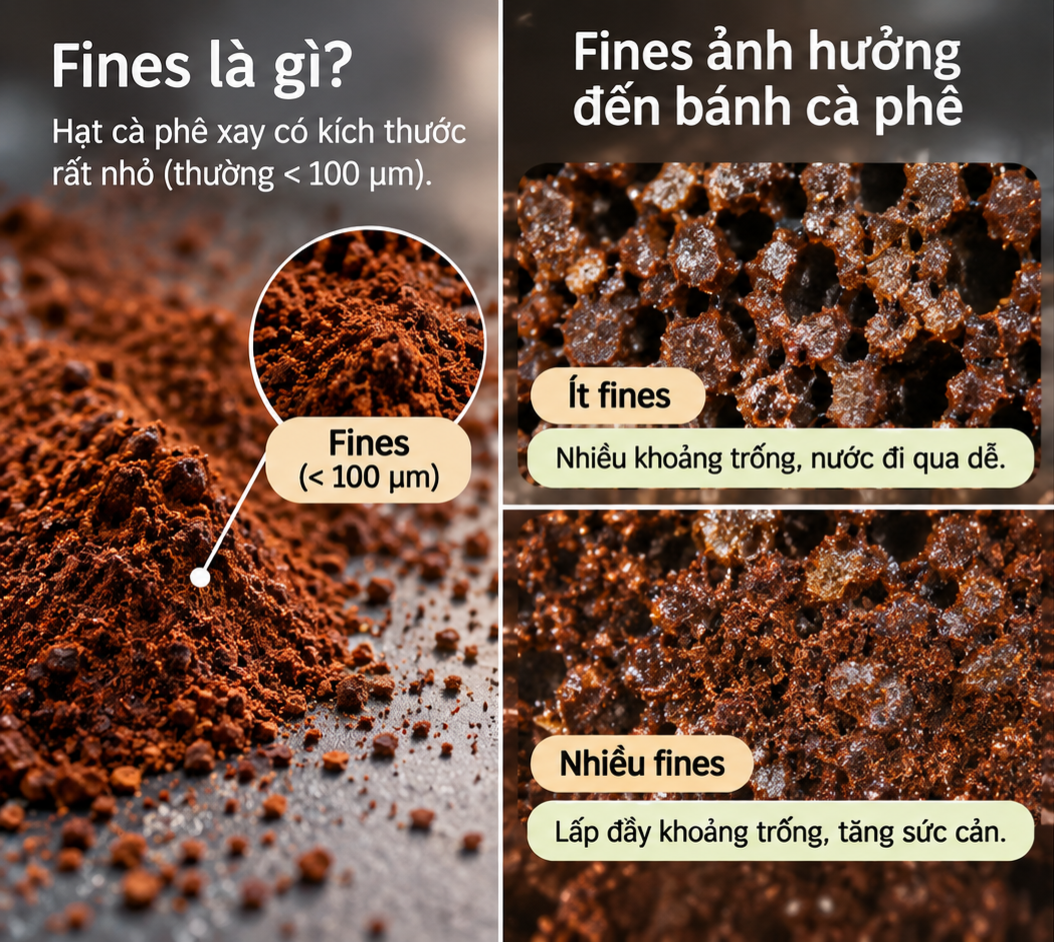
Fines are a group of very small coffee particles. In a 2024 study by Smrke et al., the authors used a threshold of below 100 µm to define the volume fraction of fines.
Espresso grounds typically exhibit a bimodal particle size distribution: a primary group of larger particles and a secondary group of smaller particles constituting the fines.
These two groups do not necessarily appear in equal proportions. The proportion of fines varies depending on the grinder type, burr geometry, raw material, roast level, and operating conditions.
Q100 = (Thể tích hạt có kích thước dưới 100 µm / Tổng thể tích hạt) × 100%
This representation follows the research method cited at the end of the article. Volume fraction should not be equated with mass fraction, as these two quantities are not necessarily equal.
2. Why can a small amount of fines slow down the flow?
Imagine the coffee puck in the basket as a layer of material composed of particles of varying sizes. Voids between the particles allow water to pass through.
As the proportion of fines increases, the small particles can fill some of the voids between the larger particles. This structure reduces the permeability of the powder bed. Under the same pressure conditions, water flows through the coffee puck more slowly.
This describes the relationship between particle size distribution and the hydraulic resistance of the coffee puck.
3. What do empirical studies show?
In the study The role of fines in espresso extraction dynamics, Smrke, Eiermann, and Yeretzian investigated the impact of particle size distribution on the espresso extraction process.
The research team used single-origin Arabica coffee from Costa Rica, processed using the pulped natural method. Each brew used 20 g of coffee, 9 bar of pressure, and yielded 40 g of beverage. Samples were prepared with different particle sizes and supplemented with screened fines to alter the particle distribution.
The monitored indicators included:
- Beverage weight over time.
- Extraction time.
- TDS of the beverage.
- Extraction yield.
- Volatile compound signals measured by PTR-MS.
- Sensory evaluation of espresso samples.
The results show that an increase in fines ratio reduces the coffee bed's permeability, slows down the flow rate, and prolongs the extraction time. Statistical models also show that both fines ratio and particle size contribute to predicting extraction time.
4. Why is the median particle size not enough?
The median particle size (X50) indicates the value at which half of the volume distribution lies below and half above, as determined by the measurement method.
However, X50 does not provide the entire distribution shape. Two powder samples with the same X50 can still have:
- Different fines ratios.
- Different distribution widths.
- Different particle densities of the main particles.
- Different levels of coarse particle occurrence.
Therefore, using a single number to represent coffee powder may overlook important information about permeability and flow.
5. Do fines make espresso less good?
It is not possible to conclude that only from the fines ratio.
A notable point in the 2024 study is that the authors did not observe a decrease in sensory scores when increasing the fines ratio in the experimental conditions. Two samples with 1 g and 2 g fines even fell into the group with high sensory scores.
However, the sensory evaluation in the study was performed by an experienced taster. This is not an experiment with a large sensory panel, multiple coffee varieties, and various roast profiles.
Therefore, this result only shows that fines are not inherently a harmful component for espresso quality. It does not prove that increasing fines always makes coffee better.
6. Applications when adjusting the grinder and dialing in espresso
In a real barista setting, when espresso flows slowly, do not immediately conclude that the grinder is grinding too fine. Consider simultaneously:
- The amount of coffee powder in the basket.
- The particle size and distribution after grinding.
- The way the powder is distributed and compressed.
- The type of basket and the condition of the filter mesh.
- Pressure, temperature, and water flow settings.
- The age of the roasted coffee and storage conditions.
A simple testing procedure is to keep the amount, yield ratio, temperature, and puck preparation operation constant. Then, change one factor, record the time, drink volume, and sensory score.
If you have a particle size analyzer, you can also record X50 and Q100 to compare between grinders or maintenance of the grinding blade. If not, understand that the grinder adjustment is only the operating parameter of the device, not a direct measurement of particle size distribution.
7. Treat fines as a technical variable, not a defect to be eliminated
Fines are a natural part of the grinding process. The issue is not eliminating all fine particles, but understanding how their proportion and characteristics affect the coffee puck.
For espresso, extraction quality results from the interaction between particle size distribution, permeability, pressure, flow rate, time, and raw material characteristics. A good profile is not determined by a single micron figure.
To achieve consistent espresso control, baristas need to observe both the coffee grounds and the actual flow within the basket, then confirm with sensory evaluation.
References
- Smrke, S., Eiermann, A., & Yeretzian, C. (2024). The role of fines in espresso extraction dynamics. Scientific Reports, 14, 5612. https://doi.org/10.1038/s41598-024-55831-x
- Full text of the study on PubMed Central: The role of fines in espresso extraction dynamics.