
Filtration mechanism of RO membranes and UV lamps in water treatment systems
In professional coffee shops, RO water treatment systems are installed for two main purposes: preventing calcium scale buildup in espresso machine boilers and completely removing impurities and off-flavors from tap water.
Operating principle of reverse osmosis (RO) membranes
RO membranes operate by forcing water under high pressure through a semi-permeable membrane with extremely small pore sizes (approximately 0.0001 micron). This process retains most dissolved solids, heavy metals, bacteria, and specifically divalent mineral ions such as Magnesium (Mg2+) and Calcium (Ca2+), along with alkaline anions like Bicarbonate (HCO3-).
The result of RO filtration is reducing the Total Dissolved Solids (TDS) level to extremely low values, typically below 10–20 ppm. This water source has very high chemical purity, helping to absolutely protect coffee machines from limescale buildup (a problem that causes pipe clogging and reduces boiler heat transfer efficiency).
Supporting role of ultraviolet (UV) lamps
Ultraviolet (UV) lamps are usually integrated at the final stage of the RO water treatment system. UV lamps work by emitting short-wavelength electromagnetic radiation to break down the DNA/RNA structure of microorganisms, including bacteria, viruses, and mold spores.
It should be noted that UV lamps only have a physical sterilization function to ensure absolute biological safety for direct drinking water. The UV irradiation process does not change the mineral ion content, does not affect dissolved solids, and does not alter the pH value or hardness of the water.
Why does pure RO water cause under-extraction?
Although RO water is extremely safe for equipment, directly using water with TDS < 20 ppm for coffee brewing is a major technical error. This overly pure water state leads to under-extraction and negatively alters the sensory profile of the coffee cup.
Elimination of ion binding kinetics
Coffee extraction is not merely mechanical dissolution but a selective chemical interaction between ions in the water and organic compounds in the coffee grounds. Water chemistry studies (notably the works of Professor Christopher Hendon and materials from the Espresso Academy) indicate that:
- Magnesium Ion (Mg2+): Has a very strong binding affinity for oxygen-rich flavor compounds, especially those creating bright fruit flavors and volatile acid groups.
- Calcium Ion (Ca2+): Binds well with heavier compounds, helping to highlight warm notes such as chocolate and caramel, and enhancing the body of the coffee cup.
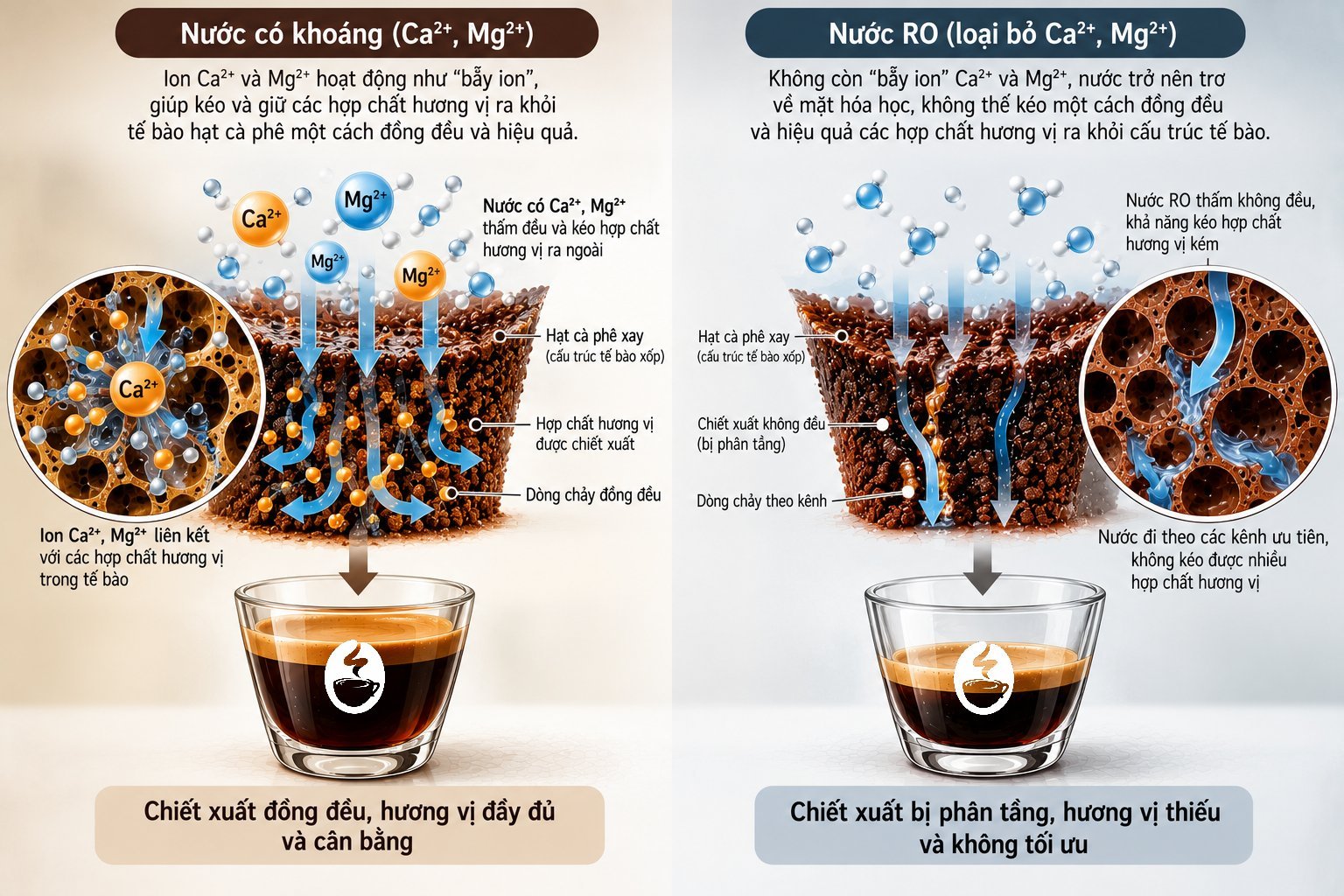
When the RO membrane completely removes Mg2+ and Ca2+ cations, the water becomes chemically inert. Lacking these "ion traps," water cannot uniformly and effectively pull flavor compounds out of the coffee bean cell structure, causing the extraction flow to become stratified and suboptimal.
Loss of pH buffering capacity
In addition to cation deficiency, RO water also lacks alkaline ions (primarily HCO3-). Bicarbonate ions act as a pH buffer, tasked with neutralizing some of the weak organic acids in coffee (such as citric acid, malic acid, and chlorogenic acid).
Without pH buffering, the acidity in the coffee cup is unbalanced, leading to sharp, pointed acidity lacking smoothness, and a shortened aftertaste, resulting in a bland and flat sensation.
---
Standardized remineralization solution for specialty coffee
To resolve the conflict between equipment protection and optimizing extraction efficiency, water after passing through the RO and UV system must undergo remineralization or technical blending before being fed into the brewing machine.
Recommended brewing water standards from the SCA
The Specialty Coffee Association (SCA) has established ideal water standards for cupping and professional brewing:
- Total Dissolved Solids (TDS): 75 – 250 ppm (ideally around 150 ppm).
- Total Hardness: 50 – 175 ppm CaCO3 (to ensure sufficient Ca2+ and Mg2+ levels).
- Alkalinity: Approximately 40 – 75 ppm CaCO3 (to maintain stable pH buffering capacity).
- pH: Within the range of 6.5 – 7.5.
Practical remineralization methods
Two common methods currently applied in third-wave coffee shops:
- Bypass Blending: A portion of pre-filtered water (retaining natural minerals while removing chlorine and odors) is blended back with pure RO water at a pre-calculated ratio via a bypass valve to achieve the target TDS level.
- Active mineral dosing system: Uses specialized remineralization cartridges or precise mechanical liquid mineral dosing systems (such as LiquidRock technology). This method allows for precise control of the Mg2+:Ca2+ ratio (often favoring a higher magnesium ratio to optimize fruit-forward flavors) without concern for unwanted impurities from inadequately filtered water sources.