
How does a coffee grinder work? From grinding mechanism to extraction potential
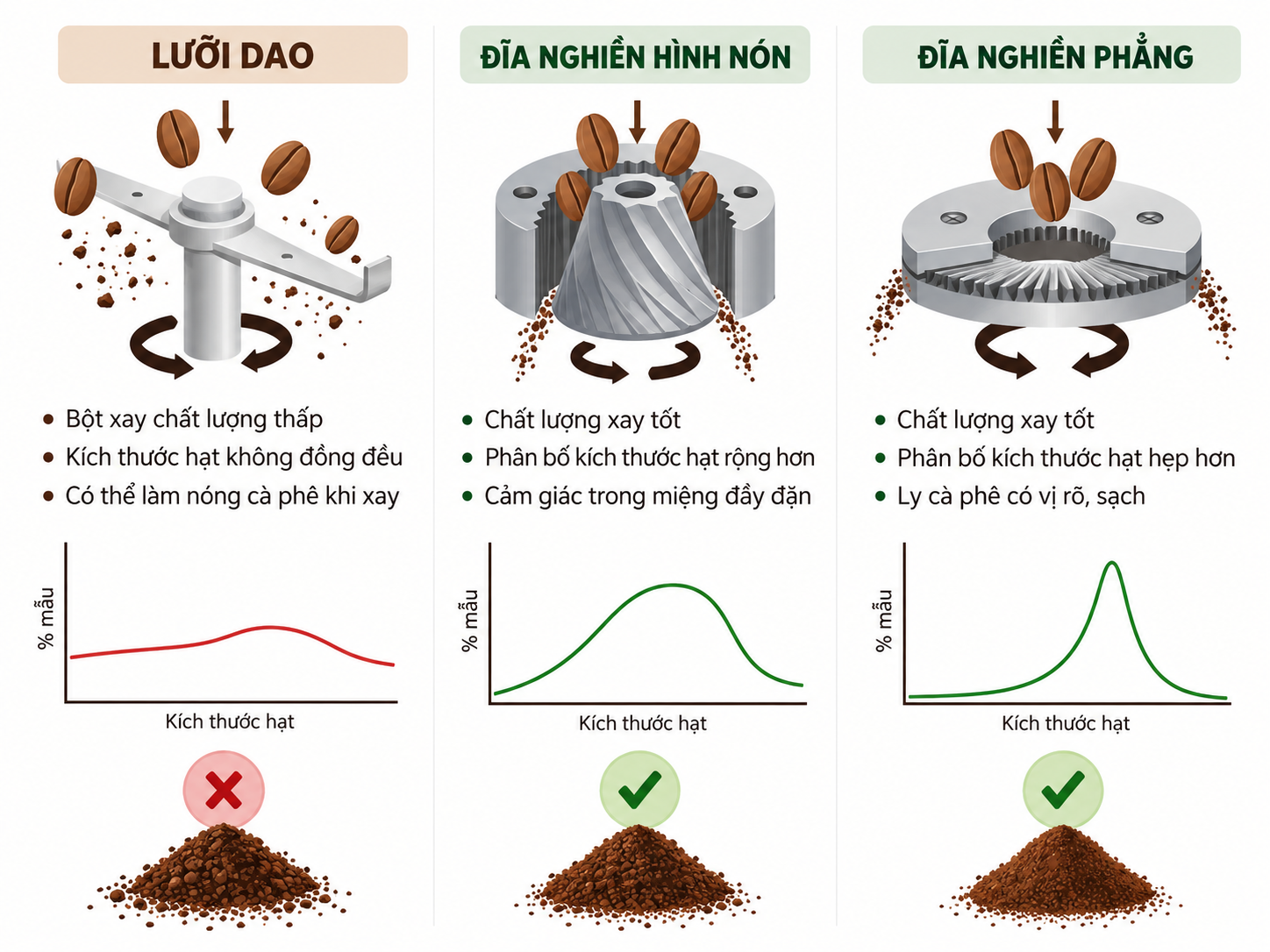
In brewing, we often adjust grind fineness when coffee flows too fast, extracts too slowly, or the flavor is unbalanced. But behind the simple act of turning the adjustment dial lies a more complex issue: how has the grinder transformed roasted coffee beans into a population of particles with specific sizes?
A batch of ground coffee never consists solely of identical particles. Alongside the main particle size group, there are usually larger fragments and very fine particles. The ratio between these groups affects the surface area in contact with water, the permeability of the coffee bed, and the progression of extraction.
To understand this, let us start with the structure of the grinding burrs.
1. Three grinding mechanisms, three ways of breaking particles
The fundamental difference lies in how the coffee beans are impacted. Blade grinders primarily use impact and cutting; burr grinders pass beans through surfaces with grinding teeth and narrow gaps. However, the shape of the burr set is only part of the system: rotation speed, tooth geometry, grinding gap, and grounds exit path also affect the outcome.
Two types of burr grinders—conical and flat—typically allow for more systematic control over grind fineness than blade grinders. However, overall grinding quality cannot be assessed based solely on burr shape.
2. After grinding, coffee grounds do not have a single uniform size
To describe coffee grounds more accurately, researchers use the concept of Particle Size Distribution (PSD). PSD indicates the amount of particles within different size ranges, rather than providing just a single average fineness value.
A broad curve indicates that particle sizes are dispersed over a wider range. A curve with two peaks may suggest two significant concentrations of particle sizes. A more concentrated curve indicates that most of the sample falls within a narrower size range.
This is an interpretation of distribution shape, not a ranking of grinders. To determine which grinder actually produces more uniform grounds, samples generated under defined conditions must be measured.
Two samples with the same median particle size can still differ in their proportion of very fine particles, proportion of large particles, and overall distribution shape. Therefore, citing a single number such as “fineness 500 µm” may not fully describe the characteristics of the ground sample.
3. Fines: the group of small particles that can alter flow
Fines is the term used for very fine powder particles. In some espresso studies, the particle group under 100 µm is examined; this threshold depends on the definition and measurement method of each study and is not the sole boundary for all brewing methods.
Due to their small size, fines have a large surface area relative to their mass. When located in the voids between larger particles, they can alter the pore structure and flow resistance of the coffee bed.
When fines alter the pathways within the coffee bed, flow resistance may increase. In espresso, this may manifest as reduced flow rate or longer extraction time. However, results cannot be predicted solely from the amount of fines: dose distribution, tamping pressure, basket geometry, roast level, and pressure also play decisive roles.
Fine particles also participate in the extraction process. The goal is to find a particle size distribution suitable for the brewing method and achieve consistent results, rather than assuming that fewer fines always result in better-tasting coffee.
4. Why does the grinder affect flavor?
Particle size affects the contact area between coffee and water. When other conditions are equivalent, smaller particles generally have a larger surface area per unit mass than larger particles. However, extraction is not merely a matter of surface area: water must access that surface and move through the coffee bed structure.
Kích thước và tỷ lệ fines
Lỗ rỗng và sức cản
Dòng chảy và hòa tan
This is a chain of relationships to understand the mechanism, not an absolute one-way relationship. In practical brewing, factors interact with each other; changing grind fineness can simultaneously alter time, flow, and the amount of dissolved solids in the beverage.
Conical burrs for body, flat burrs for clarity?
In the specialty coffee community, baristas often describe certain conical-burr grinders as imparting a fuller body, while some flat-burr grinders make flavor notes more distinct. These observations can be useful when describing experiences, but they are not universal rules applicable to all grinders.
To verify a claim about flavor, specific grinders must be compared using the same beans, roast level, brew recipe, and cupping conditions. It is also important to note that the same grind setting on two different grinders does not mean the two samples have the same particle size distribution (PSD).
Flat burrs do not inherently produce a narrower particle size distribution than conical burrs. The result depends on burr geometry, grinder design, speed, assembly precision, burr condition, and adjustment settings.
5. Choose a grinder based on your brewing needs
If brewing with a phin or French press: prioritize the ability to adjust to the appropriate grind range, consistency between grinds, and ease of cleaning. It is not necessary to buy the most expensive machine if your needs do not require a high level of control.
If brewing filter coffee: focus on the ability to adjust fineness, grind consistency, and results in actual brew recipes. Do not judge solely by whether the grounds look good or have little visible fines.
If brewing espresso: fine adjustment capability, repeatability, and flow control are often more important than whether the grinder uses conical or flat burrs. A good grinder should be evaluated within the entire system, including the grinder, basket, dose distribution method, and espresso machine.
6. A simple test to evaluate a grinder
If you want to compare two grinders, design the test so that observed differences primarily stem from the grinder, rather than from multiple variables changing simultaneously.
- Use the same batch of coffee, same roast level, and storage conditions.
- Select an appropriate grind size for the same brewing method; do not compare the numbers on the adjustment dials between the two grinders.
- Weigh the same amount of coffee and use the same brew recipe, water source, and temperature.
- Record brew time, flow dynamics, and TDS if measurement equipment is available.
- Conduct blind tastings and repeat multiple times before drawing conclusions about body, flavor clarity, or balance.
If PSD measurement is required, sieves or appropriate particle size analysis equipment can be used. The method and sampling conditions must be clearly stated, as different measurement techniques may yield non-equivalent results.
Key considerations when evaluating a grinder
A grinder determines not only how fine the coffee grounds are. It also contributes to determining the particle size distribution and the structure of the coffee bed during brewing. However, no burr shape automatically guarantees a better cup of coffee in every situation.
The most reliable evaluation method combines an understanding of grinding mechanics, observation of PSD when measurement is possible, control of the brewing process, and repeated cupping. This approach shifts grinder selection from subjective impression to a verifiable process.
Read more about coffee science, roasting, and extraction at SAVINA Coffee Knowledge to better understand the relationship between ingredients, equipment, and beverage quality.
References
- Uman, E. et al. (2016). “The effect of bean origin and temperature on grinding roasted coffee.” Scientific Reports, 6, 24483. https://doi.org/10.1038/srep24483.
- “The role of fines in espresso extraction dynamics” — a study on the influence of fines on permeability and espresso extraction kinetics. Full text on PubMed Central.
- von Blittersdorff, M. & Klatt, C. (2017). “The Grind—Particles and Particularities.” In The Craft and Science of Coffee, Elsevier. https://doi.org/10.1016/B978-0-12-803520-7.00013-X.
Note: The diagrams in this article illustrate principles and are not technical drawings of a specific grinder model or experimental PSD data.