
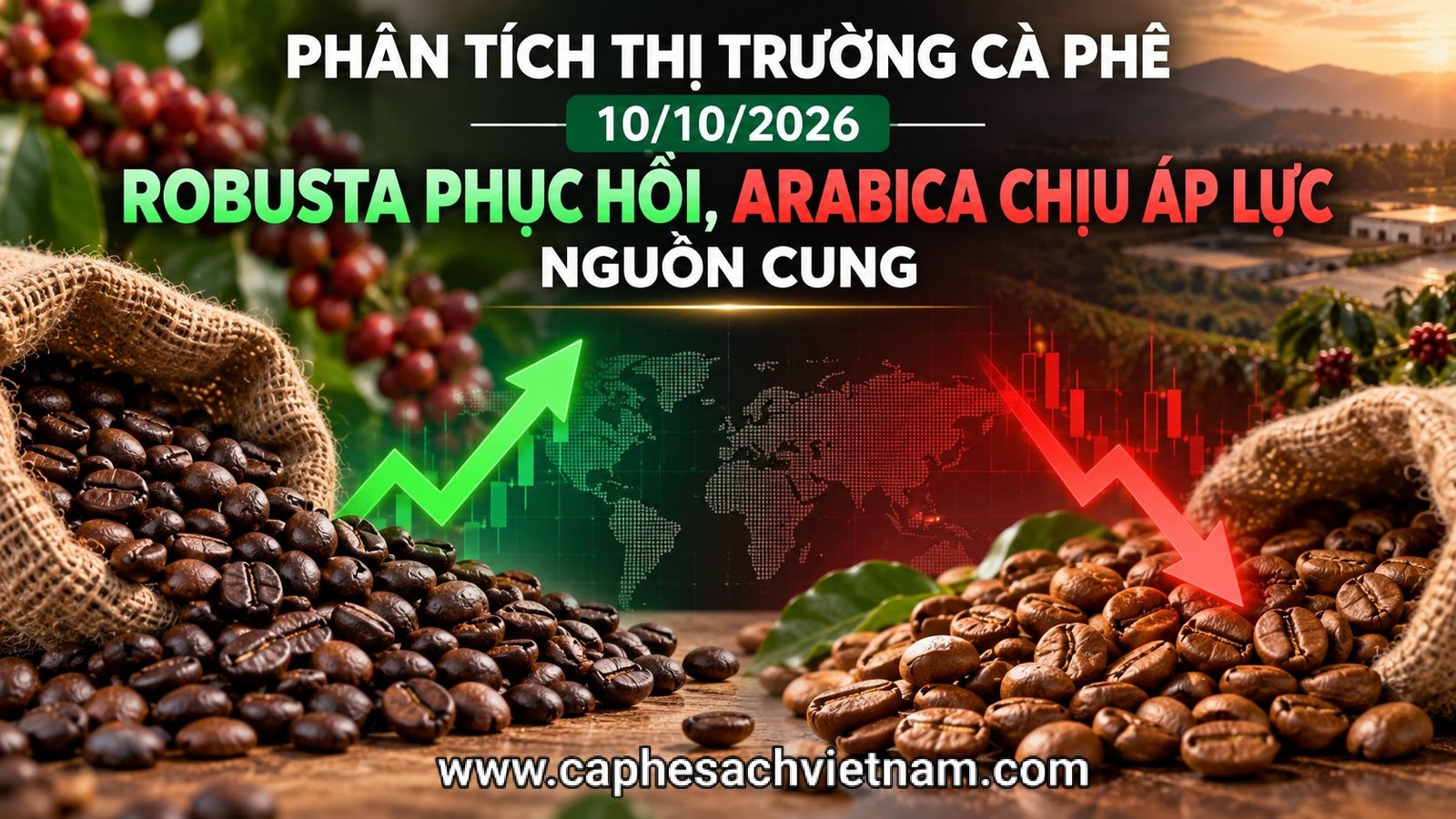
Coffee market analysis for 10/10/2026: Robusta recovers, Arabica under supply pressure
The global coffee market closed the trading week with divergent trends between the two main coffee varieties. London Robusta rose by $47/tonne as ICE-monitored inventories fell to 5,115 lots. Conversely, Arabica faced pressure from Brazil's supply outlook, profit-taking activities, and increased export volumes. In Vietnam, Central Highlands bulk green coffee prices were recorded at around VND 92,200–93,000/kg as the market prepares to enter the new harvest season.
Publication date: 10/10/2026 | Analysis period: trading session on 09/10/2026
- Robusta was supported by the shrinkage of deliverable inventories at ICE.
- Arabica faced pressure from Brazilian supply and profit-taking, but price prospects remain dependent on weather, exchange rates, and actual demand.
- Domestic coffee prices do not necessarily fluctuate in proportion to futures prices, as they are also influenced by the USD/VND exchange rate, export differentials, bean quality, and local supply and demand conditions.
1. Global coffee market overview
A notable feature of the analyzed trading session was the divergence between Robusta and Arabica. This trend indicates that the market is not only reacting to general global coffee supply and demand prospects but is also pricing in specific factors unique to each variety.
For Robusta, the decline in ICE inventories has heightened attention on the ability to meet short-term delivery demand. For Arabica, export prospects and shipment volumes from Brazil remain key variables influencing supply expectations.
| Market | Contract | Quoted Price | Movement |
|---|---|---|---|
| London – Robusta | November 2026 | $3,470/tonne | +$47/tonne (+1.37%) |
| New York – Arabica | December 2026 | 286.95 US cents/lb | -1,35% |
| Brazil – Arabica B3 | December 2026 | $350/60 kg bag | -1,10% |
| Central Highlands – bulk green coffee | Domestic market | VND 92,200–93,000/kg | Fluctuates according to domestic supply and demand |
Note: The prices in the table are aggregated from input data. Please cross-reference with the official settlement statement, particularly regarding Arabica price fluctuations and the B3 contract listing unit, before publishing as confirmed figures.
2. London Exchange: Robusta rises 1.37% as ICE inventories decline
2.1. Price movements and the role of inventories
November 2026 Robusta futures on ICE Futures Europe were quoted at USD 3,470/tonne, up USD 47/tonne, equivalent to 1.37%. A notable driver was the decline in ICE-monitored inventories to 5,115 lots, the lowest level in approximately two and a half weeks according to available market information.
Certified inventory refers to coffee meeting the exchange’s standards and delivery conditions. When inventories decline, the availability of deliverable-grade coffee may become more constrained, thereby supporting short-term futures prices, especially when delivery demand increases.
However, it is essential to distinguish certified inventory from total global physical coffee stocks. ICE inventory data does not reflect all coffee held in private warehouses, in producing countries, or in transit. Therefore, while declining inventories are a supportive price signal, they are insufficient to conclude that there is a global supply shortage.
2.2. Why can Robusta rise even as the market faces the new harvest?
Futures prices are formed by the balance between current supply and demand and future expectations. In the short term, a reduction in deliverable-grade stocks can provide support even as new supply approaches.
For Robusta, key factors to monitor include:
- ICE Inventories: the rate of decline or recovery in inventory levels helps assess the tightness of deliverable supply.
- Vietnam Harvest Progress: the volume of new coffee entering the market may alter exporters’ ability to fulfill orders.
- Roasting Demand: demand for Robusta in blends, instant coffee, and price-sensitive segments affects actual purchasing power.
- Price Differentials and Delivery Costs: futures prices must be considered in relation to physical coffee prices, quality, and logistics costs.
Therefore, the rise in Robusta should be viewed as a notable recovery signal rather than confirmation of a sustainable uptrend. The sustainability of this momentum will depend on whether inventories continue to decline and whether buying pressure is strong enough to absorb new supply.
3. New York Exchange: Arabica under pressure from Brazil’s supply outlook
3.1. Profit-taking and supply expectations
December 2026 Arabica futures on ICE Futures US were quoted at 286.95 US cents/lb, down 1.35%. The decline is attributed to profit-taking by investment funds combined with a relatively positive outlook for Brazil’s supply.
Profit-taking typically occurs when investors close profitable positions after a period of price increases. When this selling pressure coincides with favorable supply news, prices may face stronger downward pressure. However, a single session of price declines does not confirm that funds have reversed their long-term views; further monitoring of trading volumes and position data is required when available.
3.2. Brazil and the impact of export flows
Brazil is one of the most influential sources of supply for the Arabica market. As harvesting concludes in many regions and volumes enter the export system, the market may adjust its expectations regarding short-term scarcity.
Export data requires careful analysis. Increased export volumes may reflect available stock, delivery progress, or the release of previous inventories; these figures alone do not automatically prove that the new crop yield will exceed forecasts. A comprehensive assessment requires cross-referencing estimated production, inventories, delivery schedules, and import demand.
Therefore, pressure from Brazil may limit Arabica's upward momentum if the market continues to receive favorable supply information. Conversely, weather risks in key growing regions, fluctuations in the Brazilian real exchange rate, or quality and logistics issues could still alter investor expectations.
3.3. Why are Arabica and Robusta moving in opposite directions?
The two coffee varieties are linked through roasting demand and substitutability in blends, but their supply and demand dynamics are not entirely identical. Robusta may be supported by declining deliverable stocks, while Arabica faces pressure from supply prospects in Brazil.
This divergence also reflects differences in quality, consumption segments, production origins, and position structures in each futures market. Therefore, one should not infer that a rise in Robusta prices means the entire coffee market is entering an uptrend, or that a decline in Arabica prices indicates weakening global coffee demand.
4. The Brazilian coffee market: Distinguishing between futures prices and physical prices
The quoted December 2026 Arabica B3 futures price is 350 USD per 60 kg bag, down 1.10%. When using this data for analysis, it is necessary to confirm the quoting unit, contract type, and currency conversion method of the data source. Brazilian futures prices should not be directly compared with farmgate purchase prices or export prices unless trading conditions are standardized.
For the Brazilian market, three data groups are particularly significant:
- Physical supply: actual production volume, producer inventories, and volumes ready for export.
- Brazilian real exchange rate: fluctuations in the Brazilian currency against the USD can affect producers' incentives to sell for export.
- International demand: import pace, delivery schedules, and roaster demand can change the price levels accepted by the market.
Consequently, assessing Arabica prospects requires combining futures price data with physical market information, rather than relying solely on a single session's decline.
5. Domestic coffee prices: Central Highlands fluctuating at 92,200–93,000 VND/kg
5.1. What factors influence domestic prices?
Green bean prices in the Central Highlands provinces are quoted in the range of 92,200–93,000 VND/kg. This serves as a reference input level, not a uniform quote for all localities, grades, or trading conditions.
Domestic purchase prices are influenced by London Robusta futures, the USD/VND exchange rate, Vietnam coffee differentials in the export market, transportation costs, commodity quality and moisture content, as well as actual purchasing demand from enterprises.
This relationship can be described generally as follows:
5.2. Market sentiment ahead of the new harvest
The pre-harvest period often creates tension between sellers and buyers. Sellers may weigh cash flow needs, production costs, and price expectations; while buying companies focus on new crop progress, quality, delivery schedules, and contract fulfillment capacity.
If new supply enters the market quickly, selling pressure may increase, making it difficult for domestic prices to rise sharply, especially when futures prices weaken. Conversely, if farmers sell slowly, weather affects harvesting, or delivery demand increases, domestic prices may hold firmer relative to futures market movements.
Therefore, the 92,200–93,000 VND/kg price range should be monitored alongside the actual volume offered for sale each day. Observing quoted prices without assessing transaction volumes makes it difficult to determine whether the market is experiencing a shortage or merely a waiting phase.
6. Three scenarios to monitor in upcoming sessions
Scenario 1: Robusta continues to find support
If ICE inventories continue to decline, buying interest for delivery remains sustained, and new supply does not create significant selling pressure, Robusta may maintain a stronger price floor. In that case, domestic prices could receive support, depending on exchange rates, export differentials, and sales volumes in the Central Highlands.
Scenario 2: New supply exerts pressure on prices
If volumes from the new crop increase rapidly, buying companies do not actively expand positions, and futures prices remain under pressure, the domestic market may experience corrective phases. The extent of the decline will depend on selling speed, export demand, and market absorption capacity.
Scenario 3: Prolonged market divergence
If Robusta inventories remain low while the Arabica supply outlook remains favorable, the two coffee types may continue to move in opposite directions. In this case, each market should be analyzed separately rather than applying a single assessment to the entire coffee industry.
The three scenarios above are possibilities to monitor, not certain forecasts. The probability of each scenario must be updated as new data on prices, inventories, weather, and cargo flows become available.
7. Key indicators for coffee growers and businesses
To assess short-term trends, market participants should simultaneously monitor the following groups of information:
- London Robusta closing prices: determine whether upward momentum is sustained or merely a technical rebound.
- ICE inventories: track consecutive changes rather than drawing conclusions from a single data point.
- New York Arabica prices: assess market reaction to Brazil's supply and demand data and weather factors.
- Harvest progress in Vietnam: observe the actual volume of coffee brought to market, quality, and trading speed.
- Exchange rates and export price differentials: assess the pass-through of international price volatility to domestic purchase prices.
- Corporate delivery demand: distinguish actual purchasing power from fluctuations driven primarily by financial activities in the futures market.
8. Conclusion: Robusta has support, but the coffee market remains risky
Market developments provided for the trading session on 09/10/2026 show that London Robusta recovered due to declining ICE inventories, while Arabica faced pressure from Brazil's supply outlook and profit-taking. This divergence reflects the difference between the immediate deliverable supply status and near-term supply and demand expectations.
For Vietnam, the Central Highlands green coffee price range of 92,200–93,000 VND/kg needs to be viewed in the context of preparing to enter the new harvest season. Prices may be supported if sales volumes are limited, but they may also face pressure when new supply increases or the futures market weakens.
Final assessment: Declining inventories support Robusta, while Brazil's supply outlook pressures Arabica. To identify a sustainable trend, confirmation is needed from subsequent trading sessions, inventory data, export cargo flows, and harvest developments in major producing countries. Coffee growers and businesses should base decisions on costs, cash flow, product quality, and actual trading demand, avoiding decisions based solely on the volatility of a single session.
Note: This article provides market information and analysis, not recommendations to buy or sell futures contracts or commodities. Price and inventory figures should be cross-referenced with official data sources before being used for trading purposes.