
Coffee market analysis on 30/10/2026: Robusta weakens as the new harvest enters its peak
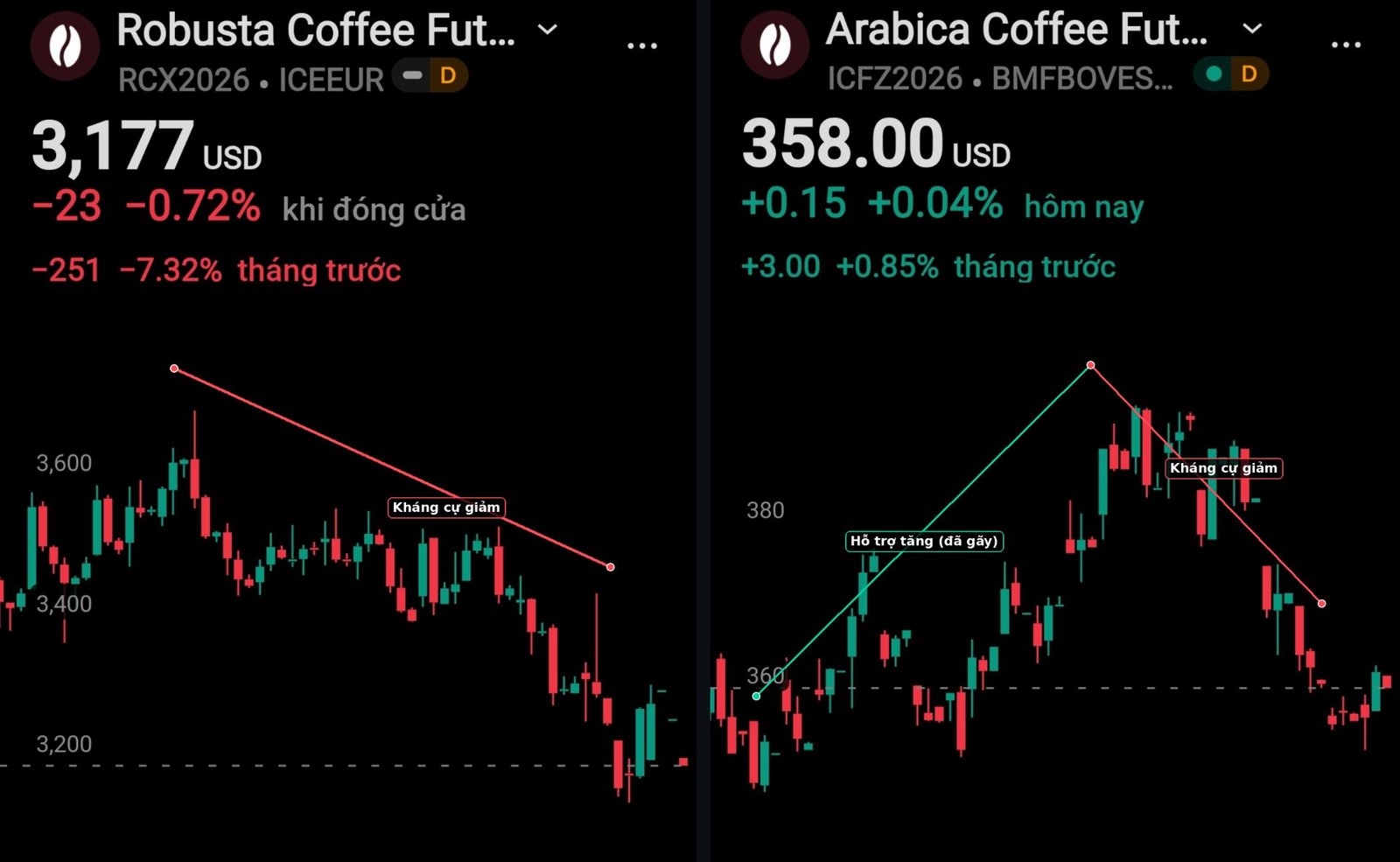
The international coffee market entered the final trading session of October with slight divergence across product lines. London Robusta declined, New York Arabica adjusted, while Brazilian Arabica recorded a small gain. In Vietnam, domestic coffee prices are under pressure from expectations of new-crop supply as harvesting accelerates in the Central Highlands.
The key factor to monitor is not just the decline in a single trading session, but the shift in the balance between remaining old-crop stocks, harvest progress, and near-term procurement demand from businesses.
Price movements on international exchanges
Closing data updated at 06:50 on 30/10/2026 shows:
| Exchange | Contract | Closing price | Change |
|---|---|---|---|
| London – Robusta | 11/2026 | 3,177 USD/tonne | -23 USD (-0.72%) |
| New York – Arabica | 12/2026 | 285.45 cents/lb | -1.30 cents (-0.45%) |
| Brazil – Arabica | 12/2026 | 358.00 USD/60 kg | +0.15 USD (+0.04%) |
Price data source: World coffee price table on 30/10/2026. The above prices are for specified futures contracts, not physical transaction prices in Vietnam.
London Robusta: Supply pressure begins to become evident
The November 2026 Robusta contract closed at 3,177 USD/tonne, down 23 USD from the previous session. Further-out contracts also posted losses: January 2027 at 3,176 USD/tonne and March 2027 at 3,167 USD/tonne.
This development occurred as Vietnam entered its new Robusta harvest season. As supply from the world’s largest producing region begins to reach the market, traders typically adjust their expectations regarding inventory replenishment in the coming months.
However, it is essential to distinguish between supply expectations and the actual volume of coffee that has been harvested, processed, and is ready for delivery. Harvesting pace, weather conditions during drying, bean quality, and farmers’ selling speed can all alter the volume of commercial coffee appearing on the market.
Arabica New York: Adjusted, but long-term trend remains inconclusive
The December 2026 Arabica contract fell by 1.30 cents to 285.45 cents/lb. Meanwhile, the March 2027 and May 2027 contracts rose slightly to 276.75 and 273.00 cents/lb, respectively.
The spread between contract months indicates that the Arabica market should not be interpreted based on a single figure. Near-term contract prices reflect expectations for supply and delivery demand in the short term; deferred contracts reflect expectations for different future periods.
For roasting and exporting businesses, it is essential to monitor forward prices, physical differentials, lot quality, and delivery conditions simultaneously. A decline in futures prices does not mean that all types of green coffee beans decrease by the same amount.
Domestic coffee prices: The new crop is a key variable
According to reference data from October 29, 2026, the average bulk green coffee price in the Central Highlands was around VND 88,400/kg, down VND 700/kg from the previous session. Dak Nong was recorded at approximately VND 88,500/kg, Dak Lak at VND 88,400/kg, Gia Lai at VND 88,300/kg, and Lam Dong at VND 88,000/kg.
Reference source: Coffee price table for October 29, 2026. These are prices published at the time of the source update, not direct trading quotes for all locations, qualities, or volumes.
During the harvest period, actual purchase prices may vary based on cherry ripeness, bean moisture content, defect rate, impurities, processing methods, and delivery capability. Therefore, when assessing the market, businesses should not rely solely on the regional average price.
Three factors to monitor in upcoming sessions
1. Harvest progress and primary processing quality in the Central Highlands
This factor directly affects the volume of new supply entering the market. If harvesting accelerates but weather conditions are unfavorable for drying, the actual supply meeting commercial standards may not increase proportionally to the volume of cherries harvested.
2. Selling pace of households and agents
Price declines may cause some growers to delay sales, while capital needs and harvesting costs create selling pressure for others. This divergence means that the volume offered for sale does not necessarily increase uniformly with harvest progress.
3. Futures contract movements and exchange rates
London Robusta prices, New York Arabica prices, and the USD/VND exchange rate need to be monitored together. For exporting businesses, exchange rate fluctuations can affect converted revenue values, while the spread between futures prices and physical prices determines the competitiveness of each lot.
SAVINA perspective: Do not equate the new crop with oversupply
The decline in Robusta prices during the new harvest period signals that the market is pricing in the possibility of replenished supply. However, a single session of declines is insufficient to conclude that the market has shifted into a state of oversupply.
For a more accurate assessment, it is necessary to continue monitoring the actual volume leaving farms, post-processing bean quality, corporate delivery speeds, and inventory trends on exchanges. If the volume of standard-compliant goods increases rapidly and sellers actively offer stock, price pressure may persist. Conversely, if delivery progress is slow or sales volumes are limited, domestic prices may not decline in line with futures prices.
For purchasing and roasting businesses, priority should be given to checking the quality of each lot, calculating cost basis according to delivery terms, and avoiding buying or selling decisions based solely on intraday fluctuations. For growers, proper sorting, drying, and storage techniques remain crucial to protecting product value during periods of increased supply.
Trend outlook: What to observe in upcoming sessions?
Price movement in a single session is insufficient to confirm a long-term trend. Investors and businesses should observe peak-trough structures, the extent of recovery after declines, and price reactions when approaching key trading zones.
- Downtrend: pay attention if prices continue to form lower highs and lower lows.
- Recovery signal: observe whether prices can break above the most recent peak and sustain levels above the breached zone.
- Trading volume: if data is available, compare volume with price movements to assess market participation.
Do not arbitrarily assign support, resistance, or moving average levels without a sufficient historical data series. Technical indicators are only meaningful when calculated from consistent data corresponding to the correct trading contract.
SAVINA's market perspective
The coffee market is entering a sensitive phase as expectations for the new crop supply begin to influence trading sentiment. However, actual supply depends not only on harvest volume but also on primary processing quality, available inventory ready for sale, and exporters' delivery capacity.
For farmers, it is crucial not to equate reference prices on electronic boards with actual local selling prices. Harvesting at optimal ripeness, along with proper primary processing and storage, can help preserve lot value even when market conditions move unfavorably.
For dealers and purchasing companies, cost basis should be determined by combining floor prices, exchange rates, differentials, product quality, and delivery schedules. Trading based on intuition or relying solely on single-session price fluctuations can increase inventory risk.
SAVINA continues to update domestic and international coffee price developments, analyzing trends by phase to provide readers with additional context for market monitoring.
How to use SAVINA coffee price charts
- 7 days: observe short-term fluctuations and price reactions in recent sessions.
- 30 days: identify monthly trends, notable peaks and troughs.
- 90 days: assess the medium-term context, avoiding confusion between short-term corrections and longer-term trends.
- Domestic: track the domestic procurement price chain using SAVINA data.
- Global: monitor futures contracts and their corresponding trading units.
Data sources and notes
Coffee prices may vary depending on update timing, data aggregation sources, and trading conditions. Futures prices are not direct local purchase prices. Trend analyses are for reference only and do not constitute investment advice.