
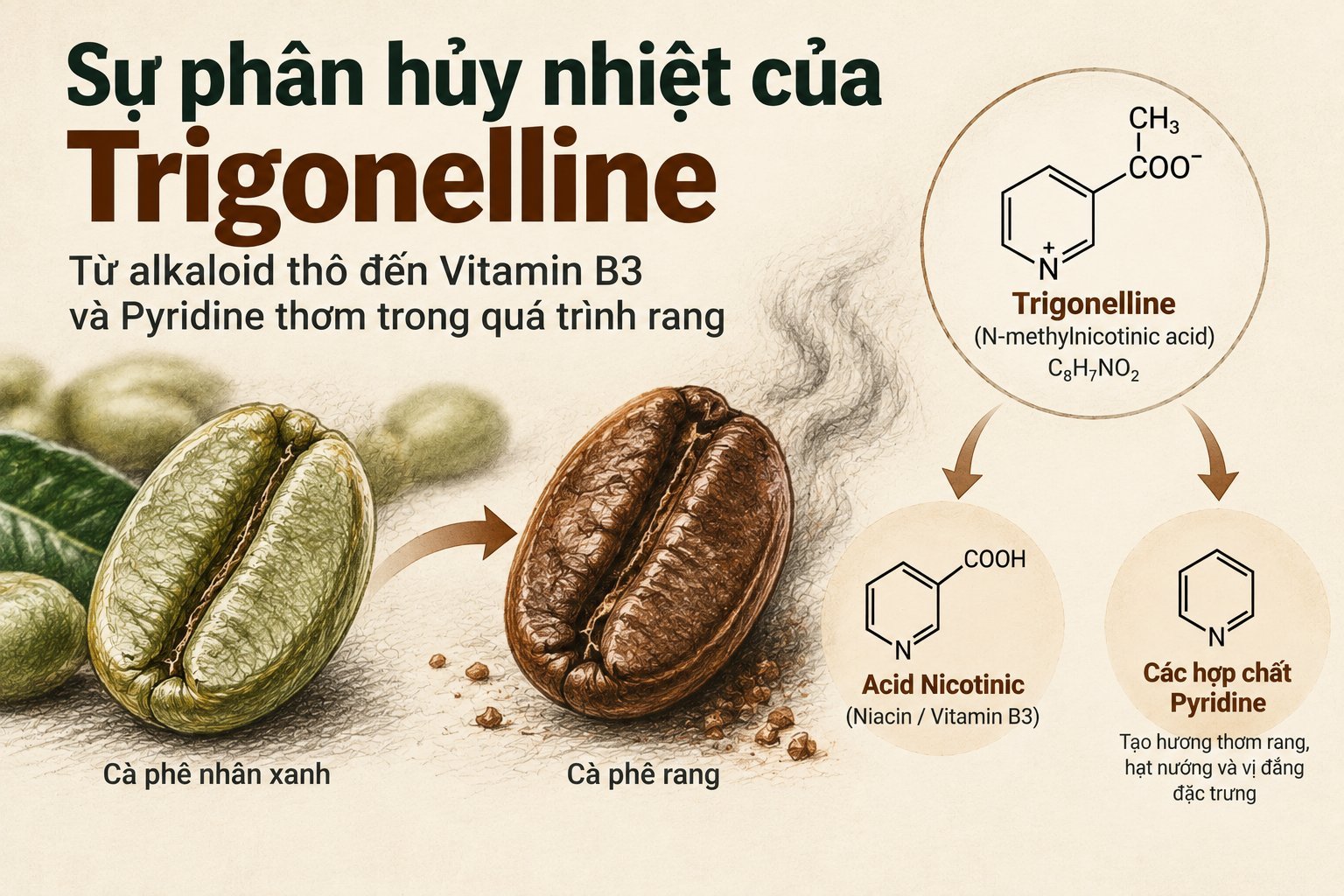
Thermal decomposition of trigonelline: From raw alkaloid to vitamin B3 and aromatic pyridines during roasting
Trigonelline is a natural alkaloid present in green coffee beans. During roasting, this compound degrades and participates in various chemical reactions, forming nicotinic acid, nitrogen-containing compounds, and products associated with roast flavor. Studying trigonelline metabolism helps explain part of the chemical composition changes in coffee beans from their green state to the finished product.
1. Trigonelline in green coffee beans: Structure and content
In the chemical composition of green coffee beans, trigonelline is a nitrogen-containing alkaloid chemically known as N-methylnicotinic acid. Structurally, this compound is formed from nicotinic acid through methylation of the nitrogen atom in the pyridine ring. Trigonelline is one of the notable soluble compounds in coffee beans, alongside caffeine and chlorogenic acids.
Trigonelline content varies by species, variety, growing conditions, fruit maturity, and analytical method. According to a review of coffee chemistry in the NCBI Bookshelf, green Arabica coffee typically contains approximately 0.6–1.3% trigonelline by dry weight; Robusta usually ranges from 0.3–0.9%. These ranges are synthesized from prior research literature and are not limits applicable to every coffee sample.
Trigonelline is water-soluble and can enter the brew during extraction. However, during roasting, this compound is subjected to heat and gradually transforms into other products. Therefore, trigonelline content in roasted beans is generally lower than in green beans, while the overall chemical composition becomes more complex.
From a sensory perspective, trigonelline should be regarded as a chemically significant precursor during roasting, rather than the sole determinant of coffee bitterness or flavor. The characteristics of a cup of coffee also depend on caffeine, chlorogenic acids, Maillard reaction products, volatile compounds, and extraction conditions.
2. Thermal decomposition reactions in coffee: What happens to trigonelline during roasting?
Coffee roasting is a heat treatment process in which multiple chemical reactions occur simultaneously. As the beans absorb heat, components such as sugars, amino acids, chlorogenic acids, and alkaloids change via different reaction pathways. Trigonelline is one of the compounds that significantly decreases as the roast level increases.
A study by Casal, Oliveira, and Ferreira published in Food Chemistry in 2000 investigated trigonelline, nicotinic acid, and caffeine in Arabica and Robusta coffee before and after roasting. Samples were treated at different temperatures in the range of 160–240°C or for different heating times, then analyzed using high-performance liquid chromatography with a diode array detector (HPLC-DAD).
The results showed that trigonelline degradation depended clearly on the roast level and was linked to the formation of nicotinic acid. The study also noted that compounds do not necessarily react in the same way when naturally present in the bean versus when heated in a dry model system. This indicates that the chemical environment of the bean can influence the reaction pathway.
Therefore, 200°C should not be considered a fixed threshold at which trigonelline begins to decompose. Air temperature in the roasting drum, bean surface temperature, and internal bean temperature are not identical. Heating time, heat transfer rate, moisture content, and roast level can all affect the final outcome.
Trigonelline decomposition does not occur via a single reaction alone. Besides demethylation, this compound can participate in other thermal reactions to form nitrogen-containing products, including pyridine and pyridinium derivatives. The proportion of each product depends on reaction conditions and must be determined by chemical analysis.
3. Conversion of trigonelline to nicotinic acid (vitamin B3)
One notable metabolic product of trigonelline is nicotinic acid, also known as niacin or vitamin B3. This form of vitamin B3 participates in the formation of the coenzymes NAD and NADP, playing a role in many cellular oxidation-reduction reactions and energy metabolism.
A study by Taguchi, Sakaguchi, and Shimabayashi, published in 1985 in Agricultural and Biological Chemistry, examined trigonelline content in coffee and its thermal conversion to nicotinic acid. The authors observed that trigonelline could convert to nicotinic acid when heated above 180°C under experimental conditions. The study also showed that the amount of nicotinic acid formed was nutritionally significant, although the conversion efficiency was not high.
It is necessary to distinguish between trigonelline degradation and the amount of niacin formed. Not all degraded trigonelline converts to nicotinic acid. A portion participates in other reaction pathways, producing nitrogen-containing products with different chemical properties.
Therefore, when referring to nicotinic acid in coffee, one should rely on analysis results of specific samples rather than inferring vitamin B3 content solely from roast level. The final content may be influenced by the initial raw material, roasting time and temperature, as well as secondary reactions continuing during heating.
Furthermore, the nicotinic acid content measured in roasted beans is not equivalent to the amount absorbed by the consumer from a cup of coffee. The amount in the beverage depends on the coffee mass used, water ratio, brewing method, and extraction efficiency.
4. Pyridines in coffee: Compounds related to roast flavor
Besides nicotinic acid, trigonelline decomposition produces other nitrogen-containing products. Among these, pyridine and pyridine derivatives are of interest because they may contribute to the aroma characteristics of roasted coffee.
Pyridine is a nitrogen-containing heterocyclic compound. In coffee chemical analysis, this term must be distinguished from pyridine derivatives and other nitrogen-containing heterocyclic compounds. Substances in this group do not share the same volatility, perception thresholds, or impact on aroma and taste.
A study by Arce Vera et al., published in 2002 in Journal of Agricultural and Food Chemistry, investigated the formation of alkylpyridinium compounds when trigonelline undergoes pyrolysis in a model system at approximately 220–250°C. This work provides evidence of non-volatile products formed from trigonelline decomposition under controlled heating conditions.
It should be noted that alkylpyridinium compounds are not synonymous with free pyridine or the entire group of volatile pyridine compounds. They are distinct product groups with different chemical properties and potential roles in coffee.
Certain volatile pyridine derivatives are documented in roasted coffee aroma research and may contribute to roasted odor nuances. However, the entire roasted, nutty, or chocolatey aroma profile cannot be attributed solely to pyridine. Coffee aroma results from multiple compound groups formed via Maillard reactions, sugar degradation, chlorogenic acid transformation, lipid degradation, and other thermal reactions.
Therefore, when analyzing pyridine in coffee, it is necessary to consider the identity of each compound, its concentration, and corresponding sensory data. The mere detection of a compound in a sample does not automatically prove that it is a decisive flavor component in the cup.
5. How does roast level affect trigonelline content?
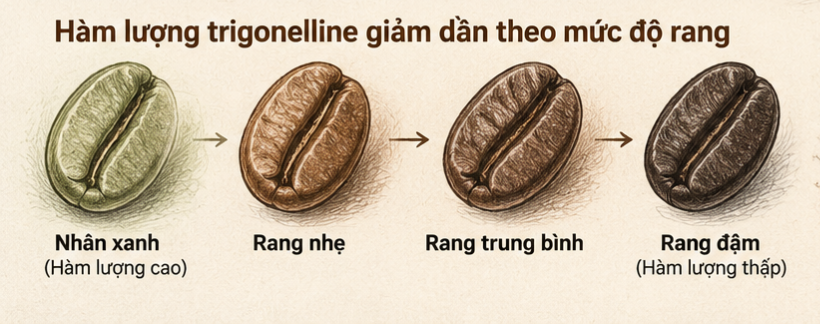
Many studies indicate that trigonelline content typically decreases as roast level increases. However, the rate of reduction is not a constant applicable to all coffee varieties or all roast profiles.
The 2023 overview Risk Assessment of Trigonelline in Coffee and Coffee By-Products synthesizes studies showing that trigonelline degradation depends on time, temperature, and processing methods. The reviewed studies report significantly varying degradation rates; a single rate should not be applied universally to all roast batches.
Two roast batches with the same end temperature can yield different chemical outcomes if they differ in heating rate, development time after first crack, batch size, airflow, or raw material moisture. Bean color is a useful indicator of roast level but cannot replace the measurement of individual compound concentrations.
As roast level increases, residual trigonelline typically decreases, while some metabolites may increase. However, secondary products can also continue to degrade or participate in subsequent reactions. Therefore, the relationship between roast level and the concentration of each compound is not necessarily linear.
To accurately assess this process, roasting curve data must be combined with appropriate chemical analysis methods, such as HPLC-DAD or chromatography techniques coupled with mass spectrometry. This approach allows for distinguishing trigonelline degradation from the actual formation of nicotinic acid and other products.
6. Significance of Trigonelline for Roast Quality Control
Changes in trigonelline content can provide information supporting the assessment of roast level and differences between coffee samples. When measured alongside nicotinic acid and other chemical parameters, trigonelline can help identify changes occurring during thermal processing.
However, this parameter alone is insufficient for a comprehensive assessment of sensory quality. A coffee sample with lower trigonelline content is not inherently better or worse in flavor than another. Final quality also depends on raw materials, processing method, bean structure, roast profile, freshness, and extraction conditions.
For roasters, the appropriate approach is to combine time-temperature data, bean color, weight loss, sensory evaluation, and chemical analysis when needed. This helps determine the relationship between the roasting regime and actual composition, rather than relying on a single temperature threshold.
From molecular changes to cup characteristics
Trigonelline is a prime example of the chemical transformations occurring during coffee roasting. As an alkaloid naturally present in green beans, this compound degrades under heat and participates in various reaction pathways, including the formation of nicotinic acid, pyridine derivatives, and other nitrogen-containing products.
This process demonstrates that coffee roasting is not merely a change in bean color. It is a sequence of reactions dependent on time, temperature, raw material composition, and the internal chemical environment of the bean. Understanding these transformations helps connect chemical data with flavor development, supporting scientifically grounded roast quality control.
References
- Casal, S., Oliveira, M. B., & Ferreira, M. A. (2000). HPLC/diode-array applied to the thermal degradation of trigonelline, nicotinic acid and caffeine in coffee. Food Chemistry, 68(4), 481–485. https://doi.org/10.1016/S0308-8146(99)00228-9
- Taguchi, H., Sakaguchi, M., & Shimabayashi, Y. (1985). Trigonelline Content in Coffee Beans and the Thermal Conversion of Trigonelline into Nicotinic Acid during the Roasting of Coffee Beans. Agricultural and Biological Chemistry, 49(12), 3467–3471. https://doi.org/10.1080/00021369.1985.10867295
- Arce Vera, F., et al. (2002). Alkylpyridiniums. 1. Formation in Model Systems via Thermal Degradation of Trigonelline. Journal of Agricultural and Food Chemistry, 50(5), 1192–1199. https://doi.org/10.1021/jf011234k
- Coffee: Coffee, Tea, Mate, Methylxanthines and Methylglyoxal. NCBI Bookshelf. Overview of coffee chemical composition, trigonelline content, and nicotinic acid formation during roasting. NCBI Bookshelf
- Risk Assessment of Trigonelline in Coffee and Coffee By-Products. (2023). Overview of trigonelline in coffee and the effects of roasting, processing, and brewing. Full text on PubMed Central
- Bioactive compounds in coffee and their role in lowering the risk of major public health consequences: A review. Overview of bioactive compounds in coffee, including trigonelline and its metabolites. Full text on PubMed Central