
Mechanism of thermal decomposition of chlorogenic acid (CGA)
Chlorogenic acid (CGA) is actually a group of ester compounds formed from quinic acid and one or more trans-cinnamic acids (most commonly caffeic acid, p-coumaric acid, and ferulic acid). In green coffee beans, primarily Arabica and Robusta, caffeoylquinic acid (CQA) isomers predominate, accounting for approximately 6-8% of the total dry weight.
When exposed to high temperatures in the roasting chamber, the sensitive ester structure of CGA begins to break down through pyrolysis. This decomposition process releases free quinic acid and caffeic acid. The presence of these free phenolic acids directly governs the mouthfeel and various taste dimensions in an espresso cup, depending on their concentration and conversion ratio.
Transformation of CGA across roast levels
CGA content does not remain constant but decreases linearly with roasting temperature and time. This loss is most pronounced when the beans pass the First Crack stage and move toward darker Roast Levels.
- Light Roast: The coffee has only undergone the initial stage of pyrolysis. At this point, CGA content has decreased by approximately 50% compared to the initial level. The remaining CGA is still relatively abundant, closely interacting with the natural organic acids present in the bean.
- Dark Roast: As the roasting process progresses toward Second Crack, extreme heat decomposes more than 90% of the initial CGA, sometimes leaving only trace amounts. The entire ester structure is completely broken down, giving way to browning reactions (melanoidins) and secondary bitter compounds.
Direct impact on acidity and flavor in Espresso
The degradation and transformation of CGA profoundly affect the sensory characteristics of the finished espresso cup, particularly the balance between acidity, bitterness, and astringency.
Brightness in light roast levels
In light to medium-light roasts, the partially undecomposed CGA combines with natural organic acids present in the bean, such as citric acid, malic acid, and phosphoric acid. This synergy creates a balanced acid structure, delivering the bright, clean, juicy, and vibrant acidity characteristic of an espresso cup. This is a core factor that enhances the rich fruity aromas found in specialty coffees.
Astringency and flavor depth from quinic and caffeic acids
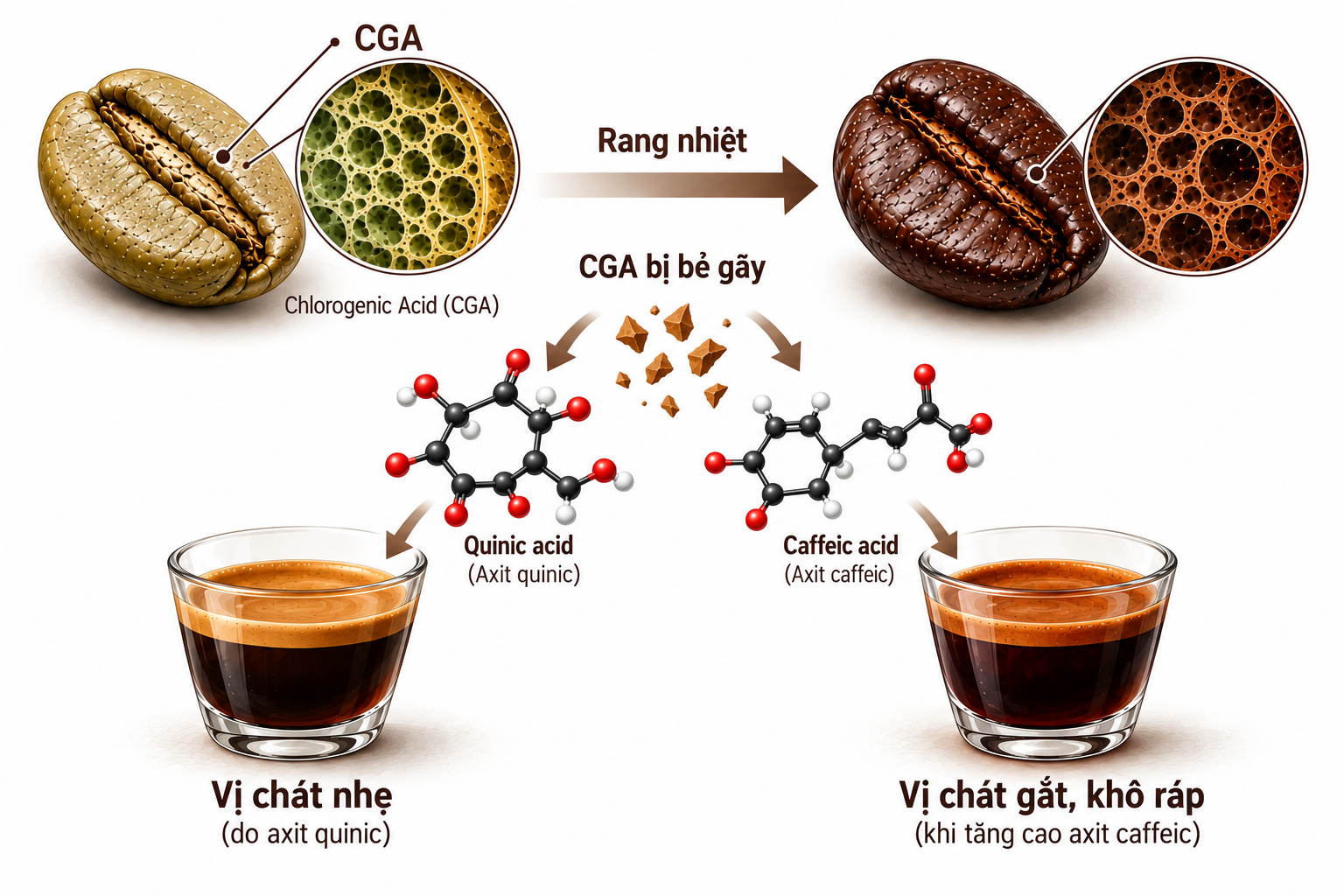
When CGA breaks down, free quinic acid and caffeic acid are released into the brew. At moderate concentrations, the presence of these two acids contributes to mild astringency, adding "depth" and complex structure to the espresso's aftertaste. However, poor control of roasting temperature leading to abrupt decomposition can cause a surge in free phenolic acids, resulting in a dry, harsh, and puckering sensation in the palate after drinking.
Suppression of acidity in dark roast levels
In dark roast batches, the near-total depletion of CGA means the coffee beans lose a significant source of acidity. By this stage, most organic acids have also been thermally decomposed. Espresso extracted from dark-roasted coffee will show a marked reduction in acidity, replaced by a richer, deeper bitterness due to the formation of melanoidins and phenylindane derivatives generated from the deep decomposition of phenolic acids.