

In the specialty coffee world, the consistency of each Pour Over cup stems not from intuition but from precise physical and chemical measurements. To objectively assess extraction quality, two parameters, TDS (Total Dissolved Solids) and Extraction Yield (EY), serve as the standard reference framework.
At the center of the Brewing Control Chart, the intersection of 1.35% TDS and 20% Extraction Yield creates the most complete cup in terms of both aroma and taste. This is considered the golden balance threshold, optimizing the full flavor potential of the coffee beans while avoiding common technical errors.
Extraction Yield: The Science Behind the 18%–22% Golden Range
Extraction Yield measures the proportion of dry coffee grounds actually dissolved and transferred into the final brewed coffee. According to the SCA Gold Cup standard, the ideal extraction yield range for filter coffee is 18% to 22%.
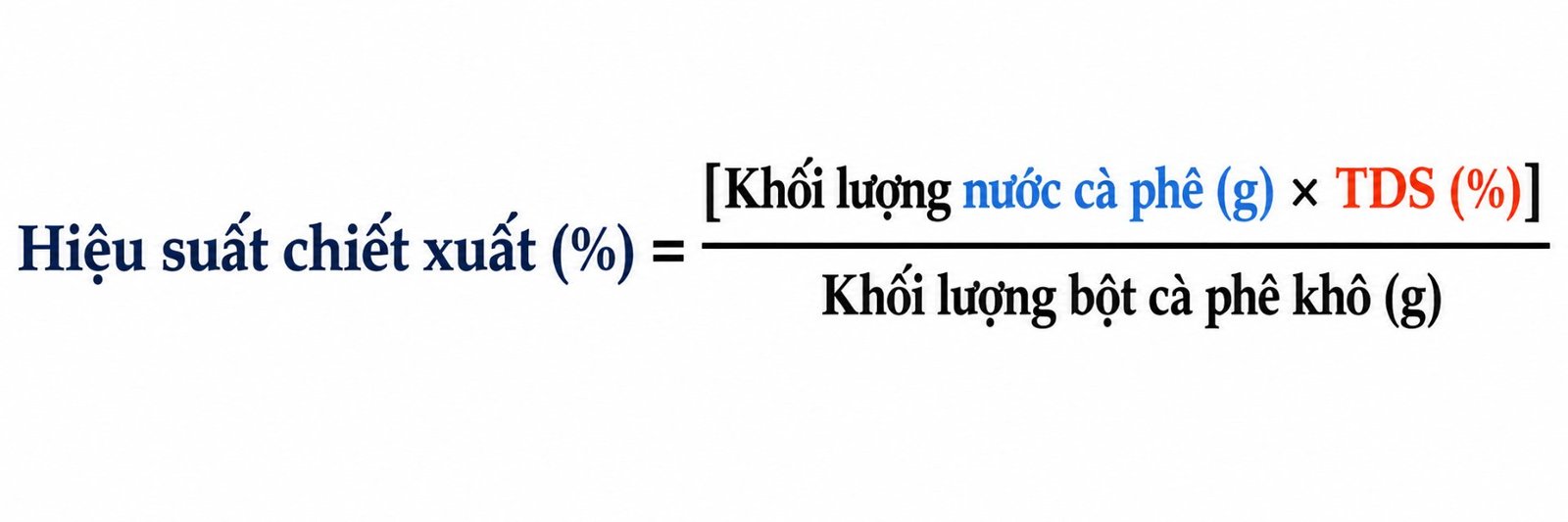
The 20% EY level sits at the very center of this optimal zone, delivering superior sensory characteristics:
- Avoiding Under-extraction: When extraction yield falls below 18%, the water only dissolves readily soluble acids and some salts, resulting in a sour, sharp taste lacking sweet aftertaste.
- Avoiding Over-extraction: When extraction yield exceeds 22%, long-chain organic compounds, tannins, and undesirable bitter substances begin to dissolve, causing the coffee to taste burnt, dry out the throat, and exhibit a charred wood aroma.
- Achieving Maximum Sweetness: At the 20% mark, most natural sugars and pleasant organic acids (such as citric acid and malic acid) within the bean's cellulose structure are fully released, creating a rich sweetness and bright, smooth acidity.
Total Dissolved Solids (TDS): Defining Strength
While extraction yield measures how much of the coffee bean has been extracted, TDS measures the concentration or "strength" of the brewed coffee solution. TDS indicates the percentage by mass of dissolved solids in the total weight of the beverage.
For Pour Over coffee, the Gold Cup standard TDS range extends from 1.15% to 1.35%. The 1.35% TDS level lies at the upper end of this standard range, offering distinct sensory values:
- Full Body: At 1.35%, filter coffee achieves thickness, a smooth texture, and a full mouthfeel without being watery or bland.
- Flavor Clarity: This concentration is strong enough for the drinker to clearly perceive the characteristic notes of the terroir or processing method (such as washed process or natural process), yet remains open enough to avoid the saturation or heaviness of Espresso.
The Dynamic Relationship Between TDS and Extraction Yield
TDS and Extraction Yield are two independent measurement dimensions that are closely linked through the brew ratio. With a fixed brew ratio, any change in TDS will correspondingly shift the extraction yield.
For example, using 15g of coffee to brew 250g of finished coffee (a ratio of approximately 1:16.7):
- To achieve 1.20% TDS, the extraction yield would be: `(250 x 1.20%) / 15 = 20.0%`.
- To achieve 1.35% TDS (a stronger cup) with the same 20.0% extraction yield, you would need to slightly adjust the brew ratio toward a stronger concentration (approximately 1:14.8), meaning using less water or more coffee grounds so that dissolved solids constitute a higher proportion of the solution.
This interaction is visually systematized on the Brewing Control Chart, a classic tool originating from the biochemical studies of Dr. Earl E. Lockhart. This chart helps baristas precisely determine how to adjust physical variables (such as grind size, water temperature, and contact time) to bring the coffee into the golden balance zone.
Practical Guide: Measurement and Adjustment at the Bar
To control and achieve the target of 1.35% TDS and 20% extraction yield, professional baristas use a refractometer as a support tool.
Standard Measurement Procedure
- Sample Preparation: After brewing the Pour Over, stir the solution thoroughly to homogenize the concentration of dissolved solids from the bottom to the surface.
- Allowing the sample to cool: Take a small amount of coffee using a pipette and allow it to cool to room temperature (approximately 20°C - 25°C). Measuring the sample at a high temperature will skew the results of the optical sensor on the refractometer.
- Calibrating the device: Clean the refractometer's lens with distilled water and set the reading to 0.0%.
- Measuring TDS: Place 2-3 drops of the cooled coffee on the lens, close the light shield, and read the result displayed on the digital screen.
- Calculating EY: Enter the measured TDS value along with the dry coffee mass and extracted water mass into the formula to determine the actual extraction yield.
Technical fine-tuning steps
If the actual measurement result deviates from the target threshold (TDS 1.35% / EY 20.0%), apply the following adjustment principles:
- Case of high TDS (e.g. 1.45%) and high EY (e.g. 23% - bitter coffee): The coffee is being over-extracted due to over-grinding or prolonged brewing time. Solution: Increase the grind size (coarser) or shorten the brewing time.
- Case of low TDS (e.g. 1.10%) and low EY (e.g. 16% - sour and diluted coffee): The coffee is being under-extracted. Solution: Adjust to a finer grind, increase the brewing water temperature, or apply gentle agitation during the pre-infusion stage to increase the contact area between water and coffee grounds.