
Many coffee lovers have the habit of treating themselves to an espresso or Americano in the late afternoon to relieve stress and maintain focus for the rest of the workday. However, this action inadvertently triggers a complex chain of biochemical reactions in the brain, severely disrupting the self-regulating sleep system. To understand how caffeine affects the nervous system, we need to delve into the nature of natural sleep pressure.
Neurobiological Mechanism: How Caffeine "Blocks" Adenosine
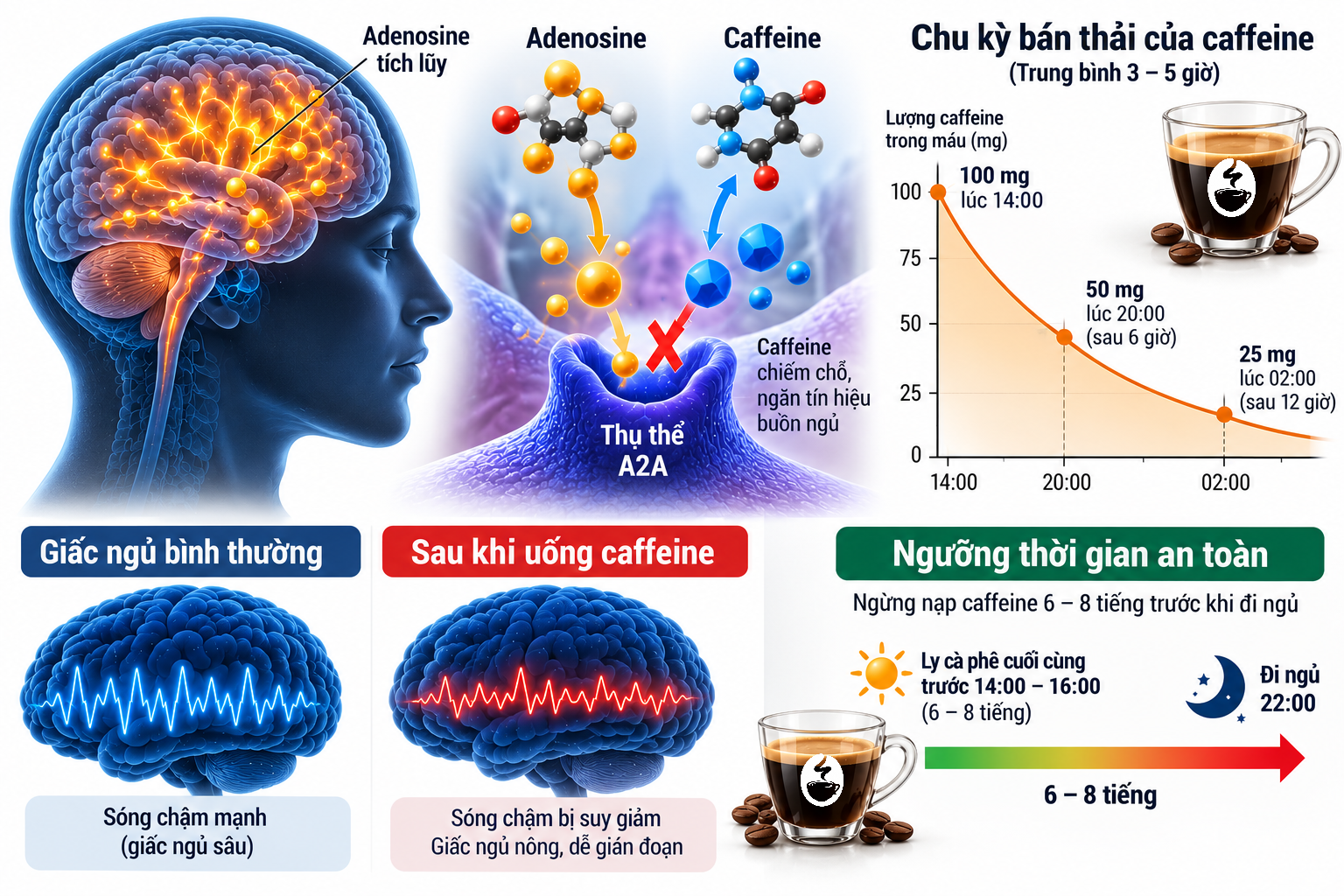
Throughout our waking hours, the energy metabolism activity of brain cells continuously produces a chemical compound called adenosine. The accumulating levels of adenosine during the day bind to adenosine receptors (particularly A2A receptors) on neurons, signaling to the body that energy is depleting, thereby creating naturally increasing sleep pressure toward nightfall.
Caffeine acts primarily as an adenosine receptor antagonist. Due to its molecular structure being similar to adenosine, caffeine easily competes for binding sites and blocks adenosine at A2A receptors in the brain. This binding does not activate the receptor; instead, it completely blocks the body's fatigue warning signal pathway. As a result, the central nervous system is tricked into maintaining a state of artificial alertness, while actual sleep pressure continues to accumulate but cannot be released.
Half-Life and Why an Afternoon Coffee Lasts Until Midnight
Many people believe that the stimulating effects of coffee disappear after about 1-2 hours. In reality, the process of clearing caffeine from the circulatory system is extremely slow.
The half-life of caffeine averages between 3 to 5 hours (or extends to 4–6 hours depending on individual physiology and biological factors). This means that if you consume approximately 100 mg of caffeine (equivalent to a standard phin filter coffee or espresso) at 2 PM, by 8 PM (after 6 hours), up to 50 mg of unmetabolized caffeine will still remain in your blood. This residual amount continues to travel to the brain, bind to neural receptors, and directly interfere with the initiation of natural sleep when you go to bed.
The Silent Destruction of Deep Sleep and Slow-Wave Activity
One of the key findings from electroencephalogram (EEG) studies is that caffeine not only increases sleep onset latency but also disrupts your overall sleep architecture.
Even if you are "resilient" and can easily fall asleep after drinking coffee late, your sleep quality is still significantly impaired. Caffeine directly interferes by reducing slow-wave activity (SWA) in the brain, meaning it significantly cuts down the duration of deep sleep (slow-wave sleep). This stage of deep sleep plays a vital role in cellular recovery, memory consolidation, toxin clearance in the brain, and energy regeneration for the next day. Reduced slow-wave activity makes sleep shallower and more fragmented, leading to feelings of fatigue and lethargy the next morning, even if your total time in bed appears normal.
Safe Time Threshold: 6 to 8 Hours Before Bedtime
To ensure the nervous system is fully released from the blocking effects of caffeine, scientists have conducted numerous randomized crossover clinical trials.
Research results (including reputable publications in the Journal of Clinical Sleep Medicine) demonstrate that consuming caffeine even 6 hours before bedtime still causes significant reductions in both total sleep time and sleep efficiency. Therefore, to protect deep sleep architecture and ensure optimal neural recovery, you need to establish a strict rule: Completely stop caffeine intake 6 to 8 hours before your intended bedtime.
For example, if your goal is to go to sleep at 10 PM, your last coffee of the day should be finished before 2 PM, or at the latest, before 4 PM. Adhering to this time threshold gives the liver sufficient time to metabolize and eliminate most of the caffeine, restoring natural activity to adenosine receptors and paving the way for deep, complete, and maximally restorative sleep.