
COFFEE SCIENCE · BREWING
Geometry and fluid dynamics in Pour-Over technique
In the pour-over method, the geometry of the dripper not only determines the shape of the coffee bed but also influences how water moves through the porous material, contact time, and the uniformity of the extraction process.
1. Pour-Over is a flow-through porous media system
From a physics perspective, the pour-over brewing process can be viewed as an unsteady transient flow system. Water is added to the dripper in pulses, then moves through the coffee grounds and filter paper before draining into the carafe.
Gravity is the primary force driving the water downward. As water accumulates above the coffee layer, it creates hydrostatic pressure (hydrostatic pressure). However, the actual flow rate depends not only on pressure but is also influenced by the permeability of the grounds, particle size, bed structure, filter paper, and dripper geometry.
The dripper does not directly dictate the entire extraction process. It establishes boundary conditions for flow, while the coffee grounds act as the porous medium generating most of the hydraulic resistance in the system.
2. Dripper geometry shapes the coffee bed state
After grinding and loading into the dripper, the grounds form a structure known as the coffee bed. The shape of the dripper directly affects the geometry of the bed and the path length water must travel through it.
Cone-shaped dripper
The grounds tend to be deeper toward the center of the bottom. The height of the coffee bed varies by position, resulting in different flow path lengths through the grounds across various regions.
Flat-bottom dripper
The coffee grounds are distributed over a wider bottom surface, tending to form a bed with relatively uniform height.
This difference alters the hydraulic resistance of the system. As the water's path changes, so does the contact time between water and coffee particles, thereby affecting extraction kinetics.
3. Hario V60: 60° cone angle and flow control capabilities
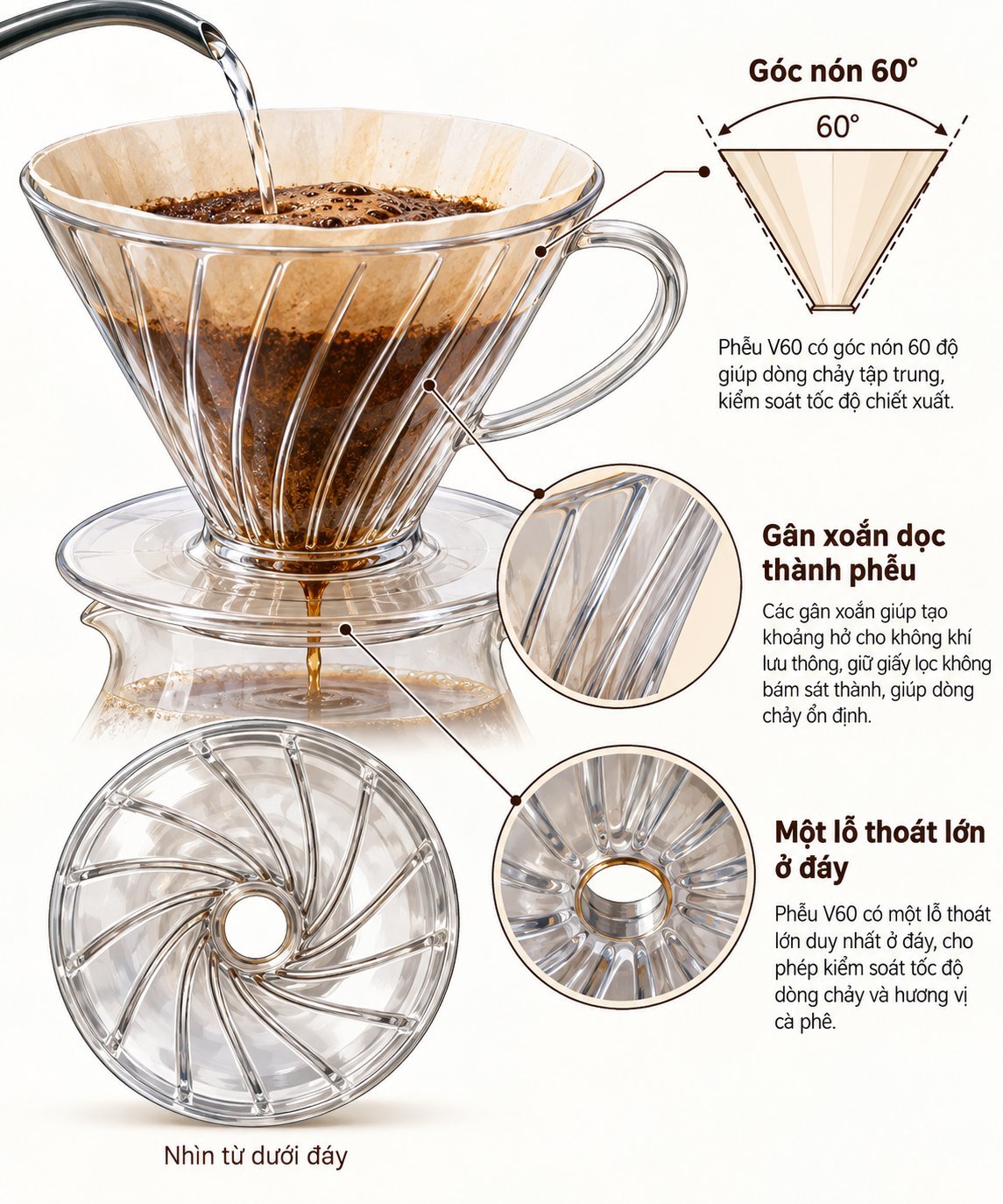
Hario V60 employs a conical geometry with an angle of approximately 60°, a large drainage hole at the bottom, and spiral ribs running along the dripper walls.
3.1. Large drainage hole and hydraulic resistance
One of the standout features of the V60 is its relatively large drainage hole. This reduces the likelihood of the drain becoming the system's primary choke point compared to designs using multiple small holes.
However, one should not assume that a large drainage hole means water flows completely unimpeded. In reality, hydraulic resistance arises from several other components, particularly:
- Permeability of the coffee bed.
- Grind size and distribution.
- Compaction level and structure of the coffee bed.
- Filter paper.
- Water volume and the height of the water column above the bed.
- Pouring technique and the degree of agitation of the coffee bed.
3.2. The role of the spiral rib system
The raised ribs on the V60 walls create gaps between the filter paper and the dripper wall. This structure helps prevent the filter paper from adhering completely to the dripper wall and supports air circulation during brewing.
Thus, the geometry of the ribs is not merely an aesthetic element. It contributes to creating appropriate drainage and aeration conditions for the filtration system.
3.3. Why does V60 depend heavily on pouring technique?
Due to its relatively free drainage, V60 allows the barista to significantly influence the system through flow rate, pouring speed, and the level of agitation.
→ changes in hydraulic resistance → changes in contact time → changes in extraction.
This is why V60 is often highly regarded for its ability to express clarity, acidity, and complex flavor layers, but it also requires the brewer to have good control over pouring technique.
4. Kalita Wave: flat-bottom geometry and flow stability
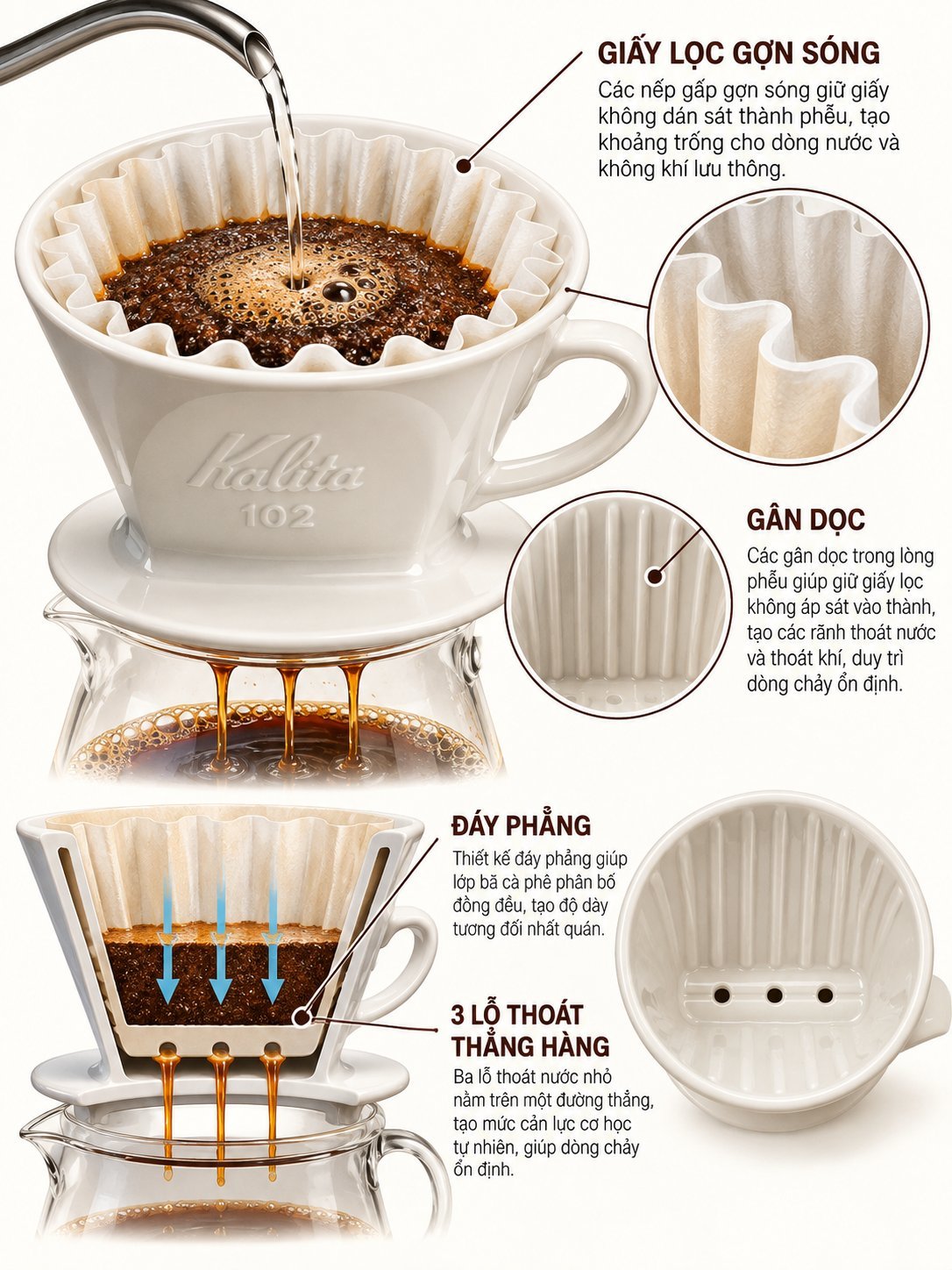
Unlike V60, Kalita Wave uses a flat-bottom design, combined with three drainage holes and characteristic wavy filter paper.
4.1. Three drainage holes and flow regulation capability
The three small drainage holes create an additional source of hydraulic resistance at the bottom of the system. When combined with the coffee bed and filter paper, they contribute to a higher level of flow restriction compared to a single large drainage hole.
This makes Kalita Wave less dependent on a single factor and generally feels easier to control for the brewer.
4.2. Flat-bottom geometry and the coffee bed
The flat bottom allows the coffee grounds to be distributed with a relatively more uniform height. When water interacts with a more geometrically uniform bed, differences in flow path length between regions can be reduced.
A flat bottom cannot completely eliminate channeling. This phenomenon can still occur if the grounds are unevenly distributed, there are locally compacted areas, particle size is inconsistent, or the pouring technique generates water flow that is too strong.
4.3. Wavy filter paper
The pleats of the Wave Filter create space between the paper and the dripper wall, helping to maintain water and air pathways outside the paper layer.
Combined with the flat bottom and the three-hole drainage system, this structure creates a system that tends to stabilize flow rate and is less sensitive to minor changes in pouring technique.
5. V60 and Kalita Wave: What are the differences?
V60 and Kalita Wave should not be viewed simply as two devices that produce two “fixed flavors.” The more important difference lies in how each design distributes hydraulic resistance and responds to the brewer’s actions.
| Criteria | Hario V60 | Kalita Wave |
|---|---|---|
| Geometry | ~60° cone | Flat bottom |
| Drainage | One large hole | Three small holes in a line |
| Hydraulic resistance | Heavily dependent on coffee bed and filter | Additional restriction from the drainage hole system |
| Coffee bed shape | Tends to be deeper in the center | Relatively flatter and more uniform |
| Sensitivity to flow rate | High | Lower |
| Agitation | Can strongly impact extraction | Generally easier to control |
| Clarity | Often prominent | More balanced |
| Body | Typically light and distinct | Tends to be fuller-bodied |
| Technical difficulty | Higher | More accessible |
6. From geometry to flavor: the chain of physical effects
Therefore, the difference between the V60 and the Kalita is not simply about which dripper flows faster. What matters is how the entire flow system responds to the brewer’s technique.
7. Should you choose the V60 or the Kalita Wave?
If the goal is manual control and exploring the coffee’s expressive potential, the V60 is a highly suitable platform. Its conical geometry, large exit hole, and sensitivity to flow rate allow the barista to significantly adjust extraction through grind size, pouring speed, and agitation.
If consistency and repeatability are the priority, the Kalita Wave offers a system with greater flow regulation thanks to the combination of its flat bottom, three exit holes, and Wave Filter.
No design is absolutely superior to the other. What matters is understanding how geometry → hydraulic resistance → flow rate → extraction are interconnected.
A pour-over dripper is not just a container. It is part of a hydrodynamic system in which the dripper’s geometry shapes the coffee bed, hydraulic resistance, and the way water interacts with the coffee.
Technical terms
- Hydraulic resistance
- The resistance to fluid flow as it passes through a medium or structure.
- Flow rate
- The volume of flow, typically expressed in mL/s in coffee brewing.
- Coffee bed
- The layer of coffee grounds formed inside the dripper after brewing begins.
- Agitation
- The degree of disturbance of the coffee bed caused by water flow, pouring motion, or brewing technique.
- Channeling
- The phenomenon where water preferentially flows through areas of lower resistance within the coffee bed.
- Extraction
- The process by which soluble compounds from coffee beans dissolve into water.