
COFFEE SCIENCE · PROCESSING TECHNOLOGY
Instant Coffee: How Do Spray Drying and Freeze Drying Differ?
Why is spray-dried instant coffee typically in the form of fine powder, while freeze-dried products appear as granules or porous flakes? The difference lies not only in external appearance. Heat transfer mechanisms, mass transfer, microstructure, and the loss of aromatic compounds all contribute decisively to the characteristics of the final product.
1. How is instant coffee produced?
Instant coffee is not simply roasted coffee ground into a fine powder. In common industrial processes, roasted coffee beans are ground and extracted with water to obtain coffee extract. This extract is usually filtered, concentrated, and then subjected to drying to remove most of the water, creating a product that can be reconstituted by adding water.
Two common industrial drying methods are spray drying and freeze drying. Both transform coffee extract into a dry product but use different water removal mechanisms.
Core difference:
Spray drying removes water primarily through evaporation from extract droplets exposed to hot air. Freeze drying first freezes the extract, then removes ice by allowing it to sublimate directly into vapor under low-pressure conditions.
Because the product structure forms via two different mechanisms, particle morphology, porosity, bulk density, wettability, and aroma retention levels may also differ.
2. Spray drying: Creating particles from extract droplets
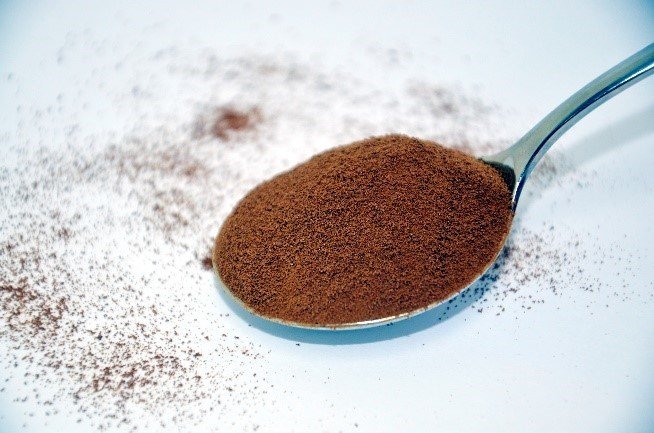
2.1. Heat and mass transfer mechanisms
In a spray dryer, coffee extract is dispersed into small droplets via a nozzle or centrifugal atomizer. The droplets contact a stream of hot air, causing rapid water evaporation and an increase in solid concentration within the droplet.
As drying continues, a solid-rich crust may form on the droplet surface. Water vapor continues to escape through this material layer; depending on drying conditions and extract properties, the finished particles may be dense, hollow, shriveled, or have a more complex structure.
Therefore, it is inaccurate to assume that all spray-dried coffee particles are perfect spheres with smooth surfaces. Actual morphology depends on extract composition, droplet size, evaporation rate, operating conditions, and post-drying agglomeration.
2.2. Hot air temperature does not equate to particle temperature
The inlet air temperature of a spray dryer may be high, but this figure cannot be taken as the actual temperature of the entire extract droplet or coffee particle throughout the drying process.
When water evaporates, part of the heat is consumed for the phase change. Therefore, product temperature is influenced by evaporation rate, residual moisture, residence time, and heat transfer conditions. Outlet air temperature differs from inlet air temperature and from the material temperature at any given moment.
Implications for quality: Aroma loss cannot be assessed solely by inlet air temperature. The entire thermal history of the product and stages before, during, and after drying must be considered.
3. Freeze drying: Preserving the porous framework after ice removal
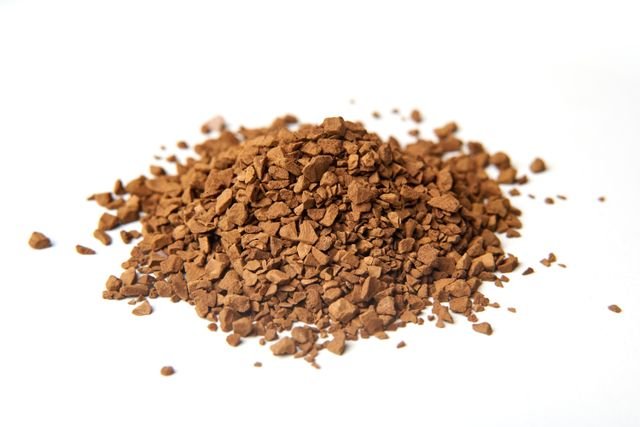
3.1. Three main stages
In freeze drying, coffee extract is cooled to freeze the water. The frozen material is then placed in a low-pressure drying chamber. During primary drying, ice sublimates directly into vapor without passing through the liquid state.
After most of the ice is removed, secondary drying helps remove additional water bound to the solid matrix. Temperature and pressure conditions must be adjusted appropriately to the material's characteristics to limit structural collapse.
3.2. Why do products often have a porous structure?
When ice sublimates, the positions previously occupied by ice crystals may become voids within the solid matrix. The shape and interconnectivity of these voids depend on the freezing rate, ice crystal size, extract composition, and drying conditions.
Therefore, freeze-dried instant coffee typically appears as granules, flakes, or porous sheets rather than a uniform fine powder. However, the structure is not identical across all products, nor can it be asserted that volume is always absolutely conserved during drying.
High porosity can facilitate water vapor escape during drying and help water penetrate the product during reconstitution. Nevertheless, practical effectiveness also depends on pore size and connectivity, the degree of agglomeration, final moisture content, and storage conditions.
4. How does microstructure determine solubility?
When instant coffee powder comes into contact with water, the phenomenon is not simply that solid particles disappear immediately. The reconstitution process can be analyzed through three related phenomena: wetting, sinking, and dispersion. This is a useful practical description; in reality, these phenomena may overlap and are not necessarily separated into three distinct stages.
4.1. Wetting
Wetting describes the ability of water to contact and spread over the material surface. Contact angle, surface chemistry, roughness, porosity, and the presence of air in voids can all influence this process.
For particles with interconnected pores, water can penetrate deep into the structure via capillary forces. Conversely, if water only wets the outer surface or if agglomerated particles form a sticky layer, the interior may be wetted more slowly.
However, one should not conclude that spray-dried particles are always difficult to wet due to their smooth surface. Spray drying can produce hollow particles, and manufacturers may also use an agglomeration step to improve wettability.
4.2. Sinking
A powder particle may float temporarily if air is trapped or if water has not sufficiently penetrated the structure. As water penetrates, air escapes and the effective mass of the particle changes, making it easier to sink.
Sinking ability also depends on particle size, bulk density, degree of agglomeration, surface state, and the surface tension of the solvent. Therefore, while a porous morphology may support sinking, it does not guarantee that all freeze-dried particles sink faster than all spray-dried particles.
4.3. Dispersing and Dissolution
After water penetration, the soluble components of coffee diffuse into the water. The reconstitution rate depends on the contact surface area, water pathway, degree of agglomeration, solvent temperature, and the physicochemical properties of the solids.
Instant coffee is produced so that its soluble components disperse into water. Any completely insoluble parts, if present, may be related to raw material composition or processing conditions. A porous structure may accelerate water penetration, but it does not mean the entire product always dissolves instantly with just gentle stirring.
Cấu trúc hạt + Độ thấm ướt + Nhiệt độ nước + Mức độ kết tụ
5. Impact of drying technology on aroma compounds
Coffee aroma results from many groups of volatile compounds, including pyrazines, furans, aldehydes, ketones, esters, alcohols, and many others. These compounds differ in volatility, odor threshold, thermal stability, and ability to interact with the solid matrix.
5.1. Spray drying and the risk of volatile compound loss
In spray drying, the large surface area of the extract droplets and rapid evaporation rate shorten the drying time. At the same time, some volatile aroma compounds may escape from the droplets along with the water vapor stream or undergo changes under processing conditions.
Loss levels are not solely due to temperature. They also depend on residence time, solids concentration, equipment design, the aroma retention capacity of the material matrix, and aroma recovery in the production line.
5.2. Freeze drying and aroma preservation potential
Freeze drying is typically carried out at low material temperatures during most of the ice removal stage. This can limit certain thermal degradation reactions and reduce the loss of some aroma compounds compared to hot-air drying processes.
Nevertheless, it is inaccurate to claim that freeze drying preserves the entire aroma profile intact. Volatile compounds may be lost in steps prior to drying, such as extraction and concentration; they may also be lost or altered during freezing, drying, and storage.
5.3. What do empirical studies indicate?
Chindapan and Puangngoen (2024) compared Robusta instant coffee produced at laboratory and industrial scales. The study used HS-SPME/GC-MS techniques to analyze volatile aroma compounds.
Among the samples surveyed, the total amount of residual volatile aroma compounds after freeze-drying was equivalent to approximately 75.98% and 73.39% of the amount present in the concentrated extract, at laboratory and industrial scales, respectively. For the corresponding spray-dried samples, these ratios were approximately 50.11% and 45.13%.
These figures are the results of a specific study and do not represent fixed ratios for all factories, coffee varieties, or product formulations. They also cannot replace sensory evaluation, as the total amount of volatile compounds does not fully reflect the proportion of individual compounds, odor thresholds, and the balance of the overall aroma profile.
Source: Chindapan & Puangngoen (2024), Burapha Science Journal, 29(2), 647–671.
6. Comparison table of spray drying and freeze drying
| Criteria | Spray drying | Freeze drying |
|---|---|---|
| Principle | Evaporation of water from extract droplets in a stream of hot air. | Ice sublimates directly into vapor under low pressure. |
| Common morphology | Fine powder, small particles; may be dense, hollow, shriveled, or agglomerated. | Porous granules or flakes, often with irregular shapes. |
| Microstructure | Depends on evaporation rate, extract composition, and drying conditions. | Void spaces are related to the ice crystal structure prior to sublimation. |
| Wettability | Depends on particle morphology, agglomeration, and wettability. | Porous structure can facilitate rapid water penetration. |
| Aroma retention | Some volatile compounds may be lost during the drying process. | Often advantageous for certain heat-sensitive compounds, depending on the process. |
| Productivity | Generally suitable for continuous, large-scale production lines. | Drying time is typically longer and the process more complex. |
| Cost | Often offers a cost advantage in production per unit of product. | Typically requires higher investment in equipment and energy. |
| Usage characteristics | Can produce fine powder or agglomerated granules that are easy to use. | Typically produces large, light granules with a porous structure. |
Table describing common trends. Actual characteristics may vary depending on equipment, operating conditions, extraction formulas, and post-drying processing steps.
7. Why is freeze-dried coffee usually more expensive?
Freeze-drying requires refrigeration systems, vacuum chambers, and water vapor condensers. The process also demands strict control of temperature and pressure across multiple stages. Processing time is typically longer than spray drying, increasing requirements for equipment, energy, and production capacity.
Spray drying offers advantages in speed, continuous operation capability, and high productivity. These features make the technology suitable for large-scale production, where cost per unit of product is a critical factor.
However, drying technology should not be equated with overall quality. The quality of instant coffee is also influenced by raw materials, roast level, extraction formula, concentration process, aroma recovery, and packaging and storage conditions.
8. Frequently Asked Questions
Is freeze-dried instant coffee better tasting than spray-dried?
Freeze-drying often has the advantage of preserving certain volatile aroma compounds and creating a porous structure. However, whether it tastes better depends on raw materials, extraction processes, product formulas, and consumer preferences.
Is spray-dried coffee affected by high temperatures?
Some aroma compounds may be lost or altered during drying. However, the inlet air temperature does not equate to the actual temperature of the extract droplets. Operating conditions and final product quality should be evaluated rather than relying solely on a single temperature parameter.
Why does instant coffee sometimes float on water?
Air trapped within the granule structure, wettability, particle size, and agglomeration state can cause the powder to float temporarily. As water penetrates and air escapes, the granules may sink.
Does freeze-dried instant coffee dissolve in cold water?
Many products can be reconstituted in cold water, but the dissolution rate is usually slower than in hot water. Particle size, porosity, product formula, and stirring method can all affect dissolution time.
Is drying technology the sole determinant of flavor?
No. The flavor of instant coffee results from the entire production chain, from raw materials and roasting to extraction, concentration, drying, packaging, and storage. Drying technology is an important factor but cannot represent overall quality.
9. How does drying technology shape the quality of instant coffee?
Spray drying and freeze-drying are two dehydration solutions with different physical mechanisms. Spray drying relies on rapid evaporation from extract droplets in a hot air stream, while freeze-drying removes ice via direct phase transition under low pressure.
This difference contributes to variations in granule morphology, microporous structure, reconstitution properties, and retention levels of aroma compounds. Freeze-drying often has advantages in porous structure and preservation of certain heat-sensitive aroma compounds, while spray drying is typically suited for high-productivity lines and cost optimization.
To evaluate an instant coffee product, it is necessary to simultaneously consider its physical structure, dissolution rate, chemical composition, aroma analysis, and sensory results. Merely observing the particle shape or the name of the drying technology is insufficient to conclude the in-cup quality.
Scientific references
- Chindapan, N. & Puangngoen, C. (2024). Comparative Evaluation of Volatile Aroma Compounds Content of Freeze-Dried and Spray-Dried Instant Coffees. Burapha Science Journal, 29(2), 647–671. Read study .
- Ishwarya, S. P. & Anandharamakrishnan, C. (2015). Spray-Freeze-Drying approach for soluble coffee processing and its effect on quality characteristics. Journal of Food Engineering, 149, 171–180. DOI: 10.1016/j.jfoodeng.2014.10.011 . This study further investigates the spray-freeze-drying method, which is distinct from conventional spray drying.
- Ghirisan, A. & Miclaus, V. (2017). Comparative Study of Spray-Drying and Freeze-Drying on the Soluble Coffee Properties. Studia Universitatis Babeș-Bolyai Chemia, 62(4), 309–316. DOI: 10.24193/subbchem.2017.4.26 .
- Lin, J. A. et al. (2026). Comparison of freeze-drying and spray-freeze-drying coffee with different roast degrees. Ciencia e Agrotecnologia, 50, e025725. DOI: 10.1590/1413-7054202650025725 . This study compares freeze-drying with spray-freeze-drying, not a direct comparison between conventional freeze-drying and conventional spray drying.
Methodological note: the aroma compound retention ratios cited above are derived from specific studies and experimental conditions. They should not be used as standard parameters applicable to all instant coffee production lines.