
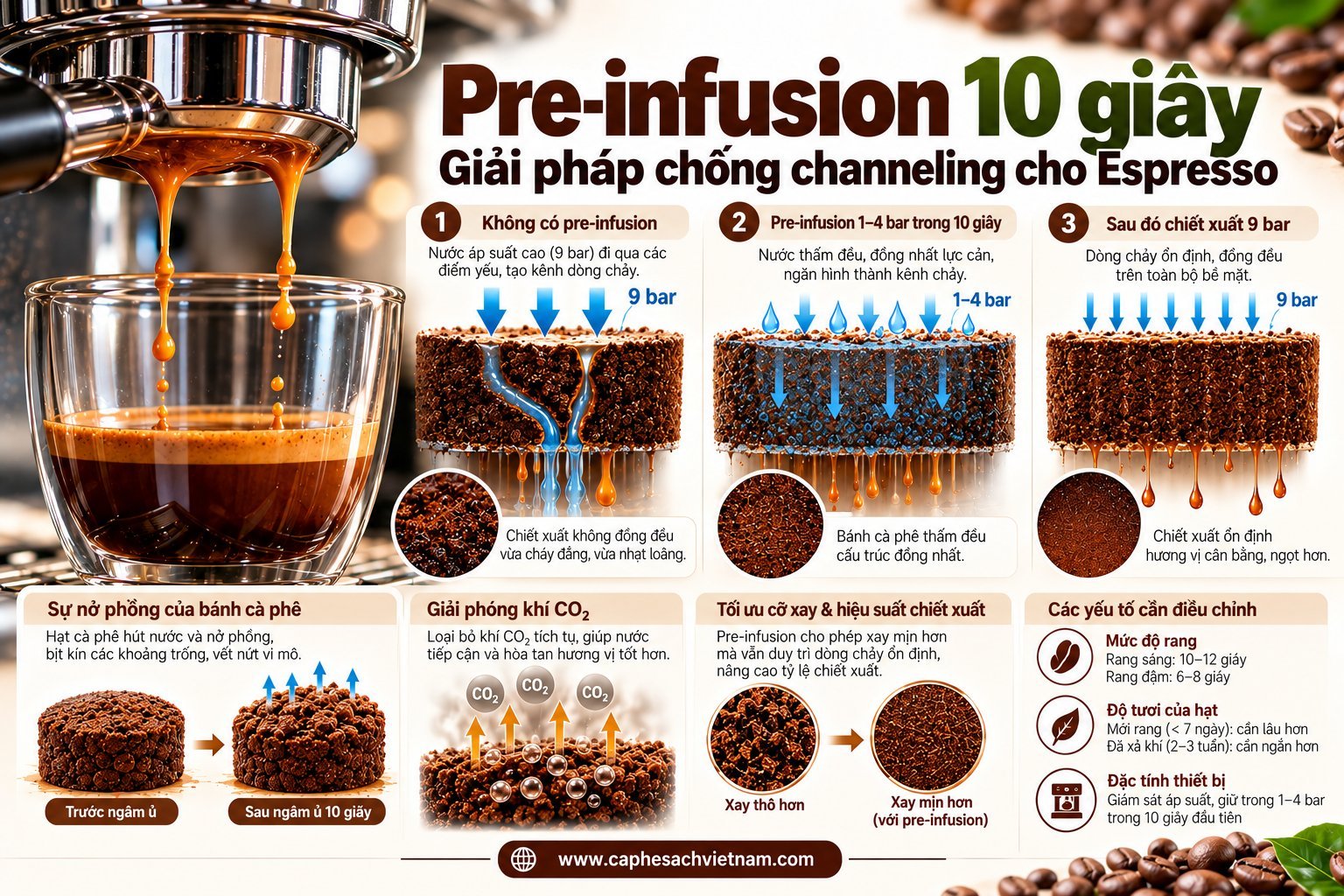
In the art and science of Espresso brewing, channeling is always the biggest challenge for baristas. When high-pressure water passes through areas of lower compaction density in the coffee puck, it automatically erodes these weak points to form fast-flow channels, leading to uneven extraction: bitter over-extraction in the channeled areas and weak under-extraction in the remaining dry zones. The pre-infusion technique (pre-infusion) during the critical 10-second window is the most effective physical solution to thoroughly address this issue.
Physical mechanism of 10-second pre-infusion against channeling
Pre-infusion is the process of introducing hot water to the coffee puck at low pressure (ranging from 1 to 4 bar) before the pump activates the full standard 9-bar extraction pressure.
When high-pressure water (9 bar) suddenly impacts a completely dry coffee puck surface, it immediately seeks out microscopic voids or loosely bonded areas to penetrate. This sudden mechanical impact causes local erosion and forms flow channels.
By maintaining gentle pressure from 1 to 4 bar for 10 seconds (or until the first drops of coffee appear at the bottom of the filter basket), the water has sufficient time to permeate evenly both horizontally and vertically through the coffee puck. This slow wetting process homogenizes hydraulic resistance across the entire volume of the puck, preventing the formation of structural weaknesses before the strong 9-bar pump pressure arrives.
Coffee puck swelling and CO2 release
The effectiveness of 10-second pre-infusion in preventing channeling is closely related to two biophysical phenomena occurring simultaneously inside the filter basket:
- Coffee puck swelling: When exposed to hot water at low pressure, the fragmented coffee cells resulting from grinding absorb water and swell. This volume expansion presses the coffee particles closer together, automatically sealing gaps, micro-cracks, or air pockets inadvertently formed during tamping.
- Release of accumulated CO2: For freshly roasted coffee, the amount of residual CO2 within the bean structure is significant. This gas is hydrophobic, creating air pockets that hinder the even flow of extraction water. The 10-second soaking stage allows for the gentle release of this CO2, enabling water to directly access and dissolve flavor compounds more effectively.
Thanks to the absolutely uniform density of the coffee puck structure after expansion, the high-pressure water in the subsequent stage will pass through the puck at a consistent speed maintained across the entire surface.
Optimizing grind size and actual extraction efficiency
One of the greatest benefits of applying 10-second pre-infusion is the ability to fully exploit extremely fine grind size.
Typically, without pre-infusion, grinding too finely increases the risk of local clogging or causes severe channeling because water cannot penetrate the overly compacted coffee puck. However, when the coffee puck has been evenly moistened and softened during the pre-infusion stage, the permeability of the entire powder mass is significantly improved.
This allows baristas to confidently adjust to a finer grind size while maintaining extremely stable flow time and rate. Finer grounds mean a significantly increased total surface area, which helps improve the Extraction Yield, highlighting natural sweetness and creating a profound aftertaste for the espresso cup.
Technical notes for mastering pre-infusion time
Although 10 seconds is considered the optimal benchmark in experimental studies, baristas need to flexibly adjust this parameter based on practical variables:
- Roast Level: Light roast coffee usually has a harder structure, is less permeable to water, and is more difficult to extract, so it may require extending the pre-infusion time (from 10 to 12 seconds) to fully soften the beans. Conversely, dark roast coffee is more soluble and porous, requiring only a shorter soaking time (about 6 to 8 seconds) to avoid over-extraction causing harsh bitterness.
- Freshness of the beans: Newly roasted coffee (under 7 days) contains very high levels of CO2, requiring a sufficiently long pre-infusion cycle to stabilize degassing. Coffee that has degassed adequately (2-3 weeks post-roast) requires less soaking time.
- Equipment characteristics: Depending on whether your machine uses a natural pre-infusion system (using the natural flow pressure of the E61 group head) or an active flow control system (flow profiling), the actual pressure during the first 10 seconds needs to be closely monitored to ensure it does not exceed the 4-bar threshold before the main pump activates.
Frequently Asked Questions
How do I know if the pre-infusion time is sufficient without looking at a clock?
The most easily recognizable visual cue is when you observe the first dense drops of coffee beginning to appear and drip from the bottom of a naked portafilter. This is the moment when the entire coffee puck is fully saturated with water, and you should immediately activate the main 9-bar extraction pressure.
Are there any detrimental effects if pre-infusion lasts too long (over 15 seconds)?
If the low-pressure soaking phase is prolonged excessively, the temperature of the coffee puck may drop significantly, and a large amount of volatile soluble compounds will be lost before the main pressure is applied. This can easily result in a lukewarm espresso, loss of delicate aromas, and potentially harsh bitterness due to over-extraction.
References
- Barista Hustle - Preinfusion Analysis (https://www.baristahustle.com/blog/preinfusion/)
- Brewed Barista - Espresso Pre-Infusion Explained: Why and How to Use It (https://brewedbarista.com/espresso-pre-infusion-explained/)