
01 · GROWING
Laying the ground
Soil, variety, altitude and the right husbandry set the potential of the cherry.
An independent platform for Vietnamese coffee, where knowledge, growing regions, processing methods and the craft of brewing are joined into one path you can follow.
Pick a region on the map to read its origin profile. Administrative information follows the current provincial boundaries; the coffee itself is described by the producing areas that matter.

The map is only the start. From each point on it, SAVINA opens a profile covering terrain, climate, varieties, husbandry, processing and the sensory direction. It is written from the origin's point of view and will keep being updated as new data arrives.
Điện Biên is a mountain Arabica region still expanding. In 2025 the province recorded8,120.71 haof coffee and6,025.06 tonnesharvested.
Local technical material on arabica lists the approved varieties asCatimor, TN1, TN2, TN6, TN7, TN9 and THA1. The Điện Biên technical guidance puts the suitable band at roughly 600–1,500 m, 16–25°C and 1,200–1,900 mm of rain a year.
The region is being steered towards specialty coffee, traceability and sustainable production. A sensory profile should be tied to a variety, a sub-region and a processing method rather than pinned on the whole province.
Sơn La is one of Vietnam's important Arabica regions. The variety name must be written exactly asCatimor SLa— not in any other spelling.
The Sơn La open data portal listsCatimor SLa — Coffea Arabicain its register of mother trees and seed gardens, alongsidearabica TN2. A number of Catimor SLa sources have been recognised at Chiềng Mung, Chiềng Ban, Chiềng Pha and elsewhere.
The geographical indication dossier describes production at roughly 600–1,200 m on broken terrain and ferralitic soil. With good cherry and controlled processing, Sơn La coffee can show clean acidity, light bitterness and a long finish with sweet and fruity shades.
Phủ Quỳ was once a major coffee area of Nghệ An but is no longer a commercial producing region of any size. On the SAVINA map, Nghệ An is therefore kept for its historical value and its germplasm.
At Phủ Quỳ the research centre once trialled a collection of 37 varieties and foundArabica Catimorsuited to local conditions; the varietyK3in the foundation garden was recorded as high-yielding and of good quality.
The record shows Phủ Quỳ once held about 7,000 ha of coffee; the Catimor area then shrank sharply as returns fell and growers switched crops. Local press reports that by around 2012–2013 almost no coffee was left in the area.
Quảng Trị's coffee is concentrated in Hướng Hóa, above all Khe Sanh and Hướng Phùng. Arabica leads; Liberica planting material is being brought into order.
Hướng Phùng now holds more than2,100 haof coffee, mostly Arabica with someLiberica. In 2025 the district recognised69 Liberica mother trees: 47 in the group locally called“plum red”and 22 in the group called“purple”. That is how the mother-tree sources are grouped in the local record; the names should not be changed.
Khe Sanh is described at roughly 400–600 m on red basalt soil. Hướng Phùng is pushing farmer–cooperative–company linkage, specialty coffee and eco-farming.
After the administrative merger, Quảng Ngãi takes in the former Kon Tum. Its coffee profile therefore runs in two directions: Robusta in commodity areas such as Đắk Hà, and Arabica in the high sub-regions.
Đăk Hà commune aims to hold3,700–3,800 haof coffee through 2025–2030, averaging over 4.0 tonnes of green per hectare per year, and to widen the high-quality supply area. It is also steering towards new varieties, mechanisation and water-saving irrigation.
Kon Plông, Tu Mơ Rông and Đắk Glei have the basis for Arabica. Public data is not yet sufficient to assign a single variety list to the whole of the new Quảng Ngãi.
Gia Lai is an important Robusta region in the northern Central Highlands. Chư Sê, Đak Đoa, Ia Grai, Chư Prông and their neighbours form a large producing area on red basalt soil.
Replanting programmes record varieties such asTR4, TR9, TRS1 and Xanh lùn. These are the varieties used in technical programmes; there is no basis for assigning each a share of the province.
Gia Lai is moving hard towards value chains, traceability and quality. Picking ripe, cutting defects, controlled processing and sensory assessment are the decisive points on the way to Fine Robusta.
Đắk Lắk is one of Vietnam's great Robusta centres. In 2025 the province recorded about217,026 haof coffee and582,113 tonnesof production.
The varieties used in replanting and production includeTR4, TR9, TR11, TRS1along with other selected material. The current replanting programme keeps its focus on TRS1, TR4, TR9 and cà phê Dây.
Buôn Ma Thuột sits on red basalt soil at roughly 400–800 m. The “Buôn Ma Thuột” geographical indication protects Robusta that meets the requirements on area, production, processing and traceability.
Lâm Đồng's coffee is layered by altitude. Above 1,500 m suits Arabica; lower ground carries Robusta and some Catimor. After the merger the profile also takes in sub-regions from the former Đắk Nông and Bình Thuận.
Provincial material puts land above1,500 mas suited toCatimor, Caturra, Typica, Bourbon. Technical material also records Catimor as widespread;THA1, TN1, TN2are in use or under study, with TN1 and TN2 performing well in trials at Đà Lạt.
In the 2021–2025 replanting, the leading varieties recorded wereTR4, TR9, TRS1, Xanh lùn (TS5) and cà phê Dây. The important areas are Di Linh, Đức Trọng, Lâm Hà, Đơn Dương and Đà Lạt/Cầu Đất.
Đồng Nai has the terrain and soil for long-cycle industrial crops. Most of the area sits on fertile red basalt in the key districts, which is what made Robusta possible here. After the shift in cropping, the province's coffee area has held steady at around7,000 ha, concentrated in Xuân Lộc, Thống Nhất, Cẩm Mỹ, Trảng Bom and Định Quán.
The main coffee area here is essentiallypure Robusta, in which high-yielding, disease-resistant clones such asTR4, TR9, TRS1are gradually replacing part of the older plantings. They grow vigorously, branch freely, resist leaf rust well, give even bean size and yield highly — 3.5 to 6 tonnes of green per hectare under good intensive management.
To deal with ageing gardens of 15–20 years and more whose yields had fallen, Đồng Nai's agriculture sector has run replanting and top-grafting schemes on the old coffee area, favouring clean new planting material (TR4, TR9, TRS1) together with soil management, rebuilding the cultivated layer and sensible intercropping, to raise the quality of the commercial bean.
Flavour does not appear at the end of the journey. It is built at every decisive step: choosing a variety that suits the region, the soil and the climate, the skill of husbandry, the harvest, the processing of the green bean, and finally the roast and the brew.
Soil, variety, altitude and the right husbandry set the potential of the cherry.
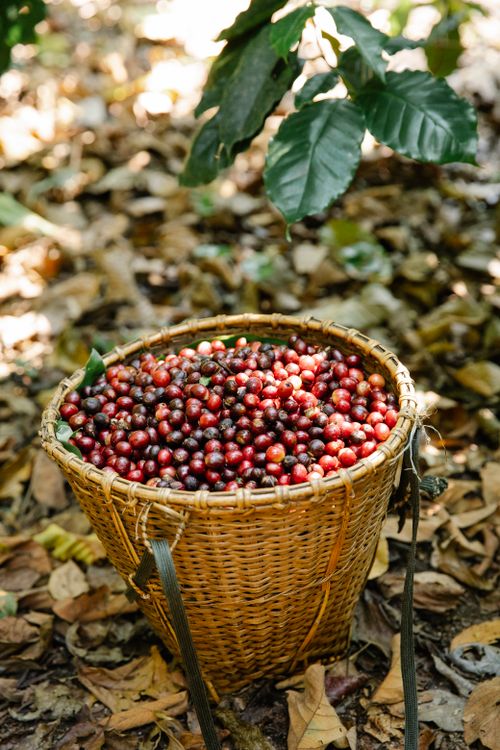
Ripeness bears directly on the quality of the raw material.
Natural, washed and honey send the sensory profile in different directions.
Time, temperature and the roast curve decide how the bean shows itself.
Water, temperature, ratio and time turn the roasted bean into the final experience.
The material is organised into topic clusters: easy for a newcomer to enter, deep enough for anyone who wants to study it.

From the origin of the species to what actually makes the difference in the cup.

What each method really does, and how it moves the flavour.

A grounding in controlling strength, time and extraction.

Sensory language stops being difficult once it is explained with real examples.
Published directly from the SAVINA CMS.
Managed directly from SAVINA's Knowledge Library.
An assistant built to answer questions on varieties, growing regions, processing, roasting, brewing and sensory work. At first it draws on the website's own content; later it will grow into a specialist knowledge base.
The acidity or brightness of a cup; it can recall orange, apple or berries.
The sense of thickness and structure of the coffee as it sits on the tongue.
The process by which water dissolves compounds out of the ground coffee during brewing.
The process in which microorganisms transform compounds in the raw material and shape the flavour.
Today's coffee prices: London robusta, New York arabica, Brazilian arabica and the Vietnamese farm-gate price, session by session.
| Thị trường | Kỳ hạn | Giá | Thay đổi |
|---|---|---|---|
| Đang tải dữ liệu… | |||
Today's Vietnamese farm-gate prices by growing region — Đắk Lắk, Lâm Đồng, Gia Lai and the main Robusta areas of the Central Highlands — so the market can be followed as it moves.
| Thị trường | Giá | Thay đổi |
|---|---|---|
| Đang tải dữ liệu… | ||

Cà Phê Sạch Việt Nam sets out to build a transparent, accessible and deep body of knowledge about Vietnamese coffee.
The aim is not to say that a coffee is good or clean, but to explainwhyit has the character it has.