
Coffee and Bone Health: Does Caffeine Increase the Risk of Osteoporosis?
Coffee is often discussed in conversations about bone health because caffeine may affect the process of calcium absorption and balance. Some studies have noted a link between high caffeine intake and decreased bone density, particularly in older women. However, many other analyses have not found a clear link between coffee consumption and the risk of osteoporosis.

This difference is not simply a disagreement among researchers. It reflects the fact that bone health is influenced by multiple factors simultaneously: calcium intake, vitamin D, age, hormones, physical activity, genetics, and caffeine consumption.
To evaluate whether coffee really harms bones, we need to separate three issues: the physiological effects of caffeine on calcium, changes in bone mineral density, and the risk of fractures in real-life situations.
1. Bones are not static structures
Bones are living tissues, constantly undergoing the process of bone remodeling. This process consists of two main activities:
- 2. Resorption: osteoclast cells break down old bone tissue, releasing minerals into the biological environment.
- 3. Formation: osteoblast cells synthesize the matrix and participate in mineralization to form new bone tissue.
In healthy adults, these two processes are regulated to maintain bone mass and structure. When the rate of bone resorption exceeds the rate of bone formation over a long period, bone mineral density may decrease.
Calcium is an essential mineral component of bones. Vitamin D regulates calcium absorption in the gut and mineral metabolism. Therefore, factors that alter calcium balance can indirectly affect bone health.
2. How does caffeine affect calcium balance?
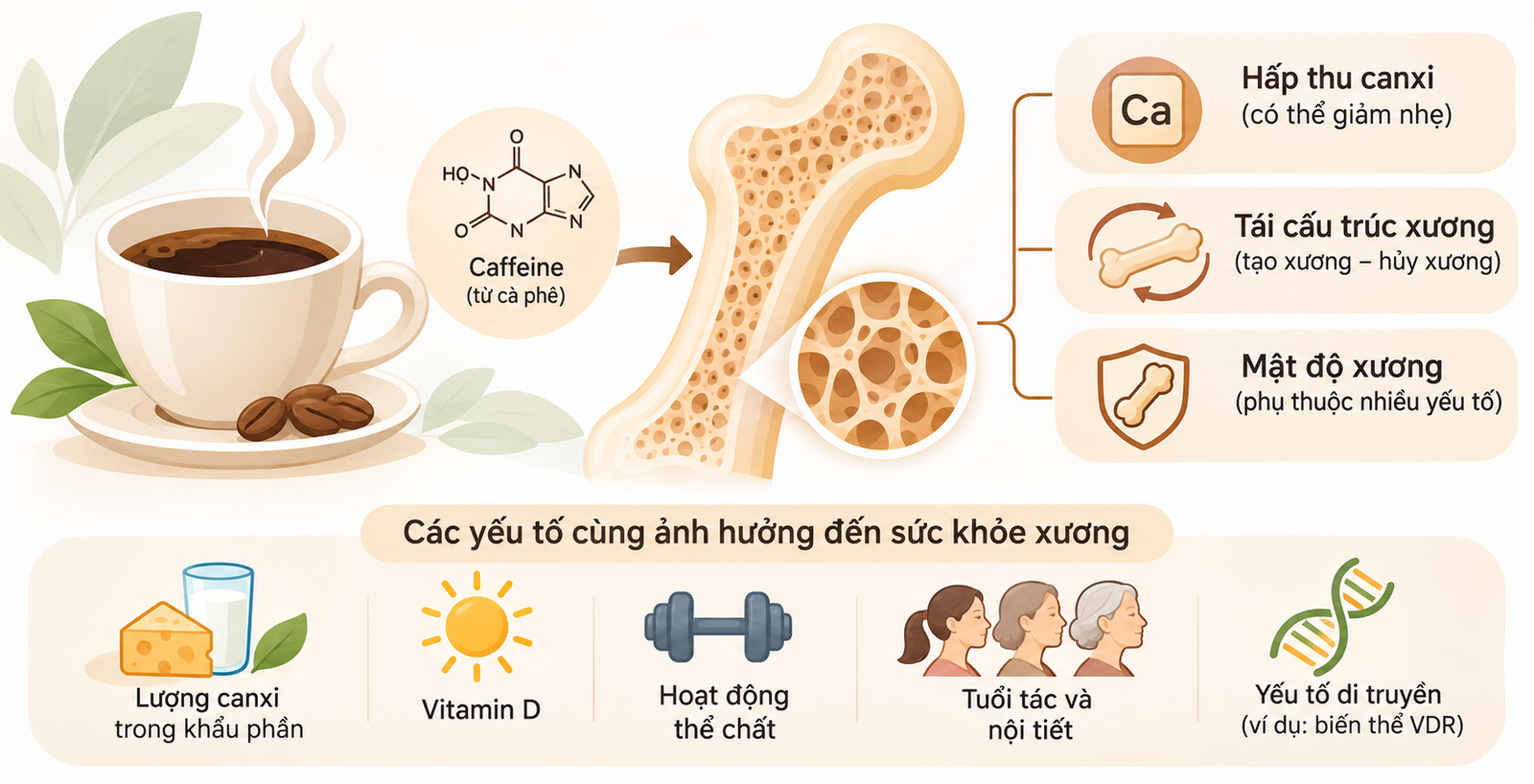
Caffeine does not directly remove calcium from bones in a simple way, as many online content often describes.
The effects studied more extensively lie in its ability to slightly alter calcium absorption efficiency in the gut and some components of the body's calcium balance.
To evaluate correctly, we need to distinguish:
- 4. Calcium absorption: the amount of calcium from food that passes through the intestinal wall into the bloodstream.
- 5. Calcium excretion: the amount of calcium excreted, mainly through urine and feces.
- 6. Calcium balance: the difference between the amount of calcium absorbed and the amount lost over a period of time.
A 2002 scientific review by Heaney found that caffeine had a small effect on reducing calcium absorption in the gut, but did not record a clear impact on the total amount of calcium excreted through urine in 24 hours in balanced studies.
3. What do human trials show?
A 1990 double-blind, placebo-controlled trial published in the American Journal of Clinical Nutrition evaluated 400 mg of caffeine per day in 16 healthy premenopausal women.
The study design used a crossover model, in which participants went through both the caffeine and placebo phases. Each phase lasted 19 days.
The results did not show statistically significant differences in:
- Calcium absorption rate in the intestinal segments.
- Endogenous calcium excretion in the feces.
- Endogenous calcium excretion in the urine.
A study found some minor changes in bone metabolism indicators, but did not prove that caffeine at the tested level caused bone density loss.
This is valuable evidence because it was conducted according to a randomized controlled design. However, the 19-day duration and sample size of 16 people were not sufficient to conclude about the risk of osteoporosis or fractures after many years.
Why do some studies suggest that caffeine may reduce bone density?
A 2001 study published in the American Journal of Clinical Nutrition evaluated bone mineral density in 489 older women, including 96 women who were followed for changes in bone density over three years.
The research team found that women with caffeine intake above 300 mg/day had a higher rate of bone density loss in the spine compared to the lower intake group in the follow-up analysis.
However, the results need to be read in the context of the study:
- The subjects were older women, approximately 65-77 years old.
- The longitudinal cohort had only 96 people.
- The average calcium intake in the high-caffeine group was lower than in the low-caffeine group at the initial time point.
- The study also noted the potential interaction with the vitamin D receptor gene variant.
This suggests that the effect of caffeine may not be the same in every population. However, the observational study and small cohort were not sufficient to prove that caffeine is an independent cause of bone loss.
5. Do newer meta-analyses provide a more unified conclusion?
This is the most important part to avoid interpreting a single study as a general affirmation.
A 2022 meta-analysis
Zeng et al. published a systematic review and meta-analysis on Osteoporosis International, including:
- 4 studies with 7,114 participants on the risk of osteoporosis.
- 13 studies with 391,956 participants on the risk of fractures.
The results showed that the high-caffeine group had a lower risk of osteoporosis compared to the low-caffeine group, with a pooled OR of 0.79 (95% CI: 0.65-0.92).
However, when evaluating fractures, the results did not show a statistically significant effect:
| Results | Estimate | Interpretation |
|---|---|---|
| Osteoporosis risk | OR 0.79 | There is a favorable association in the pooled analysis |
| Hip fracture | OR 0.86; CI 0.67–1.05 | No statistical significance |
| Femoral fracture | OR 0.89; CI 0.42–1.36 | No statistical significance |
This is a point to distinguish: a relationship with osteoporosis risk does not automatically mean that the risk of fracture also decreases.
2023 meta-analysis on caffeine and fracture risk
Asoudeh et al. pooled 22 observational studies, including 15 cohort studies and 7 case-control studies.
The research group did not find a statistically significant association between the amount of coffee consumed and the risk of fracture when pooling the cohort studies (RR 0.99; 95% CI: 0.88–1.12).
In contrast, the analysis of total caffeine intake found a positive association with fracture risk (RR 1.15; 95% CI: 1.08–1.23). Each additional 100 mg of caffeine was associated with a 2% increase in risk in the dose-response model, but the heterogeneity between studies was still significant.
This shows that the results of coffee should not be equated with the results of total caffeine from all sources. Coffee is a chemical mixture, in which caffeine is only one component.
Meta-analysis in 2025 and umbrella review in 2025
A meta-analysis published in Frontiers in Nutrition in 2025, including 14 observational studies with a total of 562,838 participants, found an association between coffee consumption and lower risk of osteoporosis (OR 0.79; 95% CI: 0.73–0.84).
This is a notable result, but the entire data was pooled from observational studies. Therefore, it is not possible to confirm that drinking coffee reduces the risk of osteoporosis.
In particular, an umbrella review published in the Journal of Global Health on August 4, 2025, evaluated 20 meta-analyses on beverages and musculoskeletal diseases. The results of the research group showed that the evidence for coffee was still inconsistent and did not find a statistically significant association between coffee and major musculoskeletal diseases.
6. What factors can change the impact of caffeine?
Dietary calcium intake
Individuals with a calcium-deficient diet may be more susceptible to changes in calcium balance compared to those who meet their nutritional needs.
Some studies in postmenopausal women have found a stronger association between high caffeine intake and bone loss in the group with low calcium intake. However, this is not evidence that drinking coffee requires calcium supplementation after each cup.
Age and hormonal status
Bone loss may accelerate with age and after menopause. Hormonal changes, particularly estrogen, affect the balance between bone formation and resorption.
Because of this, the results from the study in postmenopausal women cannot be automatically applied to young people or men.
Vitamin D and physical activity
Vitamin D participates in regulating calcium metabolism. Load-bearing activity and resistance training are also factors that are significant for maintaining bone structure.
Assessing the risk of osteoporosis needs to look at the entire lifestyle and health status, rather than just relying on the number of cups of coffee per day.
7. What should coffee drinkers be aware of?
Current evidence does not support the idea that everyone should eliminate coffee to protect bones. However, caffeine use needs to be placed in the context of overall nutrition and health.
- Do not use coffee as a substitute for food sources of calcium.
- Maintain a diet with sufficient calcium, vitamin D, and protein according to individual needs.
- Do not increase caffeine intake with the intention of improving health or bone metabolism.
- Maintain physical activity, especially load-bearing and resistance training appropriate for age.
- Pay attention to total caffeine from coffee, tea, energy drinks, and other sources.
The amount of caffeine in each cup varies according to the Arabica-Robusta ratio, powder quantity, roast level, and extraction method. Therefore, the number of cups is not a unit of measurement that accurately compares consumption between individuals.
Scientific perspective of SAVINA
The right question is not whether coffee is good or bad for bones, but how the amount of caffeine, nutritional status, and individual biological characteristics may interact.
Caffeine may have a small effect on calcium absorption. Some studies in older women have found faster bone loss when consuming high levels of caffeine, while short-term experiments and many systematic reviews have not confirmed a consistent adverse effect of coffee on the risk of fractures.
In particular, the favorable association between coffee and the risk of osteoporosis in some observational studies does not mean a preventive effect. There is also no basis to recommend drinking more coffee to protect bone density.
For coffee lovers, a reasonable approach is to maintain a suitable amount of use, not letting coffee replace a full diet of essential nutrients, and paying attention to bone health as part of a long-term lifestyle.
Reference
- Barger-Lux MJ, Heaney RP. (1990). Effects of moderate caffeine intake on the calcium economy of premenopausal women. American Journal of Clinical Nutrition. PMID: 2403065.
- Heaney RP. (2002). Effects of caffeine on bone and the calcium economy. Food and Chemical Toxicology. PMID: 12204390.
- Rapuri PB et al. (2001). Caffeine intake increases the rate of bone loss in elderly women and interacts with vitamin D receptor genotypes. American Journal of Clinical Nutrition. Full study.
- Zeng X et al. (2022). The association of coffee consumption with the risk of osteoporosis and fractures: a systematic review and meta-analysis. Osteoporosis International. PMID: 35426508.
- Asoudeh F et al. (2023). Coffee consumption and caffeine intake in relation to risk of fractures: a systematic review and dose-response meta-analysis of observational studies. Critical Reviews in Food Science and Nutrition. PMID: 35475944.
- Li W et al. (2025). Coffee and tea consumption on the risk of osteoporosis: a meta-analysis. Frontiers in Nutrition. DOI: 10.3389/fnut.2025.1559835.
- Tan H et al. (2025). Beverage consumption on bone and joint disorders: an umbrella review. Journal of Global Health. PMID: 40755011
A comprehensive review of scientific research up to November 4, 2026. The observed results do not demonstrate a causal relationship.