
Shade trees in Robusta gardens: Why do young and old gardens respond differently?
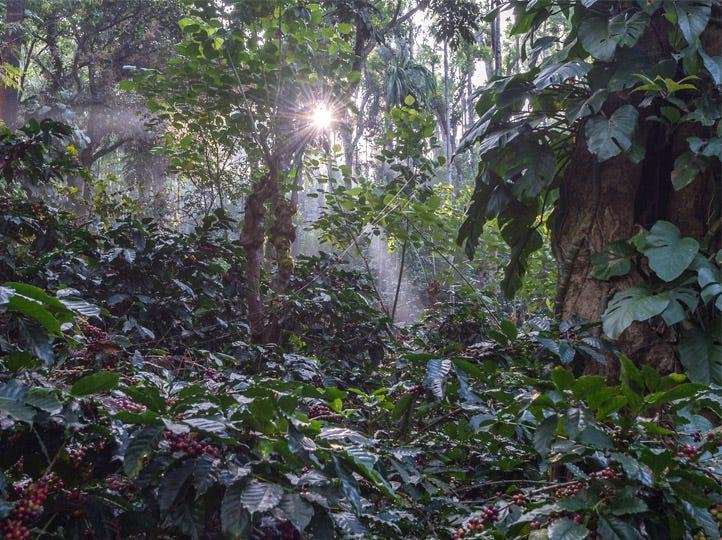
Intercropping with shade trees is often cited as a solution to help coffee gardens adapt to heat and climate variability. However, observing Robusta gardens at different growth stages reveals that the effectiveness of shade trees is not always consistent.
A field study in the former Đắk Hà area of Kon Tum yielded a notable result: shade trees significantly increased yield in young reproductive-stage gardens, but had no statistically significant impact on old reproductive-stage gardens.
133 farming households were included in the study
Le et al. published the study in the journal Agronomy in 2023. The authors surveyed 133 Robusta farms, randomly selected from two soil types: sandy loam and clay. The gardens were further categorized by reproductive stage and the presence or absence of shade trees.
In addition to yield, the research team collected topsoil samples to analyze 16 indicators, including characteristics related to soil texture, nutrients, and cation exchange capacity.
For gardens in the young reproductive stage, the recorded yields were as follows:
| Soil type | With shade trees | Without shade trees |
|---|---|---|
| Sandy loam | 4.4 tons/ha | 3.3 tons/ha |
| Clay | 4.2 tons/ha | 3.4 tons/ha |
In both soil types, gardens with shade trees achieved higher yields during the young reproductive stage. Overall, the study reported an increase of approximately 28%.
However, in old reproductive-stage gardens, the difference was no longer statistically significant. On sandy loam, yields were 4.0 and 3.5 tons/ha, respectively; on clay, they were 3.9 and 3.7 tons/ha. One cannot conclude from these arithmetic differences that shade trees always increase yield in old gardens.
What might explain this difference?
The authors noted that shade trees did not cause statistically significant changes in the analyzed soil properties. This suggests that the impact on yield under the study conditions may be more closely related to microclimatic changes around the coffee canopy.
Large tree canopies can reduce direct radiation intensity, limit temperature extremes, and alter air humidity around the plants. However, the extent of impact depends on canopy structure, tree density, rainfall, soil, and the garden's growth stage.
These results should not be interpreted as a rule that young gardens always need shade while old gardens do not. The study highlights differences between the two garden groups under the surveyed conditions, but does not establish a universal shading formula for all Robusta regions.
More shade does not necessarily mean better quality
A meta-analysis by Piato et al., published in 2020, synthesized 30 empirical studies on the effects of shade trees on Robusta. The results indicated that shade trees can improve growth and yield under certain conditions, but also create trade-offs in biochemical characteristics and beverage quality.
The analysis noted that shade levels above 30% were associated with a decline in beverage quality across the synthesized studies. The impact also depends on location, rainfall, tree age, and Robusta variety.
This is not a technical threshold that can be mechanically applied to every coffee farm in Vietnam. The synthesized studies date up to 2019, while climatic conditions, varieties, and farm management practices can vary significantly across regions.
Do not look only at the number of intercropped plants
In practice, two farms with shade trees can still create very different environments. A farm with tall, sparse canopies that are regularly pruned is not the same as one with low, dense canopies that compete strongly for water.
To assess shading effectiveness, multiple indicators should be monitored simultaneously rather than just counting intercropped plants:
- Canopy cover: Record the area of shade tree canopy covering the ground and the actual light reaching the coffee canopy.
- Temperature and humidity: Compare the microclimate in areas with and without shade trees under the same weather conditions.
- Soil moisture: Monitor moisture at appropriate soil depths to identify both the benefits of reduced evaporation and the risk of water competition from intercropped plants.
- Farm age and status: Do not combine farms in commercial production with those that have undergone multiple harvesting cycles when evaluating yield.
- Cherry and bean quality: Monitor the proportion of ripe cherries, bean size, green bean weight, and sensory quality if the goal is high-quality coffee.
Test in specific areas before scaling up
For farms needing to adapt to heat stress, shade trees can be a useful component of the farming system. However, the decision to intercrop must consider farm age, soil type, water sources, root characteristics of the shade trees, and canopy management capabilities.
A prudent approach is to establish controlled trial plots within the same farm, keeping other care factors relatively uniform and monitoring over several seasons. This helps growers determine whether benefits stem from reduced radiation, microclimate changes, or inherent differences between land plots.
Shade trees are not a switch that, when turned on, increases yield. Their value lies in appropriate arrangement according to the tree age, soil, and climatic conditions of each farm.
Read more about cultivation and growing regions at SAVINA Coffee Knowledge Library.
References
- Le, V. H., Truong, C. T., Le, A. H. & Nguyen, B. T. (2023). A Combination of Shade Trees and Soil Characteristics May Determine Robusta Coffee (Coffea canephora) Yield in a Tropical Monsoon Environment. Agronomy, 13(1), 65. https://doi.org/10.3390/agronomy13010065
- Piato, K. et al. (2020). Effects of shade trees on robusta coffee growth, yield and quality. A meta-analysis. Agronomy for Sustainable Development, 40, 38. https://doi.org/10.1007/s13593-020-00642-3