
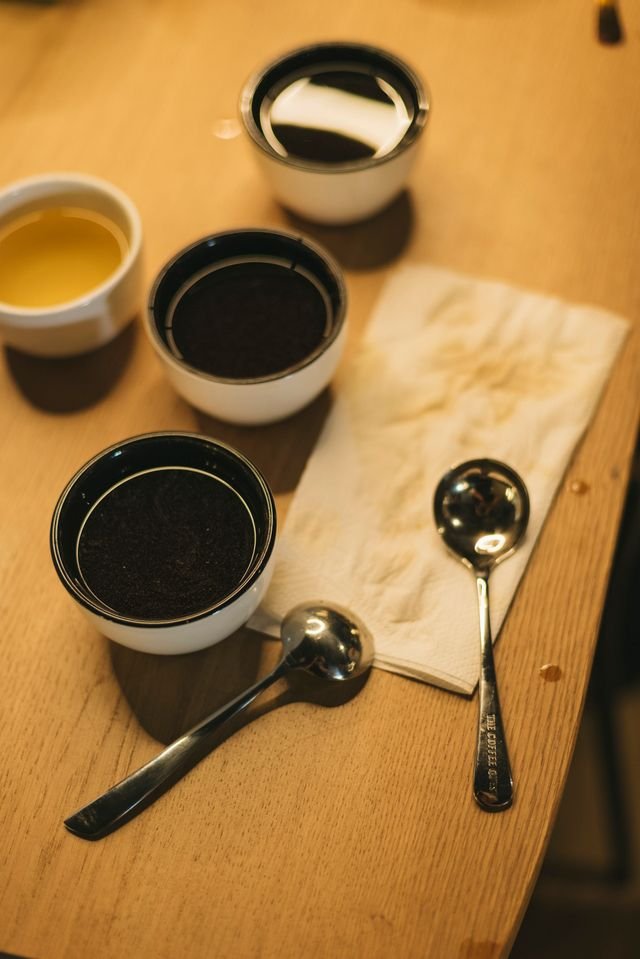
Coffee sensory calibration: Why do tasters need to synchronize their language?
With the same coffee sample, one person perceives ripe fruit aromas, while another describes it as having a gentle sweetness or caramel notes. This difference does not necessarily mean one person is right and the other is wrong. The issue truly arises when differing perceptions are used to draw conclusions about quality, set prices, or make buying and selling decisions without a shared understanding.
1. Coffee sensory evaluation is not just the ability to identify flavors
When cupping coffee, we receive multiple signals simultaneously: aroma, acidity, sweetness, bitterness, mouthfeel, body, aftertaste, and the balance among these attributes. The brain then interprets these signals into familiar descriptors such as orange, apple, honey, chocolate, or other aromatic groups.
However, sensory perception is not identical across individuals. Cupping experience, olfactory memory, familiarity with reference samples, physical state, and the cupping context can all influence how a person interprets a coffee sample.
Therefore, a skilled taster needs more than just the ability to identify many flavors. They must also express their perceptions clearly, use consistent terminology, and distinguish what they actually perceive from speculation about the causes of that perception.
For example, when describing a coffee sample with notes reminiscent of red apple, the taster is providing a sensory description. This does not mean the coffee necessarily contains red apple, nor does it automatically prove the sample is of high or low quality.
2. Why does the same coffee sample yield multiple descriptions?
Differences in sensory language usually stem from three main issues: detection capability, interpretation, and terminology usage.
Differences in detection capability
One person may easily recognize fruit aromas but struggle to distinguish between orange, lemon, and tangerine. Another may have better detection of spice or chocolate notes. This is a difference in experience and sensory sensitivity; one should not assume that one person is always more accurate than the other in every situation.
Differences in interpretation
A bright acidity might lead one taster to associate it with citrus fruits. Another might describe the sensation using terms related to the freshness or brightness of the acidity. These expressions may be similar in perception but are not entirely synonymous.
Differences in terminology understanding
This is particularly important when multiple people evaluate the same coffee sample. If one person understands "bright acidity" as a fresh, clear, and vibrant sensation, while another uses the term to indicate strong acidity, the exchange of results will lack consistency even though both are tasting the same sample.
Therefore, sensory calibration does not aim to force everyone to have identical experiences. The goal is to build a sufficiently clear shared understanding so that participants can describe, compare, and exchange results more reliably.
3. What is sensory calibration?
Sensory calibration is the process of helping tasters understand and use terminology more consistently by comparing descriptions, reference samples, and cupping results.
In practice, this process can occur at two levels.
Individual calibration
The taster becomes familiar with terminology, compares definitions, and practices identifying reference samples. The goal is to build the ability to distinguish between similar perceptions, memorize the characteristics of each aromatic group, and express them more accurately.
Group calibration
Multiple people cup the same sample under relatively uniform conditions, then compare their descriptions and evaluation results. Points of difference are discussed to identify the cause: whether due to terminology understanding, detection capability, use of rating scales, or sample preparation conditions.
The group's average score can serve as a reference point for assessing dispersion. However, the group average is not inherently the absolute correct answer. If the sample preparation method is inappropriate or the entire group misinterprets a term, the consensus result may still be inaccurate.
4. Why does sensory language influence commercial decisions?
Within the coffee supply chain, sensory results can support sample classification, flavor profile description, communication of quality requirements, and selection of raw materials suitable for their intended use.
When suppliers and buyers interpret terms differently, the risk extends beyond the description itself. The two parties may have different mental images of the product being offered, leading to sample selection, approval, or price negotiations that are not based on a common foundation.
Example: Discrepancies in scoring
Suppose an evaluation system uses a 100-point scale, and two cuppers score the same sample at 79.5 and 80.5 points, respectively. A one-point difference in this example does not automatically prove that either evaluator is wrong. It signals the need to review how criteria are applied, the repeatability of the evaluation, and the significance of the classification threshold being used.
If a company sets an internal threshold at 80 points, this difference could cause the sample to be classified into two different groups within that company's process. The commercial impact then depends on the contract, purchasing standards, and how the scores are utilized.
It should be noted that the above example only illustrates the risk at a hypothetical score threshold. One cannot conclude that every one-point difference changes the selling price or coffee quality. In particular, the 100-point scale should not be directly converted to results from the Coffee Value Assessment (CVA) method unless the corresponding methodology and evaluation rules are clearly defined.
The key lesson is that companies must align on evaluation methods, cupping conditions, terminology, and interpretation of results before using sensory data for commercial decisions.
5. Distinguishing between sensory description, intensity, and quality assessment
One reason why cupping results are difficult to align is the use of a single comment to represent multiple different aspects. In practice, describing a characteristic, assessing its intensity, and evaluating preference are distinct tasks.
| Aspect | Question to be answered | Illustrative example |
|---|---|---|
| Sensory description | Which characteristic is perceived? | Reminiscent of orange, honey, or chocolate. |
| Intensity | How strongly is the characteristic perceived? | The orange aroma has low or distinct intensity. |
| Perception assessment | How does the cupper evaluate the characteristic? | The acidity is evaluated as pleasant or unsuitable for the product target. |
A high-intensity characteristic does not necessarily mean good quality, nor does low intensity automatically constitute a defect. The significance of a characteristic depends on the overall sample, intended use, evaluation criteria, and the method applied.
In the Coffee Value Assessment (CVA) method, the description of sensory characteristics and the assessment of preference or perceived value are distinguished by evaluation section. When using a scoring tool, cuppers must read the instructions carefully and avoid automatically combining all comments into a single total score.
Information on the tool’s structure and how to distinguish evaluation components is presented in the SAVINA Coffee Sensory System.
6. How to practice sensory calibration more effectively
Step 1: Agree on terminology
Before group cupping, agree on the meanings of commonly used terms. Do not merely list flavor names; provide clear definitions so participants understand what sensation each term describes.
Step 2: Use appropriate reference samples
Reference samples help cuppers associate terms with specific experiences. When preparing samples, pay attention to ingredient quality, freshness, concentration, brewing method, and storage conditions. Reference samples should be regarded as learning aids, not as proof that everyone will perceive them identically.
Step 3: Cup independently before discussion
Each participant should record their own perceptions before hearing others’ opinions. This approach helps prevent cuppers’ descriptions from being overly influenced by suggestions made within the group.
Step 4: Compare results and identify causes of deviation
When results differ, do not focus solely on identifying who scored highest or lowest. Consider whether discrepancies lie in terminology, intensity, quality assessment, or cupping conditions. If necessary, repeat the test with a more consistent sample preparation protocol.
Step 5: Track progress over time
Calibration is an ongoing practice. Recording results across multiple sessions helps cuppers recognize which terms they frequently confuse, which flavor groups they do not yet identify consistently, and which evaluation components show high variability.
7. Practice with the SAVINA coffee sensory tool
To support the learning and use of sensory terminology, SAVINA has built a lookup and practice platform for Vietnamese coffee, with separate content for Robusta and Arabica.
The system focuses on independently compiled sensory descriptions. Each entry may include a sensory definition, reference samples for calibration, and factors in cultivation, processing, or roasting that may influence the described attribute.
Users can access the following functional modules:
- Lookup: search for terms and consult interpretations of sensory attributes.
- Practice: practice categorizing terms, identifying terms from definitions, linking influencing factors, and comparing with reference samples.
- Cupping: record sample information and practice evaluation using the provided form structure.
- Calibration: support comparison of results across cupping sessions or among group members.
The tool helps users practice terminology and examine differences in evaluation approaches. However, practice results do not replace actual sample cupping, professional training, or a company’s quality control procedures.
You can access it directly here: SAVINA Coffee Sensory – Lookup, Practice, Cupping, and Calibration.
Note: SAVINA is an independent system, not a product of the Specialty Coffee Association (SCA) or World Coffee Research, and the tool does not issue or replace Q Grader certification. When using forms and scoring scales, refer to the tool’s specific guidelines and the standards applicable to your work.
8. From sensory language to deeper coffee understanding
Sensory language is truly useful only when cuppers understand the relationship between perceived attributes and the factors that may contribute to forming those attributes. Coffee variety, growing conditions, ripeness at harvest, processing methods, roasting process, and brewing method can all influence the result in the cup.
Nevertheless, one should not make absolute reverse inferences from a single flavor note to a specific coffee variety or processing method. Descriptors such as bright acidity, fruity aroma, or sweet aftertaste are insufficient to uniquely determine the origin or process that produced the sample.
For instance, citric acid and malic acid are compounds associated with sourness in coffee. However, the final perception of acidity depends not only on the presence of individual acids; it is also influenced by the overall chemical composition, roast level, and extraction conditions.
Read more: Citric and Malic Acids in Coffee: From Farm to Roastery to learn more about these two organic acids.
9. Frequently Asked Questions about Coffee Sensory Calibration
Does sensory calibration mean that everyone must describe things identically?
No. The goal is to increase consistency in terminology understanding and evaluation execution. Differences in personal experience may still exist and should be acknowledged, rather than automatically considered incorrect.
Is the group average score the absolutely correct answer?
No. The average score serves as a reference point for consensus and dispersion. One must also consider the methodology, cupping conditions, evaluation criteria, and data quality before drawing conclusions.
Do flavor descriptions prove that the coffee contains those ingredients?
No. Sensory descriptions typically express similarities in aroma or taste experiences. For example, "honey aroma" does not mean honey was added to the coffee sample.
Does the SAVINA tool replace Q Grader certification?
No. The SAVINA tool supports lookup, practice, cupping, and calibration. It is not a Q Grader certification program and is not considered an official SCA certification.
Where should one start practicing sensory skills?
Start by learning term definitions, comparing reference samples, practicing independent description, and comparing results after cupping. You can begin at the SAVINA Coffee Sensory page .