
Why is it necessary to sort coffee cherries after harvest?
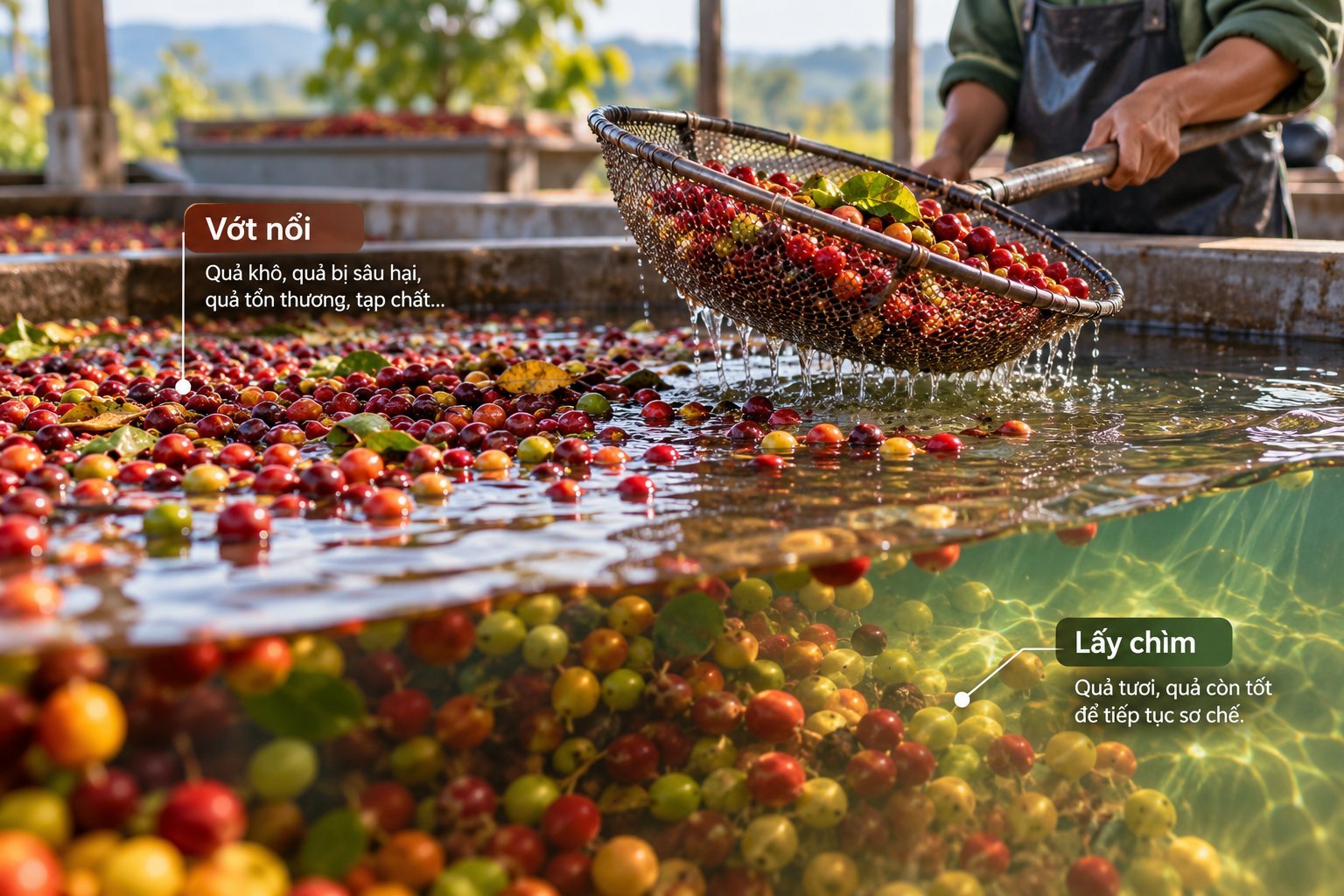
Coffee growers in the Central Highlands are certainly familiar with the step of removing floating cherries and collecting sinking ones after harvesting. The coffee cherries are placed in water; those floating on the surface are skimmed off, while the sinking group is gathered for further primary processing. The operation may seem simple, but it is based on physical principles and knowledge that coffee professionals need to understand to sort raw materials more accurately.
In primary processing techniques, this step is often called flotation sorting. The purpose is not only to separate floating cherries from sinking ones, but also to help processors identify groups of cherries with different characteristics, thereby enabling appropriate inspection and selection of processing methods.
Why do some coffee cherries float while others sink?
When coffee cherries are placed in water, whether they float or sink depends on their average density relative to water. Internal moisture content, cherry structure, trapped air pockets, and conditions such as dryness or damage can all affect the outcome.
After harvest, a coffee lot may include fresh cherries, dried-on-tree cherries, insect-damaged cherries, or shriveled cherries. These cherries do not necessarily share the same physical properties. Therefore, when placed in water, they may behave differently.
This is also why coffee professionals pay close attention to the floating group. This group may contain dried, empty, or damaged cherries that require separate inspection. However, one cannot conclude the quality of individual cherries solely based on their position in the water tank.
Does removing floating cherries mean discarding low-quality cherries?
This should not be interpreted absolutely. Floating cherries are usually inspected carefully because they may contain more dried or defective cherries, but floating status does not necessarily mean the cherry is definitely spoiled.
For instance, a shriveled, bored, or damaged cherry needs to be assessed differently from an intact cherry that floats due to its specific physical properties. If all floating cherries are removed and discarded without inspection, processors may discard usable cherries as well.
The reasonable approach is to skim off the floating group separately, observe the condition of the cherries, and check representative samples. Damaged, insect-infested, or non-compliant cherries should be discarded or processed separately according to the facility's procedures.
The sinking group should also not be considered entirely standard. Unripe green cherries may still sink to the bottom of the tank; damaged cherries do not necessarily float. To ensure uniform raw materials, processors still need to observe ripeness, color, and external condition of the cherries.
How should floating removal and sinking collection be performed?
1. Remove impurities before placing cherries in water
First, pick out easily recognizable impurities such as branches, leaves, ties, soil, stones, and foreign objects. Preliminary cleaning makes operations in the tank easier, limits dirt accumulation, and reduces workload for subsequent processing steps.
If freshly harvested coffee still contains many leaves, branches, or soil, do not rely entirely on the water tank for cleaning. Different impurities have different properties; some may float, some may sink, while objects with properties similar to coffee cherries may be difficult to separate using this method.
2. Place cherries in the water tank in appropriate quantities
Use clean water and a sufficient quantity of raw material to allow easy observation and collection. If too many cherries are added at once, overlapping cherries will make it difficult to accurately distinguish between floating and sinking groups.
Pay attention to tank hygiene and water quality throughout the process. Water with excessive soil, organic debris, or accumulated impurities will reduce cleaning efficiency and may cause cross-contamination between batches of raw material.
3. Skim off the floating group for separate inspection
Once the cherries have distributed themselves on the water surface and at the bottom of the tank, use appropriate tools to skim off the floating group to a separate area. Do not hastily conclude that this group consists entirely of bad cherries. Observe how many are shriveled, insect-damaged, bruised, or still intact.
For coffee lots with an abnormally high proportion of floating cherries, recheck the input raw material. Causes may be related to harvesting methods, the condition of cherries before delivery to the processing point, or storage time after harvest.
4. Collect the sinking cherries and continue sorting
The sinking group is collected separately for further primary processing. However, if the goal is to improve quality, check whether this group contains many green cherries, damaged cherries, or cherries showing signs of pests or diseases.
Depending on the processing method, equipment conditions, and quality requirements, coffee producers may decide to process certain cherry groups separately. Maintaining uniformity in raw materials from the start facilitates monitoring of the processing phase and evaluation of final product quality.
Does floating removal and sinking collection distinguish between green and ripe cherries?
This is a point requiring special attention. Cherry ripeness and float–sink status are two distinct characteristics. Color helps harvesters relatively identify the fruit’s development stage, while flotation sorting reflects the physical properties of the cherries when in contact with water.
A green cherry may still sink, while a ripe cherry may float if it is dry or has a different structure. Therefore, if the coffee lot is harvested with varying degrees of ripeness, merely removing floating cherries and collecting sinking ones is insufficient to produce uniform raw material.
For better control, water sorting should be combined with selective harvesting or visual sorting. These two processes complement each other: one groups cherries by float–sink characteristics, while the other identifies color, ripeness, and observable defects.
Limitations processors need to know
| Characteristics to check | How does floating removal and sinking collection help? | What additional steps are needed? |
|---|---|---|
| Dry, shriveled, or damaged cherries | Helps identify a group with distinct floating characteristics | Visual inspection before deciding on removal |
| Cherry ripeness | Cannot be accurately determined by float–sink status alone | Observe color, development level, and uniformity |
| Impurities | Can help separate certain types based on physical properties | Combine with sieving, manual picking, or appropriate equipment |
| Bean quality and flavor | Cannot be directly assessed | Inspect for defects, processing profiles, and conduct sensory evaluation as needed |
Furthermore, using water implies the need to manage water sources and wastewater. Processing facilities should arrange adequate drainage areas, clean tanks regularly, and prevent contaminated water from coming back into contact with cleaned raw material.
Application to Robusta processing in the Central Highlands
In the Central Highlands, Robusta can be harvested in several ways: selective picking of ripe cherries, strip picking by batches, or branch stripping. Each harvesting method yields a different level of uniformity, so post-harvest sorting must be adjusted according to the condition of the raw material.
For Natural process coffee, cherries are dried whole. If the batch contains many green cherries, dry-on-tree cherries, or damaged cherries, the processor should consider sorting before drying. When distinct groups of cherries are mixed together, monitoring the drying process and evaluating the final product become more difficult.
In the Washed method, sorting and cleaning are preparatory steps before pulping. However, quality still depends on pulper operation, fermentation management, washing, and drying. Effective flotation sorting cannot replace control over subsequent steps.
To assess effectiveness, processors can record the input coffee weight, the quantity of floating cherries, the quantity of sinking cherries, and the defect rate within each group. After several harvests or multiple batches, these records will help identify which harvesting and sorting methods are better suited to the farm's actual conditions.
Effective sorting begins with a correct understanding of the raw material.
Skimming floaters and collecting sinkers is a familiar and useful practice in coffee processing, but the results are truly valuable only when the coffee producer knows how to interpret and handle each group of cherries. Floating cherries need inspection, sinking cherries still require sorting, and ripeness must be assessed using appropriate indicators.
When these steps are combined with proper harvesting, thorough cleaning, and careful processing management, producers have a stronger basis for controlling raw material uniformity. Coffee quality is not determined by a single operation but is shaped by many correct decisions made while the cherries are still on the tree.
References
- Food and Agriculture Organization of the United Nations (FAO). Post-harvest Handling and Processing of Green Coffee in African Countries. Read document.
- International Trade Centre (ITC). The Coffee Exporter's Guide – Third Edition. An overview of coffee harvesting, grading, and processing. Read PDF.
Learn more about cherry structure, ripeness, and processing methods at SAVINA Coffee Knowledge Library.