
Coffee berry borer: Life cycle hidden within the bean and methods to cut off infestation sources before harvest
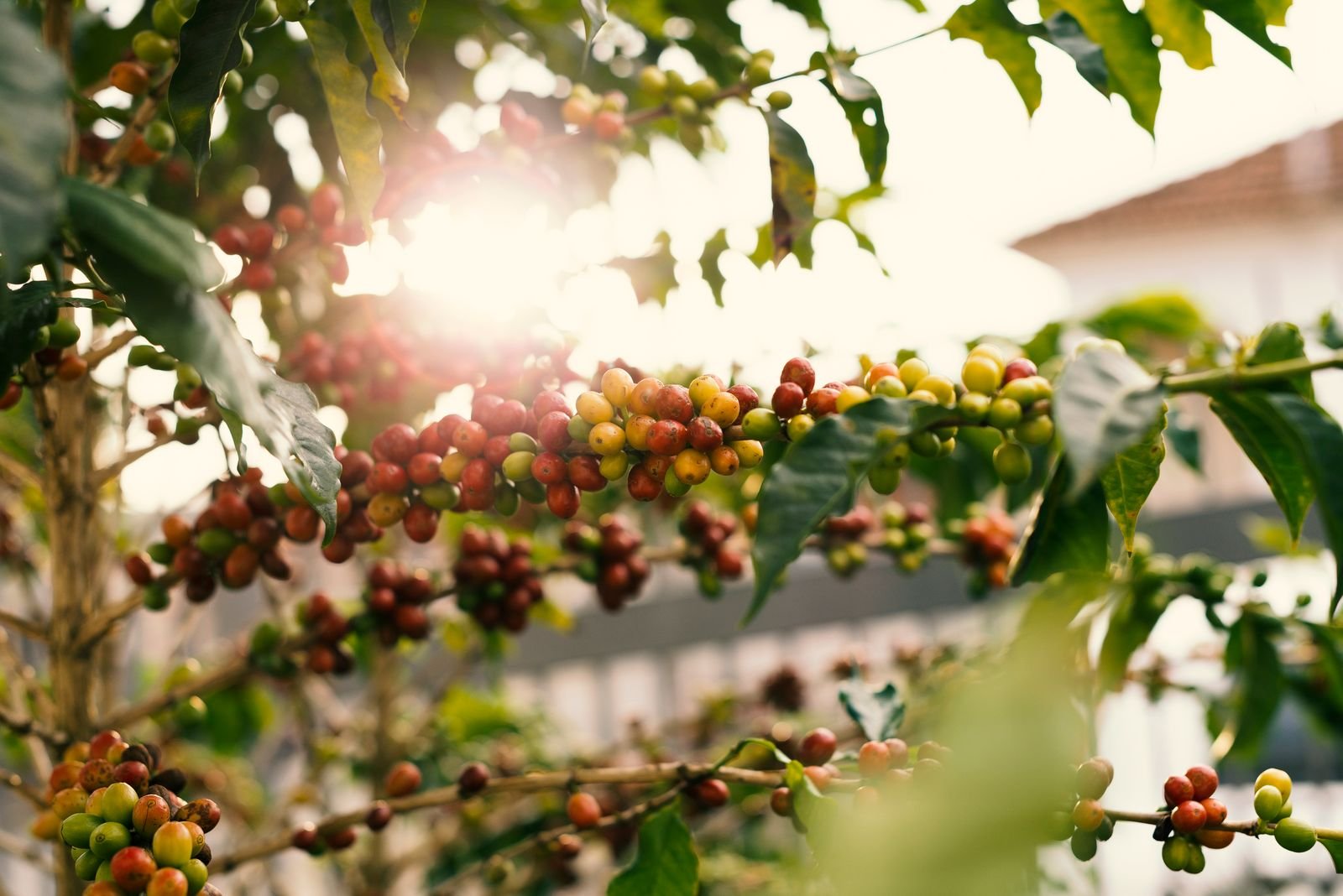
A small round hole at the berry apex is the only externally visible sign. Behind this entry hole, the female beetle has tunneled into the endosperm, laid eggs, and reared nearly an entire generation within the bean. This cryptic lifestyle dictates all control measures: any method that cannot reach the remaining infested berries effectively fails to impact the borer population.
- At what rate does the coffee berry borer reproduce within the bean, and how does temperature influence this rate?
- How many individual borers are contained in a single dry berry remaining on the tree or on the ground?
- Which measures have had their efficacy quantified by data, rather than relying solely on anecdotal experience?
Identifying a berry infested by borers
The adult female bores a small hole into the berry, typically at the apex, then tunnels through the bean and lays eggs inside. The hatched larvae continue to feed on the endosperm, the most nutrient-rich tissue of the bean. University of Hawaii documentation outlines three typical damage patterns [2].
| Damage type | Process within the berry | Visible consequences |
| Premature drop of young berries | Borers invade when the berries are still immature, before the endosperm has hardened sufficiently to support the next generation | Berries fall beneath the plant before the scheduled harvest period |
| Internal rotting of the berry | Entry holes provide pathways for fungi and bacteria to penetrate the interior | Beans turn black, reducing lot quality |
| Beans hollowed out by feeding | Females and larvae feed on the endosperm over an extended period | Complete loss of one bean; in severe cases, loss of both beans within the cherry |
Borers preferentially select berries that have developed for more than 120 days after flowering and have a dry matter content above 20 percent. Younger berries can still be infested, but females must wait within the entry tunnel until the endosperm hardens sufficiently before tunneling further and beginning oviposition. This waiting period explains why mature green berries often suffer heavier damage than very young berries [1]. The layered structure of the berry and the role of the endosperm are detailed in the article Coffee Berry Structure and the Role of Each Layer in Processing.
Why it suffices to block females from entering the berry
Within an infested berry, individuals mate with siblings of the same generation. The sex ratio is heavily skewed toward females, approximately 10 females to 1 male. Males are flightless and remain inside the berry throughout their lives, whereas females exit the berry in a fertilized state, ready to immediately invade the next berry [1] [2].
Each female lays 1 to 3 eggs per day over approximately 20 days, and overview literature records cases of a single female laying up to 119 eggs in a single berry [1]. The management implication is clear: the only window during which chemical or biological controls can effectively target the borer is the brief period when females are flying and seeking new berries. Once inside the bean, the population is largely beyond the reach of interventions [3].
Life cycle viewed from laboratory data
A research team at the University of Puerto Rico reared the borer on artificial diet at 25°C and measured the duration of each stage. The diagram below accurately plots these measured milestones: eggs take about 6 days to hatch, the larval stage comprises two instars lasting about 17.2 days, the pupal stage lasts about 6 days, and young adults require an additional 4 days before reaching maturity. The total measured development time ranges from 32.9 to 35.9 days [3].
Life cycle diagram of the coffee berry borer at 25°C
Diagram drawn by SAVINA using SVG code based on data from Mariño et al. (2021) [3]. In the field, actual durations are shorter or longer depending on orchard temperature, as shown in the chart below.
How much temperature shortens the life cycle
A guide from the University of Hawaii summarizes the time to complete one life cycle at three temperature levels. At 27°C, the life cycle takes only about 21 days. At 22°C, this figure is 32 days. At 19.2°C, the life cycle extends to 63 days [2]. In other words, warm lowland orchards allow the borer to cycle about three times faster than cool highland orchards, so the same level of remaining fruit creates very different pressure between the two regions.
Chart of life cycle completion time by temperature
Chart drawn by SAVINA using SVG code based on summarized data from the University of Hawaii [2]. Practical implication: lowland orchards require more frequent fruit inspection than highland orchards, because each borer generation closes much faster.
How many borers does a single remaining dry berry contain
This figure explains why orchard sanitation is ranked above all other measures. The average number of borers per berry increases with ripeness and dryness: green berries contain about 2.9 individuals, ripe berries about 9.1, overripe berries about 23.4, and dry berries on the tree contain up to about 46.3 individuals [1]. Hawaiian documentation also records cases of a single berry containing up to 150 individuals during the period between harvests, and borers continue to reproduce in fallen berries and in parchment coffee as long as moisture content remains above 13.5 percent [2].
Chart of average number of borers per berry by berry status
Chart drawn by SAVINA using SVG code based on data summarized by Aristizábal et al. (2016) from research by Bustillo et al. [1]. The priority for collection is thus clear: dry and overripe berries must be harvested first and most thoroughly.
How to calculate the infestation rate when inspecting the orchard
Integrated management begins with measurement. The inspector counts the number of berries with entry holes in a representative sample, then applies the following formula.
Infestation rate (percent) equals the number of berries with entry holes divided by the total number of berries in the sample, multiplied by 100
Application example: a test sample has 1,000 berries, of which 63 have entry holes at the navel. The infestation rate is 63 divided by 1,000 multiplied by 100, i.e., 6.3 percent.
Alongside the infestation rate is the metric of post-harvest remaining fruit. The reference level proposed by Bustillo et al. and summarized by Aristizábal is that fewer than 5 remaining berries per tree is considered good, 6 to 10 berries indicates partial effectiveness, and more than 10 berries means cultural harvesting practices are considered ineffective [1]. Counting remaining berries is therefore no less important than counting bored berries. Methods for determining ripeness before harvesting are further presented in the article How coffee cherry ripeness affects the quality of raw materials for processing, and how strip-picking habits cause quality loss is analyzed in the article Losses from strip-picking habits: Controlling Brix levels to position high-segment coffee quality.
How effective has orchard sanitation been measured to be
In Colombia, where the borer was detected in 1988, regular and thorough harvesting including ripe, overripe, and dry berries reduced the infestation rate from about 70 percent to below 6 percent [1]. When workers were trained to harvest more cleanly, the average number of remaining berries dropped from 22.5 per tree to 6.5 per tree, and the damage rate on parchment coffee decreased from 2.3 percent to 0.7 percent [1].
In post-harvest operations, summarized measures include tying bag mouths tightly, moving bags to the processing facility twice daily instead of leaving them overnight in the orchard, shielding the processing area, and placing alcohol traps there to catch emerging borers [1]. Alcohol traps use a methanol and ethanol mixture in a 3:1 ratio primarily to monitor the presence and flight peaks of female borers; soapy water needs to be checked and replaced weekly according to University of Hawaii guidelines [2]. The fungus Beauveria bassiana is a commonly used biological agent, but it is only effective when female borers are outside the berry or have just contacted the berry surface, so application timing must follow flight peaks recorded by traps, and only locally registered products with label instructions should be used [1] [3].
Seasonal action schedule for coffee orchards
- Throughout the harvest seasonHarvest in short intervals, prioritizing trees with many overripe and dry berries. Berry bags must be tied tightly and moved to the processing site within the day. Harvested berries are sorted immediately, as per the process in the article Why coffee cherries need to be sorted after harvest.
- Immediately after the final harvest roundRemove all remaining berries on the tree and collect all fallen berries from the ground, including dry and out-of-season green berries. This is the most important sanitation round of the year as it cuts off the borer reservoir surviving through the season. Collected berries must be destroyed by deep burial or burning according to local guidelines, not left in piles near the orchard [2].
- At the drying yard and in storageReduce bean moisture content below the 13.5 percent threshold, above which borers continue to reproduce in parchment coffee and dry berries [2]. Shield the drying area and place alcohol traps around the processing zone to detect borers emerging from infested berries [1].
- Young fruit to mature green fruit stagePlace alcohol traps to monitor female borer flight peaks. When berries are more than 120 days post-flowering and the endosperm begins to harden, increase the frequency of sample inspections as this is when borers begin to bore and lay eggs vigorously [1].
- Before the first rains of the season High humidity above 90 percent after rain signals female beetles to leave old berries in search of new ones [1]. Orchard sanitation must be completed before this time; otherwise, the initial flight will spread from the remaining berries in your own orchard.
Three common misconceptions about coffee berry borer control
Frequently Asked Questions
Làm sao phân biệt lỗ đục của mọt với vết châm khác trên quả?
Borer entry holes are typically located at the berry navel, round and small, corresponding to the female beetle size of only 1.4 to 1.78 mm. When splitting the berry, tunnels within the endosperm are visible, along with eggs, white larvae, or pupae. The combination of a navel hole and internal bean tunneling is a more reliable indicator than surface inspection alone [1] [2].
Vườn ở vùng cao có cần vệ sinh kỹ như vườn vùng thấp không?
Yes. Low temperatures extend the life cycle to approximately 63 days at 19.2°C, but do not eliminate the borer. Remaining berries in high-altitude areas serve as reservoirs, and populations will accelerate again when weather warms [2].
Bẫy cồn có thay thế được thu hoạch sạch không?
No. In integrated pest management literature, alcohol traps serve to monitor the presence and flight timing of female borers to schedule other control measures. Traps alone do not eliminate borer breeding sites in remaining berries [1] [2].
Quả bị mọt có còn dùng được không?
Borers usually infest only one of the two beans in a berry, so post-harvest sorting can still separate damaged beans to reduce overall lot loss. The extent of utilization depends on the quality standards of each lot, and heavily infested berries should be discarded along with the borer source rather than stored [1]. Methods for handling floating and sinking berries during sorting are described in the previously cited article on post-harvest berry sorting.
Continue reading in the SAVINA library
References
- Aristizábal, L. F., Bustillo, A. E., Arthurs, S. P. (2016). Integrated Pest Management of Coffee Berry Borer: Strategies from Latin America that Could Be Useful for Coffee Farmers in Hawaii. Insects, 7(1), 6. DOI: 10.3390/insects7010006
- University of Hawaiʻi at Mānoa, College of Tropical Agriculture and Human Resources. Coffee Berry Borer (Hypothenemus hampei). Guide to managing coffee berry borer in Hawaii, accessed October 24, 2026. https://www.ctahr.hawaii.edu/site/CBBManage.aspx
- Mariño, Y. A., Bayman, P., Sabat, A. M. (2021). Demography and perturbation analyses of the coffee berry borer Hypothenemus hampei (Coleoptera: Curculionidae): Implications for management. PLOS ONE, 16(12), e0260499. DOI: 10.1371/journal.pone.0260499
- Image note: The cover image inserted by VU upon posting is a free image from Pexels by Daniel Reche (ID 1556665); its Free license status was verified on the corresponding page at pexels.com on October 24, 2026. Charts and diagrams in the article were created by SAVINA using SVG code based on data from documents [1], [2], and [3].